The second book in my series is on our life in Turkiye. It follows from where the first book (Selling Snails in Istanbul) left off.
It is easy to say things when we do not have the benefit of direct knowledge. We hear things, see things, and are told things. Too often, blanks in understanding are filled in with logic, hearsay, or an expression of the author’s bias. Extreme caricatures frequently result in being foreign to reality and truth.
More than ever, we need to see and hear the evidence of actual, first-hand observation and experience. As the saying goes, ‘the truth will set you free,’ which is critical in this age of disinformation and silo-thinking. Too often, people have been lulled into dividing society and countries into an adversarial ‘us and them’ scenario.
The truth is something in between. People are fundamentally very, very similar. We laugh at the same things, we love, we cry, and we seek to improve our lives and provide for our families. There are differences in ideology and belief and differences in governmental systems, but people, at the end of the day, are people.
In the few pages of this book, I hope to pull back the veil so that you, the reader, may see what is really there and not the boogeyman many take pleasure in telling you is there.
Be brave. Look behind the veil and see what is really there.
Before we could fly back to the United Kingdom, we had to fill in a ‘tracking form’. Is this important? Well, before they would issue a boarding card, they had to see the copy of the form.
All arriving passengers to the United Kingdom are required to quarantine for two weeks. You declare where you will stay and what your contact details are. There are hefty penalties in place if you do not comply.
So, when we arrived, we were funnelled into the Passport Control area. We chose to use the automatic machines. Place passport on the reader, take off mask and look at camera. Easy-peasy, over in a moment, and no worries about social distancing.
We were met at the airport and conducted to our door in Hemel Hempstead. Our quarantine began.
Food – We Need Food
Prior to our return we purchased some groceries, which our co-owners graciously put in the flat. We were ready to, well, be quarantined.
One or two days after we landed, the tracking department rang us. Satisfied we were where we said we would be, he said we could go out on Saturday.
Now this was both welcomed news, and a bit puzzling at the same time. In one sense, it is also a bit immaterial as an all England lockdown was scheduled to begin on the Thursday before Saturday.
But Really… When Does it End?
But I was puzzled. A plain reading of the rules says the count for the days of quarantine begins the day after you enter the country. We entered on Saturday, 24 October. Therefore, fourteen days from the day after (Sunday) would be until and including Saturday, 7 December.
Yani, by a plain reading reckoning… we are still in quarantine.
Some will say, “It is only a day, who cares?”
Or some may well point out, “Well, he told you on the phone you could go out?”
Finally, the doozy of a question, “Who will know?”
Who will know? I am afraid that is a red rag to a bull for me.
What has that got to do with anything?
“Oh, so you won’t get caught.”
Are those who say such things assuming it is only wrong if you are caught? And if you are not caught – does that mean it was right? Are they saying that you will only comply when there is a reasonable chance you will be caught?
What kind of morality is that?
To this I would counter: “What is the harm in staying in?”
For me, whether it is the last day or a free day – what harm is there is staying in? In our situation, we have all the food we need. The house is warm and dry. I am getting exercise daily.
Ultimately, for me the question is not “will I get caught,” but “what is the best course of action?”
Getting caught or not, is not germane to the question nor how I decide what I will or will not do. What is right? That is the question.
With regard to our time in quarantine, it is easy. It is no problem for me to stay in one more day. Actually, two more days as Sunday is my rest day – and I wouldn’t go out walking or exercising, anyway.
Small Things can become Big…
In the small things in life, on what basis do we decide if we will do or not do? Is it on the basis of what I want? Or is it on the basis of the chances of getting caught? Or do I do what is right, simply because it is right.
I may agree with it. Then again, I may not. I may think it is ridiculous. Or, I may even be convinced that at the end of a process my freedoms will be lost.
Again I ask, “So what?” I am always ‘free in Christ’. Always. Regardless of whatever laws are passed. I am called to do the right thing – always.
“Let everyone be subject to the governing authorities, for there is no authority except that which God has established. The authorities that exist have been established by God.”
This was written in the time of the Pagan Roman Empire where worship of the Emperor was required.
Before we could fly back to the United Kingdom, we had to fill in a ‘tracking form’. Is this important? Well, before they would issue a boarding card, they had to see the copy of the form.
At this time, all arriving passengers to the United Kingdom are required to quarantine for two weeks. You declare where you will stay and what your contact details are. There are hefty penalties in place if you do not comply.
So, when we arrived, we were funnelled into the Passport Control area. We chose to use the automatic machines. Place passport on the reader, take off mask and look at camera. Easy-peasy, over in a moment, and no worries about social distancing.
A friend met us at the airport and conducted us to our door in Hemel Hempstead. Our quarantine began.
Quarantine
Prior to our return we purchased some groceries, which our co-owners graciously put in the flat. We were ready to, well, enter quarantine.
One or two days after we landed, the tracking department rang us. Satisfied we were where we said we would be, he said we could go out on Saturday.
Now this was both welcomed news, and a bit puzzling at the same time. In one sense, it is also a bit immaterial as an all England lockdown was scheduled to begin on the Thursday before Saturday.
But I was puzzled. A plain reading of the rules says the count for the days of quarantine begins the day after you enter the country. We entered on Saturday, 24 October. Therefore, fourteen days from the day after (Sunday) would be until and including Saturday, 7 November.
Yani, by a plain reading reckoning… we are still in quarantine.
The Crux of the Question
Some will say, “It is only a day, who cares?”
Or some may well point out, “Well, he told you on the phone you could go out?”
Finally, the doozy of a question, “Who will know?”
Who will know? I am afraid that is a red rag to a bull for me.
What has that got to do with anything?
“Oh, so you won’t get caught.”
Are those who say such things assuming it is only wrong if you are caught? And if you are not caught – does that mean it was right?
And, are they saying that they will only comply when there is a reasonable chance they will be caught?
What kind of morality is that?
To this I would counter: “What is the harm in staying in?”
For me, whether it is the last day or a free day – what harm is there is staying in? In our situation, we have all the food we need. The house is warm and dry. I am getting exercise daily.
Ultimately, for me the question is not “will I get caught,” but “what is the best course of action?”
Getting caught or not, is not germane to the question nor how I decide what I will or will not do. What is right? That is the question.
Finally…
Finally, with regard to our time in quarantine, it is easy. It is no problem for me to stay in one more day. Actually, two more days as Sunday is my rest day – and I wouldn’t go out walking or exercising, anyway.
In the small things in life, on what basis do we decide if we will do or not do? Is it on the basis of what I want? Or is it on the basis of the chances of getting caught? Or do I do what is right, simply because it is right.
I may agree with it. Again, I may not. I may think it is ridiculous. And, I may even be convinced that at the end of the process my freedoms will be lost.
Again I ask, “So what?” I am always ‘free in Christ’. Always. Regardless of whatever laws are passed. I am called to do the right thing – always.
“Let everyone be subject to the governing authorities, for there is no authority except that which God has established. The authorities that exist have been established by God.”
Romans 13:1 NIVUK
This was written in the time of the Pagan Roman Empire where worship of the Emperor was required.
I am a product of my culture. Maybe I am a unique expression of that culture; I don’t know. But for me road rules are absolute; they must be obeyed. I know brothers and sisters who love the Lord and strive to please Him in their life and actions. And these same God pleasing brothers and sisters flaunt, flout, stretch and ignore the traffic laws. These laws which I find hard to cross – are mere shadows on the road for them.
Then I came to Turkey.
Here we see two principles at work. The first are the actual laws as formed and legislated. The second is the actual practice on the roads of Turkey.
I noted in the early 1980s, when we first came to Turkey, this extreme dichotomy. Then the practical rule of the road was ‘bigger vehicles’ are right and ‘little vehicles’ aren’t. Traffic lights were considered ‘advisory’. There were traffic policemen out and they were enforcing the actual, legal, legislated road rules. But they were few.
Now over thirty years later, the same basic equation exists. There remains a tension between what is done and what the laws declares.
Now for a dyed in the wool legalist like me I have a conflict. If I drive according to the legal rules, I will be a hindrance on the road. No one will expect what I am doing. This is because drivers just drive. They do this without thinking of the ‘legal requirements’. They only change their driving habits when they are forced to. Driving is a corporate affair – moving like a herd; everyone in the same manner..
But the majority often choose poorly. For example, if you were to reverse engineer the laws by observation, you would come to some strange conclusions. You could conclude it is a requirement that all drivers have a mobile phone in their hands whilst driving.
Recently I was driving through the town of Erdemli. Erdemli, means with good virtue. As I am driving along, I note many pedestrian crossings. They are clearly painted, signed and marked. They have even written on the asphalt to give preference to pedestrians. The authorities are changing Turkish driving habits.
And so, I am going along, seeing all these pedestrian crossings. And then, just ahead, I note one with people waiting to cross. Well, I should be part of the positive change, shouldn’t I?
So, I brake to stop and allow the pedestrians to cross.
Then came the panicked screeching of tyres as the small lorry behind me struggles to stop before we kiss. He never, in a million years, expected me to stop ‘for pedestrians’!
And the poor pedestrians; they want to cross the street, and one lane has stopped – but the other? Who knows?
The driver of the lorry catches up with me and inquires why I had stopped. I explained there was a pedestrian crossing. He expounded, with energetic and broad hand gestures, “this is the roadway, the roadway….” To him, vehicles have an absolute and unquestionable priority.
So, the dichotomy remains. Do you drive according to the rules – and be an active hazard on the roads? Do you, keep to the rules and cease to be predictable by other road users? Or, do you drive ‘with the flow’? Do you join the herd?
The final stretch to our destination was a built up area. It may be towns and villages or just a build up of structures along the road. Anyway, what is the speed limit? And, does anyone care? To be predictable, I moved with the flow of traffic. I drove at a rate not faster than the rest, nor slower.
Was my speed technically at the correct level? The inner legalist within me declares “nay“. But it was safe and predictable.
What should my response to the new pedestrian road crossings be? Well, it is a good change. I want to support this positive development. Besides, I spend a lot of my time as a pedestrian.
Therefore, as I drive, wisdom would have me look further ahead. And when I see waiting people, to slow gradually to a stop.
Ultimately, I want to be part of the solution and not part of the problem.
Hmm.. that was ‘interesting’ and totally ‘unexpected’.
We were on the way out to recommence our food distribution to the Syrian refugee field workers. On the way, we had a short discussion about English. I was clarifying the meaning of the common English word ‘sure’. One example I gave was “I’m sure this is right.” And someone raised a counter point about the word ‘positive’. Again, an illustration like: “I am positive I left it right here” was given.
Routine traffic stops are common in Turkey. They do not stop every vehicle – there is often a winnowing, a selecting of whom to stop. There are two kinds of traffic stops. The first is to issue fines for offences committed (speeding). The other kind is a routine stop – checking for various things.
This was a routine stop and all the officer wanted was to see my driver’s licence. This was not an unreasonable request. And for me, there was no problem because I always have my driver’s licence with me. Of this I was sure. In fact, I was downright positive my license lives in my wallet. This is a product of my upbringing. I learned you MUST always have your driver’s license when you drive.
So, I had absolutely no qualms when I reached for my wallet….
Now, regardless of qualms or no qualms, I confidently reached for my wallet. No matter how thoroughly and diligently I searched, I did not find my driver’s license!
In Turkey, this is an undisputed offence. There is no point in declaring: “It is my other trousers, I forgot it at home or whatever.” All such statements are pointless and utterly meaningless.
The officer could have hit me with a 4,000 fine AND having to appear in court (!). The fine would have been bad. Appearing in court would have been very disruptive and frankly unappealing.
And, he could have written me up for not having a notarised translation of my license. Thankfully, he didn’t make either of those two choices.
He wrote me up for not having my license to present. T, always going the extra mile, had taken a photograph of her and my license. We showed this to the traffic officer on her phone. Thankfully, he accepted it as proof I have a license to drive. This was a gift. For how could he know if I possess a license?
But then it was in English, hence the requirement to have a notarised, translated copy. He asked for my father’s name, a key Turkish requirement. And asked where it was written on my license. Well…. It isn’t.
The upshot is he wrote the ticket with this photograph of my license. My offense: not having my driver’s license to show when required.
So, having earned a new piece of paper requiring a payment, we carried on to our food distribution. And, I continued to drive. The officer stated there was a risk of another fine. He felt any reasonable traffic officer would not write a second ticket.
All this was unintended…. I was sure it was in my wallet. Indeed, I was positive. But now, I had no inkling to its location. I never move it about nor take it out. Nothing, I do nothing clever with it. It belongs in my wallet, and my wallet belongs on me. So, whenever I am called upon to drive, I have my driver’s license.
Needless to say, we did not find it where I expected it to be.
Oh, on returning home, not encountering any more traffic stops, we found my driver’s license. The only conceivable place to look was my English wallet. And true enough, there we found it. When we arrived back to Turkey, it never made the transfer over. Yani, I’ve been driving without a license for nigh on three months (!). God is Gracious!
Interestingly, previously and for a few days I have been ‘feeling’ that I should get my license translated and notarised…. But I did not follow through. If I had, this whole episode would not have happened. Except what would have been a simple meet and greet with the traffic officer.
Anyway, it was a worthwhile – and tiring – day with the refugees. We went to an encampment we have named Isken 1 which is teeming with children. There I spent the time holding hands with the children, walking about, sometimes in a great circle. Over the years we have built up relationships with umpteen children.
We are scheduled to go to the Syrian refugee children on Thursday, the second day after this incident. Happily we have found my license and AND we will get it translated and notarised before we go. One fine is one too many for me.
Winter, and by that, I mean an Antakian winter, has arrived.
There is no snow in the valley – very rarely is there snow in the valley. The Amanos mountains have had a dusting of snow on the upper reaches as has the impressive, soaring pinnacle of Kel Dağı (Turkish), Jebel Aqra (Arabic), Mount Casius (ancient). This limestone mountain rises 1,717 metres out of the sea near the mouth of the Asi river (Turkish) or Orontes river (ancient) on the Turkish-Syrian border. It is the dominant feature, being the highest mountain in the area. It too had been liberally dusted with snow. However, all this dusting of snow has since receded and vanished, but there still remains a distinct chill in the air.
An Antiochean winter is, thankfully, absent ice and a driving artic wind common in Europe and North America. Here we do not entertain the extremes of winter weather that are the norm there. Consequently, you may be tempted to think that winter here is rather pleasant.
I suppose, comparatively speaking, it is. But, we do not live ‘comparatively speaking’. The heating systems and the degree of insulation employed in the buildings is only a fraction of what is taken for granted in chillier climes. Hence the homes are cold, draughty, damp and oft-times miserable, resulting in an unbalanced mix of hot spots, too hot spots, cold spots and damp, dank mouldy spots.
Consequently, even for us city-dwellers, when the humidity is high, the cold becomes a penetrating, biting, piecing damp chill. The daily temperatures are only just above, or, on occasion, just below 0ºc… but to the ill-prepared, it is more than sufficient to cause hypothermia.
Slowly, natural gas is being rolled-out in the city, having arrived just a few years ago. Hence, it has only been in the last two or three years that people are converting from coal fired central heat boilers in the apartment buildings or the coal/wood/crushed and pressed olive pips that has traditionally fuelled stoves to heat homes and shops. This slow shift will aid in cleaning the air… but not everyone can change to natural gas and not everyone wants to.
The inescapable, natural consequence of heating with coal, and usually a rather poor grade of coal, is the oppressive, heavy, haze of choking, foul coal smoke which engulfs and smothers the hapless inhabitants. Often the stove pipes empty straight into the streets, the smoke rising no higher and settles in and flows down the streets in a thick, gagging fog.
Having said all that, city living is still a veritable ‘heaven’ compared to the conditions that the Syrian refugee field workers, living in their crude shelters of tarpaulin stretched over frames and pitched in barren fields, must endure. There the damp, the rain, the low brooding clouds, the wind and the inescapable mud means that winter is a profoundly difficult, health threatening, utterly miserable time. In poorly located encampments, the damp rises up directly within the shelters, seeps in at the edges, condensation pouring down the inside walls and dripping off the tarpaulin ceiling and results in an unhealthy environment more suited to frogs and mould than human beings.
For the human residents, better the heat, insects, creepy-crawlies, snakes, the ever present wind and the unrelenting back-breaking labour under the unforgiving scorching summer sun.
Well, let’s be frank, both are bad, but winter is worse.
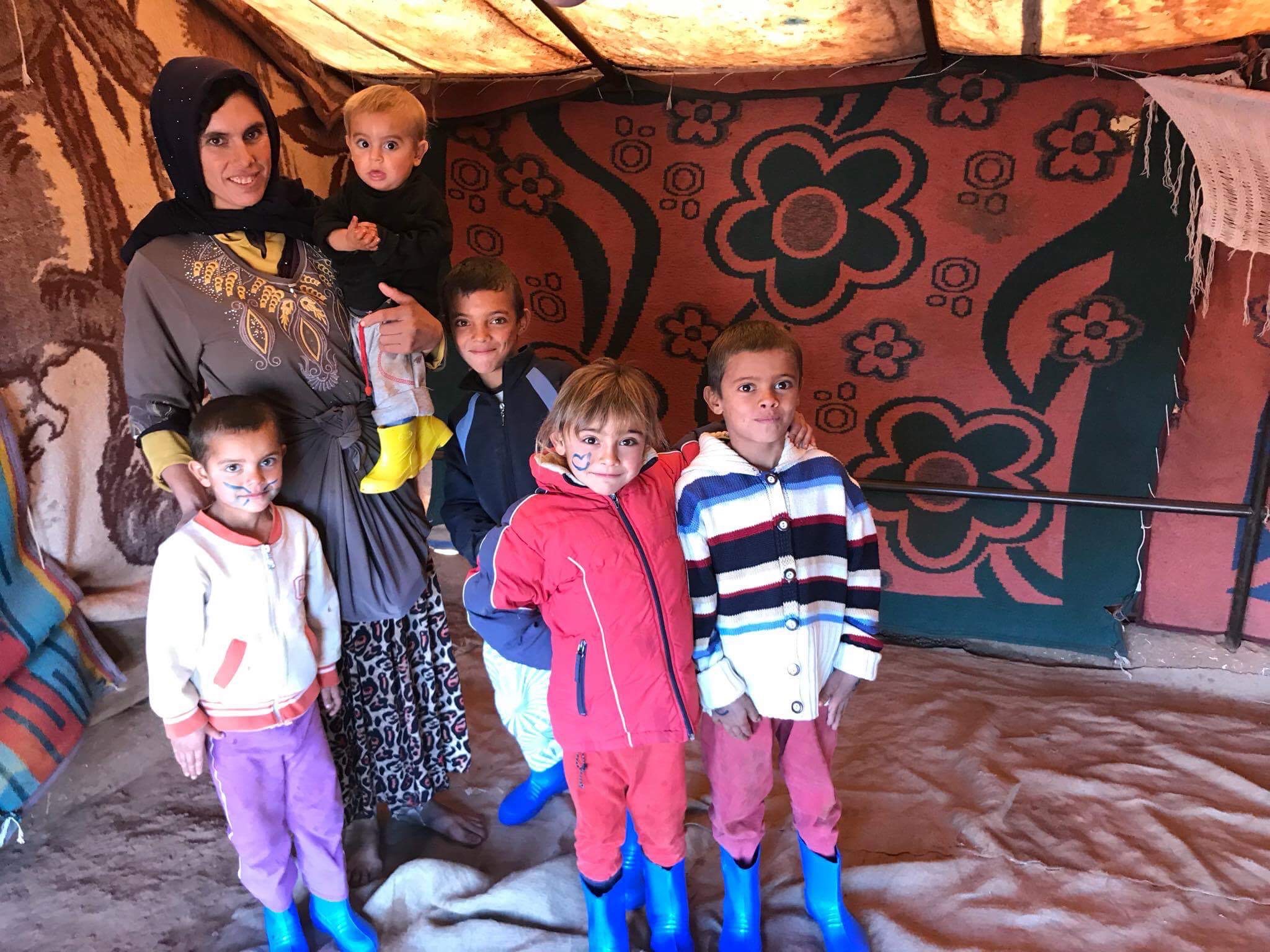
This year a brother from Istanbul came and joined with us on one of our distributions. When he saw the state of the footwear of the children, those who were wearing any footwear at all, he saw that they were wearing sandals, flip-flops or undersized shoes with their feet hanging off the back side.
Photo from a bit earlier in the year, but please note their footwear…
All the footwear was in tatters. Some were wearing socks, many were not. Not a few of the children were barefoot.
But, winter has arrived. It has not drawn nigh, it is not at the door, it has truly come… things will continue as they are, getting worse in the depths of winter before the hope of spring dawns several months away.
I am wearing proper shoes, with proper socks, and I still feel the cold. Too many of these children are barefoot and the rest are in sandals, flip-flops or slip-ons.
Most are living in desolate fields, and when it rains, the inescapable mud is literally everywhere, and after the rains have passed, there remains puddles and the low spots where the water has accumulated it is extremely reticent to seep away.
Our visiting brother was touched by the love and compassion of God and on his return to his home, made inquiries and spoke with various ones and the Lord touched someone to provide the funds that would enable us to purchase winter footwear for the children. This was not a trivial act, can you imagine the cost of boots and socks for 299 children (under ten years of age)?
We went out and sourced acceptable quality footwear, in a variety of sizes to outfit the children, always striving to get the right balance of cost to value.
And so, recently, the Team did the first distribution of winter boots and socks – because of the slow nature of the task and the number of children and the diverse encampments, we calculated it would take at least three trips to the refugees to be able to get to everyone.
This slideshow requires JavaScript.
The team went out to two of the largest encampments and fitted the boots; it was very slow going as you must fit the boots to each and every child to ensure a proper fit. And they are children… not always the easiest to organise and fit socks and boots onto…
In the course of fitting the boots, it became apparent that of the children who did have socks, that the socks were found to be sopping wet and ice cold. The children’s feet felt chilled to the bone.
The project was to provide two pairs of socks and a pair of new, water-proof boots for each child.
Now, as a general principle, when we go out to interact with the children, to play with them and such, we, normally do not inform the Social Assistance Department. It is our understanding that when we are engaged in some form of distribution, that we are constrained to contact them.
As we were ‘distributing’ boots, we informed them and they wanted to send a ‘minder’ along with us to monitor and, well, vet what we are doing.
The next ‘boot’ distribution was on a Thursday and the next encampment on the list to be visited was place we have named: Ağaçlık, that is ‘the Grove’. This has proven to be the most difficult, most challenging encampment we go to. For a detailed picture of this particular encampment, I recommend a blog describing this encampment – it can be read here.
Because of the difficult nature of this encampment, I, who normally do not go on these Thursday trips, offered to come along and assist. I felt, especially with this challenging encampment, that the more helpers the better.
E. loaded the van with a good selection of various sizes of boots and socks and then travelled an hour up the valley to our rendezvous location. There we picked up our minder – who turned out to be someone new.
This new minder seemed like a pleasant enough character. He is clean-cut, well shaved, well dressed, in his late twenties or early thirties. He is polite and easy to get along with.
We drove out to ‘the Grove’ encampment and I backed right into the encampment which recently I have been refraining from doing.
True Confession Time: I backed in, so vehicle would be near and our departure would be least encumbered, straight forward and, well, quick.
This encampment has nearly doubled in size as two gang-masters, who are brothers, have brought their separate Syrian refugee field workers together to winter on this bleak, rock strewn, isolated rise in the fields.
Our plan of action here was different than any of the other encampments where we have distributed boots and, to be frank, the people are easier to work with. Rather than have the people come to the van, and to fit and distribute there, here we felt the only way to control the process was to go from shelter to shelter and size and fit the boots at each shelter. This was inherently inefficient as we would go to a shelter, determine the boot sizes, and then someone would go to the van, collect the boots and socks, return, and when some boots did not fit, return to get the new size.
But, on the positive side, we would be dealing with one shelter – okay, sometimes two shelters – at a time, we would validate who belonged in the shelter and then fit the boots there and then.
Additionally, we also brought face paints with us to decorate each child after they have received their boots, fun for the children – and to identify to us those who had already received their boots; I did say this was a difficult encampment.
And yes, sadly, we did have some small children coming for boots (pushed along by their mums, who strove to remain out of sight, – the children themselves are innocent) and who, on examination, had the mark on their hands!
We divided ourselves into three separate entities. Two groups would go to the shelters, ensure we had just the inhabitants of the shelter and then we would collect the appropriate boots and socks from the van and fit them on the children. The third entity was charged with staying by the van, expediting our collection of boots and socks of various sizes and, regrettably, he was also charged with guarding the contents of the van.
Of the two groups going from shelter to shelter, one was led by our interpreter and the other, by E. In E’s group was our minder, who is also a bi-lingual, Turkish/Arabic speaker. He became our defacto interpreter for this group.
Throughout the time we were in the encampment, we would have men, women, teenagers coming and asking us for footwear also, as, alas, they too have very real needs. However, all we had was for the children. Some of the ladies were petite enough that, physically, they could have worn our largest child sized boots. However, the funds were given to provide for the children, and if you give to one adult, the rest will demand that we provide for them…
Whilst we are in the encampment, the sky was cloudless and the sun was brightly, warmly shining. The air was absolutely crystal clear – I mean really, really, unusually, spectacularly clear. And, for the first time at this distance, for me at least, I could see the dramatically tall mountain, Kel Dağı, down at the coasts, some 70+ kilometres away. Truly amazing!
It was a glorious day – a day when you are naturally inclined to smile.
But when my eyes shifted from the view, the sky, down to the encampment surrounding me, bathed as it was in the soft, pleasant sunlight of winter, there were puddles and inescapable mud was everywhere. The low spots were boggy. Some make-shift kitchens had active puddles inside.
This slideshow requires JavaScript.
The ground was firm enough to walk on, but, I had to be careful as it was very slippery – a thin film of red mud lay on the surface everywhere. Simply walking across the encampment was fraught with danger as, without a moments notice, my feet could slip and slide beneath me.
My shoes and the bottom of my trousers were well muddied just from our short time in the encampment. You can imagine the state of those, especially the children who abide there, 24/7.
On completion of that encampment it was evident that God delights in answering prayer as we and many had interceded for our time in this particular encampment and it actually had gone quite well,. For comparison with our earlier encounter with this encampment, please refer this blog, click here.
This time, there was no shouting, no oppressive demanding, no tumult, no intimidation, no swarming mass, no mob of besieging children; truly it wasn’t too bad at all.
The smile on my face when we arrived, in the sun, enjoying the clear air and the amazing vistas before me, was still on my face as we climbed in the van and departed.
And, on our departure, as we still had a good number of boots left, not all sizes, but, an adequate number, we headed to a smaller encampment to carry on.
At this encampment we can be a bit more relaxed. The gang-master and his wife came out and they are trust-worthy and are always a delight to see. As they often do, they offered those of us who desired it, strong Turkish coffee served in a wee demitasse. A powerful pick-me-up and sometimes, when it is really strong, a kick-me-up.
We enjoy this particular encampment. We call it the ‘White House’ as the gang-master lives in this small village in a ‘white house’. He has arranged accommodation for his Syrian refugee field labourers here in the village. Mind you, they are living in old buildings, abandoned buildings, lean-tos and such – but better than a squalid tent in a barren field.
Also, the gang-master has a clean, easily accessible, Turkish style toilet, a wash basin with soap and, as I mentioned, they often give us Turkish tea or Turkish coffee. In all the other encampments there are no clean facilities where one can relieve oneself.
Here we were distributing the boots when someone thanked E for what we were doing, and E, rightly, corrected them, and explained that these boots are not coming from us, but from ‘Christians’ and ‘churches’ around the world….
…. and immediately our minder forcefully interjected “you can not say ‘churches’”…
E promptly, forcefully, but nicely, informed him that we do and we will…
He said, “in that case stop what you are doing – you must stop the distribution – you cannot continue!”
Strange, strange, strange… methinks… we are providing needed essentials, we are not requiring people to listen to us, nor are we declaring their very real need for a Saviour, nor do we have a banner declaring we are Christians and representing Churches and the Lord Jesus Christ, nor is there a large cross painted on the vehicle or hanging from our necks, nor emblazoned on the back of our jackets, nor do we make a point to loudly, in your face, declare the truth that they all need to hear… nor do we engage in any polemics… we do not rail against the corruption, immorality, nor the actions and activities that have caused the grief of the refugees nor the source of all this darkness. We say nothing detrimental or negative.
We are called to ‘be light’, to ‘be salt’. Indeed, we are living testimonies. We are God’s Light in this a most dark area. Indeed, our God-given love and God-driven service to those who are not of our faith, is a powerful declaration to all – and, yes, by and large, they all know we are Christians.
But, if in conversation, we mention “church” or “Christian”, well, for the minder, a red line has been well and truly crossed, we have gone beyond the pale, we must be stopped!
It is not so much the minder himself, he is a man under authority. He has been expressly and clearly instructed, by his superior, to not allow us to speak in or of the Name of our Lord Jesus Christ, nor to say that we are Christians and that Churches are involved. Never mind that churches are not required to assist and yet have free-will helped these strangers of a different faith.
At our minder’s imperative that we ‘cease and desist’, we began to attempt a dialogue with him. He immediately began by declaring that the Church is the active enemy, and that all the problems in the Middle East come from the United States – and herein is the rub, for many in this part of the world, the United States and the Church are seen as one.
Now, my mind, which attempts to be logical, has trouble squaring the circle whereby Muslims killing Muslims in this part of the world is the work of the U.S. …
But he was convinced.
He retorted:
“Who,” he asked, “is paying the money?”
“Who is ‘pulling the strings’?”
“Who is master-minding, organising and orchestrating it all?”
It has been my repeated experience that for far too many people living in this part of the world, the clear answer to all these questions is the United States.
As it really is not possible to dialogue with an ideologue… there really is no common reference point, there is no established base line for a frank discussion… the only recourse was to ring the minder’s boss.
This E promptly did…
The boss was adamantly of the opinion that we can not and must not, say we are ‘Christians’ or that the aid is coming from ‘churches’. For him, and as he is the head of his department, for his department, this is flatly unacceptable.
He went so far as to directly and openly say to E, “If you do not want these people to go without boots and if you do not want them to go hungry, then do not say you are from a church”.
Bizarrely, he seems to be extremely content for these impoverished people, these suffering refugees, these hapless individuals sheltering in barren fields, these people of the same faith as himself – his co-religionists – to go without boots and to go hungry rather than to have them receive aid and, from time to time, directly, hear us say the most frightening of words: “Christian” and “church”.
Unbelievable.
Remarkable.
What, in the world, is he so, instinctively, afraid of?
What does he expect to happen through the utterance of these two words?
E informed him that we have, are, and we will continue to declare from whence this assistance is coming. She pointedly said to do otherwise would be dishonest, to lie, the aid is not coming from us, by our hands at the end of the process maybe, but, she pointed out, we are Christians, motivated by the Love of God and the source the provision comes from Christians and Churches in other countries.
She declared we are called to be honest. We are called to ‘speak the Truth in love’.
Additionally, again addressing our part, we are called to love our neighbour, and currently our neighbours are these Syrian refugee field labourers – of an alien faith. So we take the provisions, that God has provided via Christians and Churches, and go out to where these people are living to ‘love our neighbour’.
And that is how it was left: he said his bit and we said ours.
He said categorically, “Do not say,” and we replied categorically, “We shall say.”
Where this tale shall end, we do not know… but we shall continue to be, to do and to say as we have… until we no longer are able…
Strangely, he had requested, and we provided some of the boots we had, for his department to distribute to the needy Syrians in the local town. And, in the past, he has requested and received some food-stuffs to distribute in the town to Syrian refugees.
It is noteworthy, and rather remarkable to me, that he seems to be happy to receive aid from Christians and from Churches, but not for the Syrians to hear from whence this aid arises. He knows. We declare it to him… repeatedly…
Again, I am gob-smacked…
…Why is he so, profoundly, viscerally sensitive to two mere words?
It must also be kept in mind that this is nor just ‘his’, but his attitude is indicative of the greater ‘fear’ and the greater negative and hostile attitude towards Christians in this land of the Bible by the vast majority of citizens living in this country.
Owning a private motor vehicle is one of life’s great blessings, affording ease of travel, carting of groceries and timely transport always at our beck and call.But, naturally, all these benefits have an associated overhead.Private vehicles are not cheap to purchase, maintain, tax and licence.And, as in many other countries, there is the additional task of the vehicle inspection – for private vehicles, this is required bi-annually in Turkey.
Therefore, there is an on-going balancing act, weighing up the benefits and blessings of owning a vehicle against the costs and requirements that must be met in owning said vehicle.
As motorcar owners, we are called upon to endure the ever rising costs of petrol.We pay the annual insurance premium, which also seems to be ever more expensive.When tyres wear out, we replace them.When it is time for the annual service, we bite the bullet and pay the piper.This is all part and parcel of the ‘cost of ownership’, for which we subject ourselves for the blessings and benefits so afforded.
But, in this balancing act, for me, there was a straw that broke the camel’s back – a small, rather insignificant thing that tipped the balance and motivated me to divest myself of our motor vehicle – a trivial thing in itself, but it was that which provoked me to give up all the blessings and benefits.What was this petty little ‘straw’?It was the mandatory bi-annual vehicle inspection.
Please do not misunderstand, the vehicle inspection is not an onerous or difficult task – there are a number of steps; steps which are not hidden or obscure, all the steps are known in advance – all one needs to do is perform each step and the vehicle inspection is, fundamentally, a non-event.That is the truth and the reality for the vast majority of people.But, for me, it simply became a bridge too far.
A few years ago it was a far different experience.At that time you went to one office ‘somewhere‘ to get a piece of paper to say you had paid your vehicle tax and had no outstanding traffic fines.Then you traipsed to another office to have the LPG (Liquid Petroleum Gas) system checked – and collecting another important piece of paper.After this, to another place to have the exhaust system checked – and gaining another essential piece of paper.Finally, when you have all your bits of paper collected, you went to the vehicle inspection place – a rude hut on the side of a road – where all they basically did was collect the various pieces of paper, the inspection fee and threaten to physically inspect your vehicle.Often all I was asked to do was to pop the bonnet – which was then closed – that was the inspection.
Oh, I should mention that each piece of paper had it’s own individual charge against it and the vehicle inspection had it’s own, more weighty charge.
But that was a few years ago.
Now the system has been vastly improved, streamlined and modernised.
The new system is based on the German vehicle inspection regimen.
Therefore, all over the country, the State has built proper, dedicated vehicle inspection centres.At the same time, they are working towards a form of ‘joined up government’.In this way, at the time of your inspection they check, in real-time, to see if you have any outstanding fines – as of that actual moment – and if you do, you must leave the queue, and go somewhere else and pay your fine and then return (to the back of the queue).In the same way your payment of the annual vehicle tax is confirmed.You no longer need to go to another office and gain the requisite piece of paper to prove this – that is a marked improvement.
You still need to present the LPG certificate and the Exhaust Test certificate.
Nevertheless the new system is much better than the old way.It is more joined up.
Oh, and they have a rendezvous-appointment system; you make your reservation on-line and therefore you have an identified ‘time slot’ for your inspection.
This sounds like a vast improvement and should be the cause of great, heart-felt adulation and rejoicing.
But theory and practice often are but passing ships in the night.Even with all the real and notable improvements, I still do not like the vehicle inspection regime.
And, I do not like the cost of the vehicle inspection.Typically, after two years since the previous inspection, I’ve forgotten the cost.In preparation for another vehicle inspection, it always comes as a disconcerting shock to me.
The little certificates, still required, for the exhaust check and the LPG check (if you have a LPG equipped automobile) are all modest fees – it is the inspection itself that is more weighty, you know when you pay that one.
And so it was, for me, a result, a consequence, of this one last ‘straw’, added to all the other financial burdens of owning an automobile, that we now no longer own a motor vehicle in Turkey.
Having divested myself of a vehicle, I am free – I don’t have to give even a momentary thought regarding the delights of motor vehicles and their bi-annual inspections.It is a glorious, delightful feeling of freedom.The cloud is gone, the burden has been lifted.The financial requisites have been expunged.
Wonderful…
However…
The elder does own a vehicle and in addition to his responsibilities in the fellowship, he is engaged in full-time employment.He does not have the time nor opportunity to run around and collect the certificates and then spend the time required for the actual inspection itself.
And so, as the date for his vehicle inspection drew nigh, he thrust the vehicle papers and keys into my hands and said, “Get it done.”
Well, truth be told, we are here to serve and sometimes the most appreciated service is in the mundane, banal, common, most non-spiritual aspects and things of life.
Being here to serve and to do ‘that which needs to be done’, I know that I ought not/should not say ‘no’.And so, on the outside, I smile (or was it more of a grimace) and I indicate acceptance of the task and take the keys and papers.
But, inside I am wailing, “NOOoooooo!”
Whilst it is true that I rid myself of our vehicle, because of the over-all costs of ownership, but, notably, the requirement of the bi-annual inspection played a disproportionately large rôle in my decision.That really was the last ‘straw’.
But here, once again, one more time, I go again.
Oh joy.
My first task was to get an appointment.For this I went on-line and worked my way through the various pages and made an appointment for about a weeks time.We had missed the due date for the inspection so there would be a peppercorn late fine – but it was the earliest appointment I could get.That is the problem of an appointment system, there may not be an appointment on or near your date.
The appointments fill up fast and well into the future.
Now before going for the physical inspection, I needed to get the LPG certificate and hence, went to the appropriate office for that aspect of the inspection.
The engineer asked to see the tank which is under the floor of the storage compartment.I wasn’t prepared for that, so I had to manhandle some things out of the way to be able to gain access to the tank and then lift them out of the way so he could examine the physical tank.Normally they just use a hand held sniffer device where they poke its nose in various spots seeking the telltale odours of a leak – but he want to visually ‘see’ the tank this time.
That brought about the first bit of bad news.One look at the tank and he said he couldn’t do the inspection and promptly collected his tools and departed.
What he saw on inspecting the tank was that the tank was now ten years old.The rated life of a LPG tank is ten years.The upshot, we needed a new LPG tank.
We failed the inspection at the very first hurdle.So much for this rather easy and straight-forward step.
I cannot go for the full vehicle inspection without this certificate.Therefore, with a list of authorised LPG garages that the inspection department approves of, I head off to have a new tank fitted.
I find the garage and begin making the arrangements.I learn the price and am all set to go when he asks if there is any fuel in the tank.Normally the tank is kept full-ish.Indeed, for the inspection I had even thought about topping it off – but, thankfully, I had resisted the temptation.That was very good.
This brought about the second bit of bad news.
“The tank need to be empty,” says he, “… safety.”
True, after all they will be removing the old tank, and if it is full of LPG gas, it would be a dangerous, volatile, potentially lethal explosion risk.Besides, we paid for that LPG – we do not want it to go to waste.
“Oh,” says I.
A new task has been added before the fitting of a new tank to facilitate the required inspection, I now need to drive the vehicle until the LPG is exhausted.
I was under the impression that there wasn’t much in the tank – and I had my instructions… drive until it is absolutely empty, then return.Emptying the LPG tanks is another story which if you are interested you can read at: Emptying the Tank.
In any event, two days, and many, many kilometres later (I said I didn’t think there was much in the tank) I returned to the garage with a duly exhausted tank – the car now running on petrol – it is a dual fuel system.(Why a dual system vehicle?Petrol is prohibitively expensive and LPG is dramatically cheaper)
The new tank is fitted and I am instructed to go off to a petrol station and put about a quarter tank of LPG in and return to the garage for safety checks. This made me ponder, if there is a ‘leak’ and I’m driving back to the garage… could it not…
Successfully returning, the installers commence checking the system for leaks.
Oops, (!) unfortunately they find some leakage.So the work carries on to find, identify, sort and recheck the system.
Finally, they declare it is all clear and issue me with their official paper having installed the new tank – for the LPG inspection.
So I’m off to top up the LPG and then to the office for the LPG inspection and hopefully acquire the required certificate.
At the office, the engineer comes out with his sniffer device and checks around the tank and the regulator and under the bonnet; the lines and carburettor and various points and places.No beep, no flashing lights, no odours – all smells of roses.
We have the all-clear.We go upstairs, where I pay the fee and get our new certificate.
So, we are nearly there.This, just a small aspect of the preparation for the inspection tasks, should only have taken an hour or two at the very most, but has now taken up the best part of three days.
Thankfully, the testing of the exhaust system was without incident and the certificate was duly paid for and issued.
The day of the dreaded appointment approaches.
Now commercial vehicles must all be inspected annually, and private vehicles bi-annually.Tractors, motorcycles – virtually all motorised transport must also be inspected.I mentally count, how many bays there are in the inspection station – that would be seven.Therefore, I begin extrapolating how many vehicles can they see in an hour.With appointments set at every thirty minutes, therefore, the maximum number of vehicles at the inspection station would be seven times two equalling fourteen per hour. That sounded okay to me – not overwhelming, shouldn’t be crowded, should be orderly, should enter for inspection at my appointed time.
I felt I could cope with that.No worries.
I hate arriving late, and often, habitually even, I arrive early to where I am going.On this day I arrived at the inspection station early even for my normal early arrival time.
The sight that greeted me was not fourteen vehicles waiting.
Alas, vehicles were parked in all the available spaces.Indeed, they were parked, double parked, triple parked; basically there were vehicles parked and standing everywhere.They were parked up where it was intended that vehicles be parked and also where it was clearly inappropriate for them to be parked.The large apron before the doors to the inspection station were crowded – nay, overcrowded, jam packed, overwhelmed, full…
I immediately noted that near the door to the office there is a thick crowd milling about, immediately by the door of the office there was another mass of men, and I feared, that once passed the door and in the waiting room of the office there will be a crowded crowd inside.
The large expanse inside the fenced grounds of the inspection station is full of a whole variety of vehicles that there is no room for even one more vehicle – that is to say, the vehicle that I am driving – I am refused entry – my appointment notwithstanding.So I must go outside the grounds and find a place nearby to park up and then walk in.
Like absolutely everyone else, this is contrary to my desire to be close to the action, to be timely, to be ready to go through and be done with this inspection.I, too, want to be parked up inside the compound.But, sadly, it is not to be.
I really want to be ready, so when it is time and I am required to enter the inspection bay I can respond in a timely manner – being parked outside the grounds strongly mitigated against all that.
As I park up a chap approaches me offering to ‘help me’ with the bureaucracy of the inspection.
But, I reason, I have an appointment, I am confident that everything is in order, I have the car insurance papers, the exhaust certificate, the LPG certificate and I know there are no outstanding fines and the car tax has been paid, therefore, I feel that I do not need his help and politely decline his offer.
I make my way through the gate, across the apron, through the first lump of men, past the second amalgamation of men and, finally, into the office.As I feared – it is teeming with men.It seems that the task of vehicle inspections is a primarily male occupation – and in this confined space it is clear that not everyone has access to… er… well, let me just say the air was ‘ripe’.
Whilst there is a rendezvous system – it seems that they also take people without appointments and fit them in, as and when they can…so much for a manageable fourteen vehicles.
I take my number from the dispenser by the door.
Obviously, I must be exuding my internal discomfort for, once again, a chap approaches me offering to ‘help’ and takes a quick look at all my documents.It turns out that one of the little certificates that they stamp at the vehicle inspection station is full – I need another piece of paper.
This is may only be significant in a bureaucratic nirvana such as this, but the lack of this bit of paper is a cause of failure and returning to the start of the process…
Yikes!
But, not to fret, he assures me, he is just the man to sort this problem out.
Out we go, through the throng of idle men to the fence where he calls over to a vehicle parked on the side road outside the Inspection station.A girl comes over and takes the paper work and returns to the vehicle to fill out the appropriate forms.
And so ten minutes later – good thing I decided to go earlier than early – and twenty five Turkish liras lighter I have all my paper work in order.
I really am not enjoying this.
I know that the next step is to wait in the office until my number comes up on the display. Then, at that point, I will hand in all my collected paper work, have a check performed on the computer to ensure no new traffic offences have been lodged and that the tax has been paid, pay the hefty fee for the inspection and then to outside to await the summons to bring the car in and surrender it to the chap who will take it inside for a rather through – German style – inspection.
I have my number for the first step, inside the office, where I must first clear this bureaucratic phase. I am more than aware that the next step would be to go outside until summoned for the actual inspection.
How do you know you are being summoned? Uh, that is when you hear the name on the paperwork called over the tannoy.And the tannoy system there is in keeping with the majority of tannoy systems the world over, all you really deduce from their blasted, garbled, utterances is that something has been emphatically declared.In the past, when I’ve had cause to be in this position, I found it so muddled, distorted and indistinct that I was not even sure what language was being utilised.
Contemplating all this, I buckled.I asked the chap, my ‘helper’ what he would charge to hold my hand through the up-coming steps (I’m assuming either his hearing is up to the tannoy, or he has the gift of interpretation).We then agreed a price and now, I am left at his mercy, feeling all the more like a ‘lamb before the slaughter’…
And so, my ‘helper’ and I return to the office, he takes charge of my ticket and as the room is packed, he asks someone he knows to vacate his seat so I can sit down. So there is an immediate, tangible benefit for engaging him.
Now the office is air conditioned and I have a place to sit – so that is good.
But, even so, there is a lot of loud talking, and people hanging about, and the counters are full, and the air is, er, rather ‘natural’ – so, it still not the most desirable place to be.
My number comes up, my helper calls me to the counter, but in my mind I have a nagging concern.This is not my car, it is the elder’s.It is not in my name.They ask for my ID and I hand them my foreign passport which, of course, is in English.
There was no problem with my ID. Whew!
I surrender the car papers, insurance documents and my collection of certificates.The computer check is done and all is in order.The fee and late fee is paid and out we go to await the next phase – listening for the crucial tannoy announcement (for those who can decipher it, or have the gift of interpretation).
Now we wait, outside, with no air conditioning.We have been expelled from the office to commence the task of ‘waiting’ – but I have no inkling as to how long I will be waiting.So much for having a set appointment time.
This, hopefully, is the last step – as long as the motor vehicle does not fail the inspection.
Our final task is simply waiting to be summoned to deliver the vehicle for the actual vehicle inspection to commence – the vehicle which is not there, but has been consigned to the outer reaches – languishing outside the fence and down a side road.
All that we have done thus far is the preliminary, essential preparation work – it all counts for naught as the key element is the physical, rigorous inspection of the motor vehicle.
Outside of the office, there is little shade, but this is Antakya in the summer.It is scorching – wherever you are – shade not withstanding, you are subjected to degrees of stifling – but all hot.There are but a very few places to sit – and they are all occupied.
For me, herein is the truly traumatic part.How do I know when it is ‘me’ they want to go in?I ponder, will they try and call the foreign name of the chap who brought it in (me)?Or will they be calling the name of the owner?Will it be blasted unintelligibly over the tannoy, or will it be a workman who comes out the door with a clip board in hand and shouts?My mind is awash with various, unknown possibilities…
And this is precisely why I hired my helper.He not only knows the system, but he also knows the people in the system.He talks with them, and at the appropriate time he has discerned and understood it is my turn and tells me to bring in the car.
Off I madly trot as well as someone of my age and fitness can, across the baking hot tarmac of the parking lot, out the gate, down the side road where the car is parked.I hop in, turn it on, go the wrong way up a ramp (well, there really is no other way to do this), up to the gate, convince the chap at the gate to let me in – harder than you would expect – and proceed up to the door where they are waiting to take delivery of the vehicle.
The door is as far as I can go – my ‘helper’ as well.
The ‘inspector’ takes charge of the vehicle and drives it in.They check the brakes and lights and search for rust and examine underneath the car.They check the brake lines and look for various types of faults.I do not know all of the things they check, but it appears to be detailed and vigorous.
We walk around the building – it is a big building – and wait on the opposite side, the exit side, for the car to emerge.
At the end of the process, we had a number of small faults – it seems they must find some faults – but nothing big enough for a failure – ergo, we passed !
I receive back all the paper work, with the appropriate places filled in and stamps affixed.We get a sticker for the number plate to declare when we must return and repeat this marvellous, wondrous experience.
At the end of the day, I had divested myself of our car, partly to avoid this experience.
I guess my Lord has other ideas and there are things that I can best learn by going through this delightful bi-annual vehicle inspection process.
My wife and haven’t done anything special for a while, so I floated the idea of walking down to the new Antakya Archaeological Museum to have a gander. We’ve been there before, but as we purchased ‘Museum Passes’ last autumn, we can go for ‘free’. Of course it is not actually ‘free’, but more accurately ‘pre-paid’, but it feels free. Sometimes it is nice to go to a museum, and streak past many exhibits to spend time exploring, experiencing and enjoying just one particular aspect. The Museum Pass enables this. Summer has not yet come, and consequently, strolling in the afternoon is acceptable, so we decided to head out in the afternoon.
After lunch, we struck out, planning a fairly direct course as the museum is a fair walk away (3.3 kilometres there – oh, and then there is back).
This took us, naturally, to the dominate road in the old quarter of Antakya. This road is ‘Salvation Avenue’. Salvation can have a special meaning for Christians, but locally, it is probably a reference to the war of independence or some other victorious battle.
This ‘Salvation Avenue’ runs, straight as a die, through the heart of the old quarter. By examining street plans of the ancient city – and due to the mountain being a a fixed point, and the river (until recently crossed by the ancient Roman bridge) as another fixed point, you can discern where the ancient layout and the modern ‘old quarter’ coincide.
In ancient times there was a major street dissecting the metropolis. This was a unique, colonnaded street which hosted the first street in the Roman Empire to boast ‘street lighting’… a significant thoroughfare and as Romans tended to make, a very straight street.
It would appear that ‘Salvation Avenue’ follows directly on top of the course of this ancient thoroughfare. If archaeologists were to conduct a dig, it is extremely likely they will come upon the ruins of that ancient way just two or three metres below the road surface.
We headed off, our goal in mind.
As we walked along on the pavement, I noticed ahead, two men dressed in civil attire, but one had a distinctive radio hanging from his waist.
As we drew nigh, the one with the radio turns towards me, and pointing a single finger directly at me, directs me to stop. He looks like a policeman. His manner of stopping me was as one who has authority, very unlike salesmen and beggars.
Once stopped, he begins patting and examining his pockets until he finds his ID and produces it to officially declare that he is a policeman. His travelling companion did not do this – I suppose one is sufficient, would be the thinking.
He knew he had stopped foreigners, we are somewhat obvious, he therefore spoke in English, and asked for my passport.
Under the current conditions, I ‘never leave home without it’. I reached into my pocket and produced my passport. He looked at it and we then had a discussion on what made up the ‘United Kingdom’.
My wife, following our rules, ‘only do or answer what you are asked, volunteer nothing’, is standing there, passport safely stored in her bag.
He asked for her passport as well.
They took photos of both passports – the modern ‘smart phone’ at work in all its glory. Then they sent a text message or email with the salient information from the passport somewhere.
He asked what I do. I explained I ‘help a local church’. My belief is the truth will be spoken convincingly and comfortably – and is verifiable and hence is the best course to follow. Besides, Holy Writ instructs me that my ‘yes’ needs to be ‘yes’ and my ‘no’ must mean ‘no’ – in other words be honest in my communications.
Which church?, and such questions naturally followed.
This done, they hold us there on the side of the footpath – it is not a wide footpath.
A man came up to assist, he identified himself as the local ‘muhtar’ (the elected head of a neighbour in a town). The two identify themselves as police (without showing ID) and the man beats a prompt retreat.
We are informed that we are awaiting a message – our details having been sent somewhere, are being scrutinised and a response will be forthcoming.
As we wait, the other policeman engages me in a discussion of religion – specifically, ‘Protestantism’ and ‘Evangelicals’. As we are chatting, the other policeman’s phone rings and I hear him talking with the person on the other end. He refers to me as a person with responsibilities at a church.
When the call was concluded, he, making no additional comment, gave us back our passports and sent us on our way.
So it was a ‘random stop and check’… he seemed to be at pains to point out that we were not the only ones so stopped. That, in itself is somewhat odd for me – why would you do that, unless…. it was not random, but targeted…. it is a path I use frequently….
Enough pointless and profitless paranoia…
There is a very important referendum on Easter Sunday – we will be celebrating the Resurrection of our Lord and Saviour, and the Turks will be going about their democratic duty voting in the referendum. This has probably resulted in some additional security checks.
The weather report for Monday, 27 March called for overcast, cloudy skies.However, this being Antakya, the weather was lightly, slightly overcast, bordering on sunny.
As we had a good-sized, eager team from America, the loading of the lorry was done in an quick and efficient manner.
With a full complement of individuals to assist, drive and translate, all bases covered, we headed out to the fields up the valley from Antakya, just past and under the jurisdiction of the town of Kırıkhan.
When we arrived at Kırıkhan we picked up two individuals assigned to us by the local Social Welfare Department.For a number of weeks now, we have picked these two young men up.They are well presented, clean shaven, in their early twenties, but neither has even a basic GCSE equivalent qualification.One is slim and taller and the other is shorter, and, well, rounder.
In the beginning we did not know why they were to accompany us.When E, the elder’s wife and the head of the Syrian Refugee work in our fellowship, queried the reason why they were to accompany us, she was told they were there “to help and assist in the distribution”.
This was somewhat incongruous with their activities as they never lent a helping hand, rather, they stood around and watched, took photos, played with their phones and chatted to each other.In stark contrast, our lorry driver, who is only contracted to drive his lorry, happily and willingly helps in the distribution, handing down the bags and really helpful in a variety of ways.
On one occasion, the tall ‘helper’ wanted to see what was in the bags we were distributing and so we happily let him select the bag he wanted to open, and peruse the contents.
In the course of the distribution, it is our practice to stop for a meal break, and our ‘helpers’ have broken bread with us.
On this day we collected our ‘helpers’ and headed out to the first encampment of the day, situated on a barren corner of a field at the conjunction of two field roads.
This encampment was on my list, but the team hadn’t been there this season, so there was an underlying disconnect – if they haven’t been there, how is it on my list?
Therefore, when we arrived, it was a bit confused to say the least.
As we worked our way through who was there, and how many souls made up the various families and providing the appropriate amount of foodstuffs, they, as people are wont to do when receiving something, began to express their gratitude to us.This was also the encampment where the child was, the one who had the devastating skin disease and had lost all his fingers and toes, and who was suffering terribly.Because Sovereign Lord, in His Love and Grace used us to help the lad and his family – he is now receiving treatment in Antalya – other relatives, still residing in this encampment, once again expressed their heartfelt gratitude to us.
Now, from the beginning, when people expressed gratitude to us, our response has always been to declare that the assistance, the provision, that which is coming from our hands, is first and foremost the provision of our Loving God; often we will say “give thanks to Jesus”; additionally we declare that the provision has been enabled by the giving of Christians and various churches from around the world.Not overbearing, but a clear, simple declaration of truth.
And so, at this, our first encampment of the day, as people were expressing gratitude, we, as we do, once again clearly made known the source of the food stuffs they had received.
This was repeated a few times at this encampment as it came up a few times.
Now, one of our ‘helpers’ over heard all this, it seems for the first time.
This stumbled him greatly.He accepts that it is acceptable for us to help people – but in his view, it is wholly unacceptable for us to “advertise” (his word not mine) that we are Christians and to say that these provisions come from Churches.
I find this rather bizarre because on the following day, as I was on my morning constitutional, I walked past the Council buildings here in Antakya and there on the pavement were seven or eight boxes that I concluded were food aid as there was a list of the contents (food items) on the side plus, in rather large print, the name of the Council.They are, by the same token, likewise making ‘advertisement’ by identifying from whence the aid comes.
I dare say it would be apparent that the problem was not so much the ‘advertisement’, but the mentioning of ‘Christians’ and ‘Churches’ that was the cause of his ‘offence’.
And so, we are now exposed to the true nature of our so-called ‘helpers’, more ‘auditors’ than ‘helpers’.
Now, in Turkish culture, if there is a problem, generally speaking, you will not directly confront someone yourself, but, using a third party, you will let your thoughts be known.In this instance, this method was employed and one of our number was charged with telling E to cease and desist in proclaiming that we are Christians and that this aid comes from Christians and Churches – in the ‘offended one’s view’ – to stop making ‘advertisement’.
This she flatly refused to accept, arguing that the ‘helpers’ did not have the authority to make such a restriction, that there is freedom of religion in Turkey, that we have been doing this from the beginning of this work and that we would continue to do so.
This, it is fair to say, did not go down well with the ‘offended one’ and his companion.Therefore, the ‘two’ retreated and proceeded to ring their manger and to inform him that we were ‘making advertisement’ and we ‘would not desist from doing so’.The manager – the regional director of Social Welfare Department, so informed, declared that he was sending the rural police, the Gendarme, to come out and “stop us”.
Whilst they were making their phone call, E also took advantage at this time to ring one of the people she had talked to in the regional office, the Document Comptroller – a key individual who is the gate keeper of the work that flows to the regional Governor – a central and influential position.He is also a very religious Muslim, and in their previous meeting, E had shared her faith very openly with him.That occurred in the district governors office during a previous occasion when she spoke about what we are engaged in, with the regional governor, and various managers, including the director of Social Welfare.She delineated to the Document Comptroller the current situation as raised by our ‘helpers’ and requested his assistance.
This was all transpiring at the planned second encampment of the day.
We began our distribution.
The ‘two’, muttering to each other, stood off to one side, watching, not hostile, but not happy either.The one who seemed to be most offended seemed to be ‘righteously indignant’ that we were using aid distribution to ‘advertise’ who we are and from whence the aid comes.
I approached them to engage in conversation with them and they informed me that in the Koran it declares that “when doing good, your right hand should not know what your left hand is doing”.I found this an interesting quote.I found it a remarkably interesting quote.
Indeed, after our return and on further investigation, it seems that there is no such reference in the Koran (it may be in the Hadith – ‘the Sayings’, I do not know, but it is not in the Koran proper) but it is clearly in the teachings of our Lord Jesus Christ as recorded in the New Testament.His quote to me was very interesting. I muse, “Was he inadvertently quoting from the New Testament in his opposition to Christians?”
Anyway, back at the encampment, the ‘helpers’ suggested we say something innocuous and ambiguous – the unstated result would be that the hearers would be ignorant that Christians have anything to do with it.Again, they unintentionally and subtly declared that the point of stumbling is not in making ‘advertisement’ but in the nature of the advertisement.
The stumbling blocks were the words ‘Christian’ and ‘Churches’.
It always amazes me how profoundly sensitive and deeply insecure they are, that a simple mention of the source of the aid is deeply offensive.This may arise from a deeply inbred insecurity about their own beliefs or as an example of the spiritual warfare that we are engaged in, or a mix of the two.
As we were distributing the aid, we were, at the same time, awaiting the arrival of the rural police, the Gendarme.
It is true to say that things had not been running to schedule on this day, and our mid-day meal break was going to be an hour or so late – this is in no-wise noteworthy, truly it is of no importance for the healthy amongst us, but it definitely was not good news for the diabetic amongst us who needs to ingest sustenance at regular intervals.
Alas, my blood sugar was in decline.
It was when we finished our distribution and the next item on our schedule was our delayed meal break, that I noted the bright blue Gendarme vehicle on the road coming into the village.I was not alone in noting it as our two ‘helpers’ were on active look-out for it.
On catching a glimpse of the Gendarme vehicle, one of the ‘two’, the one who was the ‘informer’ and the ‘offended one’ ran off to intercept the Gendarme least they carry on looking for us up the road.
It is the most I’ve seen him do in the time he has been with us.
He intercepted and collected the vehicle and it made its way down the ratty old side track to the location of our distribution.
Two officer class or at least, senior NCO class individuals alighted, followed by a scrawny looking conscript whose task it was to guard the vehicle and be ready for ‘trouble’, holding, as he was, a rather large rifle.
The Gendarme strode over, sour, stern expressions on their faces.
Turkey is dealing with many extremely serious problems; a Kurdish uprising and associated violence and terrorist acts, the presence of millions of Syrian refugees – some of whom are not the ‘cream of society’ and hence prone to doing wrong, others who are active adherents to IS and its bloody ideology, plus all the normal policing problems in a border area related to smuggling, AND YET… and yet… here they are, armed and ready to deal with the threat that some people engaged in a ‘good work’, occupied with helping the disadvantaged, vulnerable, destitute individuals, and in the course of doing this are mentioning, or speaking of being Christians and that the aid comes from Christians and Churches…
Truly, I am speechless.
Nevertheless, the Gendarme are there, looking serious, and taking it very seriously indeed, and the two of them together take an aggressive tone and approach declaring that we “can not do this”.
One individual, whether it was the ‘specialist’ with the Gendarme or the ‘informer’ – the ‘offended helper’, I do not recall, but they declared that ‘we can not do this’ and E immediately confronted him and declared to his face that she is not listening to him as he is clearly ignorant of the law.
She boldly declared that as a Turk she has the right to share her faith with whomsoever she chooses and they can do nothing about that – it is her right.She confidently stated that she could call all the Syrians over and present the Good News to them, in front of the Gendarme and that they could not arrest her as it is her legal right to share her faith.
She also stated that we have been helping Syrian refugee field workers for three years and declared that all thoughout that time we have clearly proclaimed who we are and from whence the aid is coming.
She also explained, that although she has this legal right to openly share her faith, that we have not taken advantage of these vulnerable people – we have assisted openly, freely without let or hinderance, only declaring the source when it is appropriate, that the nature and source of this assistance would be honestly known.
The Gendarme wanted to examine the contents of a distribution bag, and so one was selected at random, opened up and the contents scrutinised.Rice, beans, sugar, tea, oil, bulgar wheat, macaroni, soap, salt, lentils – all very dangerous items in the wrong hands…
Finally, the phone call that the gendarme were waiting for came through – we think from the district governor’s office.After the call, the senior gendarme turned, his visage now smiling and friendly, and he declared that there was no problem and we were free to carry on.
The ‘two’ – our assigned ‘helpers’- were intimately involved in all these discussions, they were, after all, both the ‘informant’ and the ‘offended party’.They heard the defence as presented by E, and as well, that the Gendarme did not counter it nor attempt to refute or deny it.They observed that the Gendarme did not arrest us, nor compel us to desist in speaking of being ‘Christians’ and the ‘Church’.
This interlude with the Gendarme now concluded, we loaded everyone into our vehicles, including the ‘two’, our ‘helpers’, who are to accompany us in our distribution, and, as we declared, made our way to our luncheon location.My chosen venue for lunch was a tree by the side of the road about a kilometre up the road, halfway between two encampments.The Gendarme followed us there.
We stopped to eat.
The Gendarme, after pausing and after we offered to share our food with them (declined), continued on their way to other, more serious, business.We tucked into the lunch provisions: black olives, bread, sliced tmates, cheese, luncheon meat and ayran (a yogurt drink).
On this occasion, the ‘two’ declined to join with us – but as we insisted that they have something, they did accept the ayran drink.
From there we went to the third encampment of the day and then on to the final one.The ‘two’, as is their customary practice, were idly standing around, watching.
At the last encampment, I spoke again with them, not about what had transpired, just, friendly chatting with them.Hopefully, demonstrating the love, compassion and Grace of God.There was a goat pen at this encampment and one, the ‘informer’ – the ‘offended one’ – explained how he has experience with animals from his childhood in a local village and he put his finger through the wire and the goat suckled it.He did this a number of times.Then he did it again and the goat bit him.Undeterred, he did it again with another goat, and this one drew blood.At this point he desisted.
This was what I had intended to be our penultimate encampment, but everything was distributed and with nothing left in any of the vehicles, we prepared to depart and return to Antakya.As we have done in weeks past, the ‘two’ then moved from our vehicle to the lorry. The lorry driver drops them off on his way through Kırıkhan and we take all of our people back in the van.It gives the ‘two’ a good opportunity to talk about us, and to have a quiet word and query our lorry driver.
Over the course of the day, it was revealed by various ones that, it seems, there has been a number of complaints about us, not just from the ‘two’ who accompanied us, but from others as well.As you would expect, the complaints are made by ‘anonymous’ sources.
It is clear that the complaints do not arise from the recipients of the assistance, nor from the gang-masters who organise and manage the work of the Syrian refugee field workers.If the gang-masters didn’t want us, they could simply say so.They are the ones who have to organise and ensure that the recipients are brought back to the encampment when we do the distribution as we do not just dump a load of aid ‘by faith’ – we check ID and family composition at each distribution.The gang-masters actively facilitate our distribution.
Therefore, the query arises, from whence do the complaints arise?
I dare say, it is likely to be from those (religious individuals) who are stumbled, offended and frightened by the fact that Christians are doing ‘good works’.Christians, just doing the good works, is a stumbling block.
If we acted like them and were only helping our co-religionists, that would be okay.They would understand that.In their eyes, we would be the same as them, for this is what they would do.But Christians helping suffering Muslims, this is prima facie offensive and wrong.The fact that we are open and honest about from whence the aid comes, is compounding the offence, adding insult to injury.
Additionally, it is probably true that there are Turks who are not receiving assistance and hence are jealous and complain. In this case, they would be basically reflecting the attitude, “If you aren’t helping me, you shouldn’t help them.”The fact that, as citizens they have automatic access to much state aid, and, at the end of the day, their simple living conditions are still light years ahead of people living under canvas in a muddy field notwithstanding.
In any event, whatever the motive, the ‘complainers’ are patently content that if we are stopped that the consequence will be that the hungry will remain hungry, that the children will not receive adequate sustenance, that those dwelling in primitive shelters in the fields and with insufficient clothing, that their suffering will continue unabated.They are content with the suffering of their co-religionists RATHER than suffering the indignity of allowing Christians to help, aid, assist, and assisting without let or hinderance, without some ‘requirements’ being fulfilled by the recipients.
Clearly, what we are involved in, is aid on the basis of ‘grace’ and not right, nor race, nor religion, nor language – grace (undeserved, unearned, unmerited favour) – motivated by the Love of God.
Indeed, if the ‘complainers’ want us to cease and desist in our activities, if they were prepared to step into the breech and meet the need and from their own pockets and their own resources go out and with their own physical efforts go and help their co-religionists – I would have no problem.We would happily desist.
Sadly, however, they want us to stop – but they are not willing to pick up the task, to meet the need.They are content for the deprived to be deprived, the disadvantaged to remain disadvantaged, for the suffering to suffer…
God is not.
Eternal shame on them – this not as a curse, this not as a prayer, this is not a wish or desire, but this is the natural conclusion of their actions.
Western nations turning away refugees to maintain their lovely life style should also take note…
Tuesday and Thursday are the days when the team goes an hour up the valley, to the encampment, pitched in the shadow of the religiously conservative town of Kırıkhan. This encampment hosts the tent where our ministry to the Syrian refugee children is done. We’ve named this ministry ‘The Haven of Love and Compassion’.
The goal of the ‘Haven’ is multi-faceted:
Firstly, to demonstrate love and compassion to the children, as the name we have given this work indicates. They have experienced so much suffering, devastation, horror, deprivation and pain. Our desire is to expose them to the Love of God.
Secondly, we desire to bring a degree of ‘normality’ to their lives. Games are organised, that they may be free to act and be children; laughing, jumping, playing together. Often the children are burdened with very adult responsibilities being imposed and thrust upon them. We desire to offer a respite, a brief time when it is okay for them to be simple children, doing childish, things without responsibility, obligation and without fear of chastisement and punishment.
Thirdly, as many of these children have been displaced for years, they have lost the opportunity to gain even a basic, rudimentary education. Education, that is to say, basic reading, writing and arithmetic, are IS?? the most essential skills the children need whatever the future may bring upon them. To meet this very real need, we have engaged Syrian teachers – refugees themselves – to teach these basic skills to the children.
Lastly, we provide a good, hot, wholesome meal to nourish and build up the children. We were humbled when we commenced providing this meal as the children often set aside and harboured some of the food for their absent family members (who were labouring in the fields) – they thought of the needs of others above their own desire to consume the food laid out before them. Realising this, we strive to meet both of these needs: the children before us and their absent family members. This seemed like the best way to ensure the children were well nourished. At the end of the meal we either provided a sweet treat or fresh fruit. Contrary to what I anticipated, they highly valued and enjoyed the fruit.
16 February, being a Thursday the team went as usual to the tent for the ministry of the ‘Haven of Love and Compassion’.
However, on arrival the team were greeted by the District Education Director together with the district Mufti (the ‘mufti’ is an official learned in Islamic law who is in charge of Islamic affairs for a province or district.
On their arrival, the Education Director launched into an aggressive and harsh diatribe against the team. Whilst the team desired to explain what they were actually engaged in doing, the Education Director was on a rant and provided no opportunity for the team to respond.
The Education Director was venting his spleen, in a torrent of a sharp, one-sided discourse. His vitriolic harangue, continued without pausing, hence it was limited to a solely one-way communication. As he was not offering an opportunity for a dialogue, for give and take, this resulted in him not understanding anything of what the team were attempting to say.
Under this unrelenting, one-sided barrage, one of the team became rather agitated and he himself became angry. Consequently he started countering the Education Director rather harshly himself.
In spite of this tit-for-tat exchange, and in spite of the dangers of this degenerating into a pointless and harmful hissy-fit, by God’s undeserved, unearned and unmerited Grace, the Director must have understood his own error, as he softened his approach and actually apologised for how he had been speaking.
The brother who had become vexed also apologised at this juncture, confessing that to speak that way was against his understanding of the teaching of the New Testament.
Once the air was cleared and from that moment onwards, the discussion became a true discussion, with all parties both speaking and listening.
When he asked, “Why didn’t you get permission to do this work?”, Elmas, the elder’s wife, began to explain about all the governmental offices she had gone to and all the myriads of officials she had seen on the way. She mentioned the names of the Provincial Governor, the assistant Provincial Governor and other directors she had seen.
Once he realised his assumption of this being a lone-wolf, uncontrolled, independent and irresponsible action was false, and that indeed, this work is not being done in secret or a quiet corner without anyone knowing about it – on the contrary, that we had already been to those who are his superiors, he then began to really listen to what we had to say.
The entire situation, what we do, who we serve, everything, including the government offices we have been to was carefully detailed for him.
Finally he declared, “You are not allowed to teach children”, which, in Turkey is true. All education of any description from formal schools to informal dance classes must all be authorised and approved by the Ministry of Education. This is the Turkish way and the Turkish norm.
As these were Syrian refugees, and as they had been receiving noeducation before we commenced, Elmas replied, “If we don’t teach them, then you need to do it.”
What can the Education Director for that region say in response to this? Whilst it is true we can not teach children, they exist solely to teach children.
“OK,” he said “we will do this.”
Now, he very well may have been planning on doing this in any event – central government has pledged to educate the myriads of Syrian refugees in their midst… but now he openly acknowledged the responsibility.
The Education Director continued and said, “Next week we will begin both Turkish and Arabic lessons.”
With the resources of the Ministry of Education, they will not be limited to the wee bit we were able to do twice a week. He indicated that they would provide teaching five days a week and for five hours a day.
It would seem that at the very least, the educational needs of these Syrian refugee children looks to being addressed.
The Education Director commented further, as we had laid out the full scope of our ministry, “On the topic of helping the refugees with food, clothing and other things, you need to go to the Kaymakam (District Governor) and ask for his permission, or else you will be committing a crime,” he said.
The team took Elmas to the office of the Kaymakam (a Kaymakam is a District-Governor who reports to the Provincial Governor).
It was agreed that Elmas should go in alone – the brother who had lost his temper feeling it best he not be there. As nothing is ever simple or straightforward in Turkey, she was there for next 2 ½ hours.
In the event, the Kaymakam was not in the office, but was coming ‘soon’, and so Elmas first saw the “Document Comptroller” (a position that I’ve found difficult to translate). While she was waiting for the Kaymakam, the Document Comptroller expressed his curiosity about our beliefs, and consequently asked many questions. His queries were all freely and fully answered.
In the fullness of time the Kaymakam arrived, and with the help of the Document Comptroller and after a pause to brief him, she was ushered into the presence of the Kaymakam. The Document Comptroller also attended.
Elmas found the Kaymakam to be a well-intentioned man. He seemed to want to help. The situation was fully explained to him. However, he declared that as our church does not have official status, that we could not, as a church, engage in aid distribution. There was a discussion of the possibility of her applying for permission as an individual which may be acceptable – but the church connection was a definite stumbling block.
The reasons and motivation for our helping the Syrian refugees was clearly and openly shared with both the Kaymakam and the Document Comptroller. Elmas explained that the greatest command the Lord Jesus Christ gave us was this:
Jesus replied: “Love the Lord your God with all your heart and with all your soul and with all your mind.” This is the first and greatest commandment. And the second is like it: “Love your neighbour as yourself.” Matthew 22:37-39
It was explained that Syria is our neighbour, and because of this we are helping the refugees from Syria… because according to Jesus’ words, we are to love our neighbours.
After that, they called the District Social Welfare Officer to come into the meeting.
This official simply told Elmas that we could not assist the refugees.
After declaring that, however, he then began to ask questions. He wanted to learn about our beliefs.
He asked various questions and received complete answers.
He was very interested in one particular topic. He believes that there are different Gospels among Christians. He has been taught that each Christian division (Orthodox, Roman Catholic, Protestant) has a different Gospel or New Testament in which they believe – hence the differences between them.
Try as she might to explain that there is only one New Testament, he dogmatically returned to what he believed was correct. Everything that we presented he found very strange.
At this juncture Elmas expressed how very sad she felt.
“Why?” he asked.
She replied, “If an educated person like you cannot understand this, then how am I going to be able to explain myself to the person on the street?”. She concluded by commenting “This is why they have a wrong understanding about us.”
He seemed touched. She was able to talk to this man for a full hour.
In her view, he seemed a humble man.
At the end of the discussion she thanked him for his time, and said she would pray for him.
“Will you really? How will you pray?” he asked.
“I will pray that God will bless you and make you salt and light in this province.”
This he was not expecting and immediately queried “What do you mean ‘salt and light’?”
“Salt gives taste to our food and I will pray that you would give taste to this province, and that you would shine like a light” she replied.
This pleased him.
She asked for his name and he replied Mustafa Erkayırıcı.
He then asked if his name was in the New Testament. He was told that even though it was not in the New Testament, his surname, with the meaning of one who protects or supports, was very good.
He then requested a New Testament. It was agreed that we will take him three New Testaments, an Orthodox, Catholic and Protestant New Testament so that he can compare them (remember, he believes that there are different New Testaments – the best way to convince him they are the same is to provide him with them and he can then discover this for himself)…
We are encouraged that the children will now have lessons every day and for five hours a day.


 4,000 fine AND having to appear in court (!). The fine would have been bad. Appearing in court would have been very disruptive and frankly unappealing.