I am beginning to read of people referring to 2020 as the ‘lost year’. Some, with a more biblical bent, may refer to as the year the locust has eaten.
Dramatic references which people apply to describe this year. When January began, I don’t think anyone, save those who knew of the developing virus, had any inkling of what 2020 would be like.
We had plans. To renew my driver’s licence in Turkey, we were planning on making a trip to a Greek Island. It would have been a quick break and by going and coming, I would have another six months’ validity on my licence to drive in Turkey.
If you are wondering, I was greatly looking forward to going to Patmos. It is a small, often forgotten island by tourists. An ideal, quiet place to go.
So, yes, we lost that trip. But is this really how 2020 should be recorded? As the ‘lost year’?
For many, this is their desired designation for the year. But as believers and followers of the Christ, is that our appraisal?
It is true that many have died because of COVID-19. Many – thousands, tens of thousands, hundreds of thousands have died as a direct result of this ‘novel’ or new virus. The economies of the world have been dealt a staggering blow. Many businesses have collapsed and are no more. Jobs have disappeared, never to return. The old normal disappeared overnight.
Things Have Been Shaken
This year has shaken, not just a country, nor a people, but the whole world. There is nowhere on the face of this globe that has escaped the effects of this pandemic.
The things of life we took for granted – have been taken away. Countless people have lost their livelihoods. And for too many, the changes are irreversible.
But this virus has also exposed what is most important to people. People will say many things, but, as things disappeared, their real priorities came to the fore.
The virus has shown us whether people are willing to limit themselves and their desires to protect others. We see a side of people that is rarely on display.
People begin to demand their ‘rights’ and privileges. There seems to be an attitude that if I ignore the virus, it will go away. There are reports of people, as they lay dying, were proclaiming it could not be happening as there is no virus.
A Very Delicate Balance
Whether we acknowledge it or not, is our lives are held in a very precarious balance. It is not robust. Something as small as an invisible virus can upend the world.
When people say “the Lost year” they are expressing a longing for the old times. Too many people have felt the things we did and enjoyed before the virus are ours by ‘right’. And if ‘by right’, you cannot and must not take them away from me.
We describe it is a “lost year” because we could not do the things we ‘wanted’ or were accustomed to do. We look at what was lost… and focus on that. Hence, the ‘lost’ year.
But life is about far more than our annual holiday or travelling overseas to see exotic places. It is more than our personal traditions and the events we have habitually engaged in. Life does not consist in going where I want to go, or meeting (face to face) those I wish to meet. That may be part of it, but it is not the ‘all’ of it.
Something Unexpected
One unexpected aspect of the virus was a slowing of pollution. While Elon Musk proposes taking a dead planet like Mars and make it alive, we seem to be bent on taking this living planet and making it dead.
The residents of Venice have seen their canals become clear. When they looked at this rare sight, they found fish in the waters. The levels of air pollutions have dropped worldwide. And many people suffering from asthma and other breathing difficulties have found relief.
There is an old saying: “You don’t know the value of something until it is gone.”
I think we have seen the reality of this saying this year. By missing some family gatherings, we have come to appreciate them more. Too often, in the past, we may have groused and complained about ‘uncle so-and-so’. Or we may have felt it was a ‘burden’ to travel to see relatives at the festive time. Now, we miss it and long for it.
Before the virus, people freely complained about their work environment. Griping and whining was too often our daily lot. Their focus tainted by these negative feelings. But those who lost their jobs long to have them back. Those who have kept their jobs suddenly find themselves grateful.
Ego-Centric
We can describe mankind as ‘ego-centric’. And so we evaluate the effects of the virus as how it has impacted our lives and our desires.
Frequently you will read of people asking: “When will things return to normal?”
But, I want to ask: “What was so ‘great’ about the pre-virus times – the old normal?”
We remember it as great for us. And yet it was tinged with bickering and complaining. Often, sometimes far too often, we were not happy.
We went on our trips and complained to one another. The hotel was as good as the one last year. The plane was late. They didn’t have the food I like.
It is a standing joke in the western world that we come back from our annual leave needing a break to recover.
Let’s look beyond ourselves for one moment.
Not for everyone had these ‘good’ things. For many, they were the unseen, forgotten, lost individuals. They worked one, two, three jobs, or they could never find work. They scrounged and scrimped and tried to get by… and just survived. When the pandemic shut everything down, they had no safety net. For them, the worst got impossibly worse.
Whilst we were living according to our desires and passions, there was a multitude of the ‘left behind’. They will not look at 2020 as the ‘lost year’ but just a continuation of the sad and hopeless normal.
Pause and consider
Before the virus, how many of us were really, truly thankful for the opportunities and freedoms we had?
I mean, we had a society of those who ‘have’ and are not thankful and the multitude of those who simply ‘do not have’.
The old normal doesn’t look so cheery and rosy to me. It certainly wasn’t very pleasant or good for many, many people.
It was and continues to be deeply unfair and unjust.
The Start of it all.
The virus originated in someone wanting something that was deemed illegal. Wild meat is forbidden. But enough someones wanted it, so there was a trade and a market in forbidden meat. And a virus that infected animals made the jump to humans. It started because of what some people choose to eat, giving the opportunity for something that does not naturally happen.
Some will say, and continue to pray, that this virus will disappear.
Their goal and desire is to ‘return to the old normal’. They want to meet freely, shop freely, travel freely, and holiday freely. Those who cannot do those things before or during or after the virus – they give no thought to. None. It is all about ‘ourselves’ – sadly.
Yes, we may dress it up and make it sound spiritual or holy. But at the end of the day, our motivation is to ‘get life back to normal’ – that is our pleasant normal.
Change Perspective
Now, take a brief moment and look at our world from God’s perspective. Remember, He sees everyone – the world over. He knows what you consider ‘normal’, and what the disadvantaged person in your own community considers ‘normal’.
Remember, God is Just.
Remember, God created this world – and knows what we have done to it.
And remember God loves the world – the whole world and not just our part.
Remember, God desires that all come to faith – those living in luxury and those living in poverty.
Look at the world from God’s perspective for a moment. Where does our normal fit into that? Our normal is for, well, us. We enjoy it. We do the things we want to do.
So, when we pray that the virus would be dealt with and life can go back to normal – how is that in any way addressing God’s concerns and desires for the world?
Pause and Consider
Pause and consider God’s perspective, then consider how we will pray.
The Year has been – it cannot be ‘Lost’.
This is not the ‘lost year’. A year is not lost. If you are living, this year is.
The only question is: what are we doing with this day? Life is not about what we have or what we do – but it is about who we are.
In adversity, what we are is laid bare. It is there for all to see. But, more to the point, it is there for us to see. We tell ourselves a lot of ideal things about ourselves. We declare our goodness and humility. But really, what kind of person am I? What do I consider is most important in my life? Under the virus, what do I miss most in life and why?
To my thinking, this is not a ‘lost year’. I believe it is an important, pivotal year for us as individuals. And I think it is pivotal for our countries and for the world.
The Conclusion of the Matter
The question is: “Are we going to long for and labour for a return to the so-called ‘good old days’?” Or are we going to seize this opportunity and use it to see a better world – a more equitable world? Will we take this chance to reach out to those who have been left behind? We will strive to have a cleaner world? Things have been taken away – will we try to build back better? Or will we strive to get back to the ‘good old days’?
For me, this has not been a lost year. Has it for you?
We have always lived in a world subject to change without warning. But for most of my life, there has been a predictability about life. Plans were made and by and large, came to pass.
There has always been sudden, unexpected interventions, changes and upsets but, generally speaking we could comfortably plan. I meet a man who had planned out all his sermons three years in advance. I could not relate to that, and I am sure it was subject to change – but he was planned out that far.
And then came COVID-19.
An unseen, minuscule speck of virus material jumped from beast to man in China. China, what is that to me? It is thousands of miles distant. But it spread.
The virus made its presence known in country after country as people fell ill. As it was a ‘novel’ or ‘new’ virus no one on the planet knew how it would act. No one knew what could combat it, what medicines were effective and what damage it could do. It was new – no one knew anything about it.
And some initial responses were shots in the dark – and attempt to deal with an unknown, mysterious enemy. Sometimes the measures were spot on, and sometimes they missed the mark by a mile. But what did we expect? It was a new virus – we had no experience with it and subsequently did not ‘know’ what to do.
Virtually all the countries around the world shut down. Of course, the degree of the shut downs varied. Airline traffic basically came to a halt.
Unexpected Side-Effects
The air cleared and waterways became cleaner. These unexpected side effects were seen and appreciated by many. Not appreciated enough to want it to become permanent. We enjoy our jaunts, travels and adventures too much to sacrifice them to save the planet. And this remains true, even if it improves our standard of life.
As different governments responded worldwide, it became increasingly complicated. This country will let me leave – but that country will not let me enter.
In the UK some people went to a ‘safe’ location for a holiday, only to find it was on a restricted list before they could return. And so, after their holiday, they were quarantined on their return.
There was a day we could book a flight – and be reasonably sure we would take the flight. Once we would dream and plan and arrange a break (long or short) and carry it through.
Alas, not any more. We have a flight booked for twelve days from the writing of this. I do not know if the flight will still be scheduled, if internal travel will still be allowed, if the UK will still allow people to arrive from here. It is all uncertain.
In former days, we acknowledged that much in life is beyond our control. We would, from time to time, say “Lord willing”. It was sincere, but not deeply felt because things, kind of, well, happened.
Ah, But now…
But now… but now things change precipitously. One moment it is all set and stated and fixed. And the next moment it is all change.
Life has always been uncertain. We control precious little in life – often all we can influence or control is our attitude and our response to the situation we find ourselves in. This is true all the time.
Now, in these days, we are far more aware of this fundamental truth. We make plans only to have them changed by others. There is no ‘by your leave’ or discussion. They, for their reasons, dictate, change, modify or cancel as they will. And we are left picking up the pieces.
Feeling Fed-up
Many are tired, indeed fed-up with the current state of affairs. Mind you, the virus does not care what you believe, nor the degree to which you think you can influence or change things. The virus is what it is. Give it the right circumstance and it will infect you. And given your medical, physical and psychological state and any recent mutations of the virus, you can become ill. Some would have long term damage to organs or even become deathly ill and die.
All this to say, we as Christians openly declare our faith and trust in God. We lay claim to His promise to be with us in all circumstances. We acknowledge that He is sovereign in all and over all. Finally, we acknowledge Jesus as “Lord” – that is the Master, director and leader of our life.
Control – What Control?
We have no control over anything (save our attitude, what we choose and how we react to life) – and we both declare this and embrace this. God is in control of our lives. God is good. But not everything that happens to us is good. We still get ill. And we lose our jobs. We can become homeless. God is good – but that does not mean that everything will be as ‘we’ want it. The question is: “Is He is truly ‘Lord’ of our life?” Have we relinquished control to Him? Are we prepared for what He says and does in our lives? Then it will not be what ‘we’ want but what ‘He’ wants.
God’s perspective is greater than our limited, human-based view. We look for comfort. We seek not just employment, but meaningful employment. Our natural man wants the ‘health & wealth’ message as it appeals to all our natural desires. God desires that we become whole creatures. He desires our character to grow and develop. Indeed, He wants us to have an ‘abundant’ life that is not tied to nor dependent on our circumstances. He wants us, like Paul, to learn the secret of contentment regardless of our situation. Paul declared that he had learned how to ‘abound’ and how to ‘suffer need’. He had learned to be content whether a guest in a rich-man’s home or shipwrecked and cast into the wild sea.
Now We Can See More Clearly…
The world-wide pandemic has removed the façade that we control our lives and are masters of our own destiny. The world-wide pandemic has exposed the lie that we tell ourselves. The crutches, props and dreams of the natural world have crumbled and fallen.
Now is the time for us to not just acknowledge but to experience and practice the great truths of what God has for His children. To be at peace is our calling. And to rejoice in all circumstances is something we can do in Christ. To experience ‘contentment’ in all things is our calling.
Jesus spoke openly about tribulations and difficulties in our lives. He, if you will, promised these things. And yet we act surprised when a pandemic comes upon the world. We act as if something unusual is happening. Jesus said these things would happen – and He promised to be with us to the end of the age!
It is easier now – living with COVID-19 has torn away the false hopes and false beliefs. If you want peace, if you want hope, if you want to be free of stress – now is the time to take God at His word. Now is the time to trust Him and to allow Him to be Lord and to ‘grow in grace and in the knowledge of God’.
Currently…
At the time of this writing, our return flight tickets to the UK have been changed a total of four times. The last change made the flight either impossible or lasting a full day in the petri dish of airplanes and airports. This is not very inviting. And with a month and a half to go – no sense that things will stay constant until the departure date…
So we opted for the shorter flight, but leaving in just a fortnight. But, in today’s world, much can change in a fortnight. No need for stress, no need to worry, no fretting in my heart. Peace. Contentment. Now is the time to rest in the Lord – and not in the airline, nor the past experience when tickets and scheduled rarely changed. And, now is the time to acknowledge that Jesus is Lord of my life, and I am committed to that which He says is best – and not me. Now is the time to know and to experience and to practise the abundant life that Jesus said He came to give.
And so we live. We wait for the date – if by God’s will we fly and arrive, we do. And if, likewise, by God’s will we do not – we will continue walking with our Lord. For our Lord He is, and we embrace that – by His grace.
One rule of life that never changes is everything changes. We get older. People are making new discoveries all the time. Things that were the height of fashion become chintzy.
For example, nearly forty years ago when we lived in Turkey there was a perceptible spirit of fear. There was the fear of being arrested and deported. Some succumbed to fear. I’m not saying it was right or God honouring. I will not try to defend the indefensible. But I lived in a fog of fear.
I must add, not everyone felt this way. There was a brother on our national team who was fearless. For almost forty years – through thick and thin – he served the Lord in Turkey. Yes, the police arrested him. He saw his day in court. At one point he was subject to a deportation order. He disputed his deportation and won. And, by the God’s Grace, he carried on here until this year.
Until this year…
This past winter he and his good wife visited their home country. On their return they learned of a re-entry ban. What was the reason? Evidently there is a secret security file. And as it is a secret file, you cannot see it nor challenge it.
Now my friend has been deported in the past. He has opened many court cases and – at the end of a long process – he has won. On this occasion, the official informed him of a deportation order and the re-entry ban. Whilst they were detained at the airport, his lawyer arranged a stay on the deportation order. So far, so good.
But, alas, there was nothing that could be done to delay the re-entry ban.
Rule of Law
We uphold the ‘rule of law’ and that people are innocent until proven guilty. Since the Code of Hammurabi, we hold that laws are to be published and known. The laws also enumerate the penalty for breaking the law. The legal system is to be transparent.
But, what do you do with people engaged in legal activities you do not approve of? Laws do not address things we dislike. Laws address crimescommitted.
What then, can be done when there are no applicable laws?
But who will question a foreigner being denied re-entry if they pose a National Security threat? Most Turks would take the view, “There is no smoke without fire.” The assumption is of guilt. And if they are wrong – the person is just denied entry; their lives carry on. No harm no foul.
But There Remains a Problem…
There remains the question, who makes this decision? We do not know. The process is opaque.
There are no legal means to question the decision. Is there someone you don’t like? Put their name on the list. The problem is taken care of. And, to date, there has been no effective redress to this.
I do not know how many people the state have banned from re-entry. The first time I noted this happening was about four years ago. A brother – working in Gaziantep – was returning from a trip overseas. He was stopped and returned to the country he had travelled from. And that was not his home country.
This year alone there have been over 18 people denied re-entry. That number reflects those that I know of. These are all from the Christian community – I do not know of others who may have been denied re-entry.
There is No Discernible Pattern
Some, like our friends who have lived here for nigh on forty years, have been denied re-entry. Others who have been denied re-entry have been here much less time. Of those affected, the bulk have been U.S. citizens. We can surmise this is in response to the state of relations between Turkey and the U.S. It is not only Americans who have selected for this; others have been denied re-entry.
How Does That Effect Our Thinking?
Now, we confess our dependance upon Sovereign God. He is the Creator God – the Maker and Sustainer of all Things. Full Stop. Our reliance in such mundane and pragmatic matters is on Him. And if we trust Him, we can rest in Him. And so we do.
But, it makes you reflect.
“If this were my last stay in Turkey, if I could never come back – how would I want to leave things?”
A Spiritual Response
Now, I can go the Spiritual route. I can say “If these are our last days in Turkey, I will talk about our Great God and sharing the Good News.”
But, hey, that is why we are here. This is what we are doing day in and day out. It is who we are and what we do through life, service and testimony. This we are doing and will continue to do as long as our Lord has us here.
A More Mundane Response
And yet my mind drifts to the banal. By God’s Grace we share a house in Antakya with the Elder and family. If the powers that be, under the Sovereignty of God, ban us from returning to our home, then our flat would be theirs.
However, until then, our flat is, er, well, our flat. And we have set it up and organised for us and our tastes. For the spaces we share with the Elder and family, I have painted all the communal walls. But some walls in our flat still have the original, rather gaudy paint. And we have lived here for almost a dozen years. How true it is that the wallpaper, or in this case, wall-paint, fades into the background and you do not see it any more.
We are well settled in. And when I say ‘well settled in‘, let the reader understand I mean we have amassed a flat full of ‘things’. These include both meaningful and meaningless things. And of the things we have collected, they are often replaced by new or better things. Thence we have both the new things and the old ‘things’ because they are still functional.
Collections…
Some people collect mugs or stamps or spoons or some other item. I collect the remains of building projects. I have electrical parts, plumbing parts, odd pieces of metal and off-cuts of wood. They are piled here and stuffed there, in boxes and on shelves. Now some of these are items are of questionable value. This is true. However, I would also say, on those rare occasions when the need arises, you will be thankful you still have them.
Time For Serious Appraisal
But we are storing a lot of junk.
And then there is the detritus of our video work. There are boxes of sources tapes from long since completed projects. There is a plethora of required kit. And, some of it we haven’t used for ten years. Time has passed – as it does – and once very expensive cameras are now well out-of-date.
The Dawning…
When we consider people’s sudden and without prior notice, denial of re-entry, my thoughts turn to the state of my workroom. Even I must admit the best word to describe it would be a mess. In the past, for our annual sojourn in the UK, we have just locked the door and walked away. The mess was always waiting for us on our return. But, if without warning we found we could not return, the sorting and dealing with this morass would fall to the Elder and his wife.
Now we love them and desire to bless and encourage them. Leaving them this mass of material to deal with, would not be a blessing. It would be more like a curse. And we did not come to add to the burdens of our brother and sister in the Lord.
We are fully here and fully engaged in the work we feel God has called us to. Yet, at the same time we are also trying to make our flat more, er, conventional.
For the first time since moving here, we are giving time and energy to clean up my mess. And whenever we have tackled it, we all know how difficult it is to clean the attic or garage. But, I did not expect it to be such an emotional task.
Our Short-Term Plans…
We will take our annual sojourn in the UK in October. Then in January 2020, DV we return and reapply for a residence permit. But, first, we must re-enter. I am not expecting a problem.
We live in a shared property, the Elder lives above and we below. If we cannot live in Turkey, the flat would be there to use as they desire. Thus, to be prudent, we are preparing the flat to be more appropriate for the Elder and family to take over.
And if we are here for the next ten years, it is a good thing to do to spring clean the flat. Our home will enter a new phase and be more pleasant and useful for us.
The Scale of the Task
Some may recall the days before digital video when the big ‘new’ thing was High 8 video tape. Well, we still have High 8 tapes recorded from that time. But the question is, “Do we still have the means to view it?” And the second question, is even more important, “If we want it, do we have the means to extract it?”
We have a box of tapes. If this material can be retrieved, is it worthy of the effort and cost? Or is it time to say, “That was good for that time – and that time has passed?”
That is the status of our High 8 tapes. But when we engaged in preparing Turkish Language teaching videos, we used digital tape.
We made over 25 programmes which created trays and trays of source video tape. For many programmes we shot using two cameras. Hence, when I edited the programme, I had two different angles to use. I hoped to add interest to what was a basic talking head video. That means we have lots of tape.
Same Questions – But More Complex
Time has passed and like the High 8 tapes, the question arises, “Are these tapes still good?”
And although we have the kit, does it still work? Can we view the material? If we wanted, can we extract the material?
If we want to extract the material to hard disk, it is time intensive. To extract one hour from a videotape requires one hour in real-time. Hence, however long the recording is, that is how long it will take to copy it off tape. The question, “Is it worth the time investment?”
And there is a more important question. As the programmes have been shot, edited and distributed, “Is there any point in maintaining the original source material?” If the answer is ‘no’, then the tapes can be disposed of. And if the answer is ‘yes’, “Then why are we storing the tapes?”
A Key Question
But maybe the key question is, “If we wanted to remake the programmes, is the best way to reuse the material?” Followed by, “Is there a better way to do so?” And, “Would it not be better to shoot a new video on new kit and to the new standards?”
And there are more questions. These tapes did not drop out of the sky. We purchased and used them in preparing a video. These tapes represent our investment of both finance and time. Each tape is part of our life and what we have done here on earth. I am loath to bin them. But, if we can not retrieve the video, they are in effect binned already.
Is There Life in Video?
When we first came to Antakya, we carried on with the video work. But with our involvement in the church we were juggling two different tasks. Then five years ago, we learned of the plight of the Syrian refugee field workers. The love and compassion of God moved us to help them. But, there remains 24 hours in any day. The time to help the Syrian refugee field workers supplanted the video work.
Truth Be Told
I have learned that what I produced was not what my fellow workers wanted. And I could not produce the material they wished for.
When I started this work, I had many ideas and ideals. But the ‘proof of the pudding is in the eating.’ And over the years, I proved that I was not up to the task. There are things I can do, and other things I can take a stab at it. But there were tasks beyond my ability.
Lights, Camera, Action
The first task is setting the camera(s) and lights, plus setting up to record the sound. All of that to get the raw material. After that the next step is the editing. The editor needs to have a picture of what the final programme will look like. That was one aspect where I am lacking.
And, if I have used one camera, then I will only have to balance the colour of the one camera. However, if I used two cameras or more, then the colour must be balanced between cameras. That is more challenging.
Sound test… One, Two, Three…
The sound needs to be mixed into the video. If you have good audio, it is easy. However, if your audio is bad, this can be impossible to fix.
Likewise, if I did not set the lighting 100% correct, it is clear in the video. This is difficult to correct in post production. Whilst it is true you can fix a lot of things in post-production – the best solution is to do it right when it is shot. My skill set was not up to doing that. I always had a lot of problems to sort in post-production.
Graphics…
Then there are graphics that the editor must conceive and create. The over-all look and feel of the programme is subjected to the whims and wisdom of the editor. This is true for good or ill.
If you fall short in one or two tasks, the whole effort suffers.
The one key area I failed in, is being the overall ‘producer’. This is the key rôle. I had some vision and skill and I could do many parts of the puzzle. But being close only counts in horse-shoes and hand grenades.
It Was Not All Bad
Please do not misunderstand, it was not all bad. We produced many programmes, and they were used. And some specific programmes found a good use in Germany. But I could not create the style of programmes that the worker community desired. I felt the time came to bring it to a close.
Hüsrana uğramak
In Turkish there are two ways to express disappointment. One is ‘hayal kırıklığı’ or broken dreams. This is light and happens all the time as life goes on. The other is ‘hüsrana uğramak’. This is heavy and is reserved for the disappointments in life that hit hard and deep.
For me, and video work, ‘hüsrana uğradım’.
Reality Bites
We purchased two cameras for the video work; one in 2001 and the other in 2004. Then they were great cameras. In the noughties most people had and were viewing the 4:3 aspect ratio. Today the 9:6 aspect ratio has supplanted the 4:3.
In my world, if things work, they have value. But in the media world, yesterday’s marvel is today’s cast-off. For me, obsolete is a hard word. And yet, by the standards of society today, my kit is past its use-by date. Or in plain English, it is obsolete.
Hence, it is time to clean up the video room. I found it difficult to accept this. It is time to go through the mass of video kit and to dispose of – well – all of it.
“Yikes!” – I surprised myself in writing that.
Truly, that is my mind and not my heart speaking.
Some of the kit
the Base: a monitor lying flat and a 2-way mirror at an angle
the camera shoots through the mirror
the finished set up
The speaker looks directly at his notes and, without seeing it, the camera
The words are reversed on the computer to display correctly on the mirror
For instance, in the past we laboured hard to create a home-made tele-prompter. I had a special welded metal base made to hold a computer monitor. This was unique as the monitor needed to lie flat on its back. And to support this we required a hefty tripod. Then I affixed a two-way mirror held up by wooden dowels. Over it all T. sewed a custom black shroud. A lot of creativity and work – and it worked a treat.
Then there are the lights, stands, a green and a blue screen. Plus, we have a bag of firewire cables and a large bag of assorted USB cables. Each piece was purchased as and when needed. But we do not need them anymore.
Life moves on.
It Is Profoundly Difficult For Me…
I hate disposing of good, working things. Even though I may no longer have a use for it, it is still good. In Britain I have been forced to accept that often the only option for good things is disposal. But here in Turkey, there is hope that things can find a new home or a new function.
Conclusion of the Matter
And now, the end of this chapter has drawn nigh. A raft of emotions have washed over me. But, even as this chapter ends, we are not idle for the Lord had already started a new chapter in our lives. As we clean up the detritus of the old, we press onwards into the new. God is good – always.
I am a product of my culture. Maybe I am a unique expression of that culture; I don’t know. But for me road rules are absolute; they must be obeyed. I know brothers and sisters who love the Lord and strive to please Him in their life and actions. And these same God pleasing brothers and sisters flaunt, flout, stretch and ignore the traffic laws. These laws which I find hard to cross – are mere shadows on the road for them.
Then I came to Turkey.
Here we see two principles at work. The first are the actual laws as formed and legislated. The second is the actual practice on the roads of Turkey.
I noted in the early 1980s, when we first came to Turkey, this extreme dichotomy. Then the practical rule of the road was ‘bigger vehicles’ are right and ‘little vehicles’ aren’t. Traffic lights were considered ‘advisory’. There were traffic policemen out and they were enforcing the actual, legal, legislated road rules. But they were few.
Now over thirty years later, the same basic equation exists. There remains a tension between what is done and what the laws declares.
Now for a dyed in the wool legalist like me I have a conflict. If I drive according to the legal rules, I will be a hindrance on the road. No one will expect what I am doing. This is because drivers just drive. They do this without thinking of the ‘legal requirements’. They only change their driving habits when they are forced to. Driving is a corporate affair – moving like a herd; everyone in the same manner..
But the majority often choose poorly. For example, if you were to reverse engineer the laws by observation, you would come to some strange conclusions. You could conclude it is a requirement that all drivers have a mobile phone in their hands whilst driving.
Recently I was driving through the town of Erdemli. Erdemli, means with good virtue. As I am driving along, I note many pedestrian crossings. They are clearly painted, signed and marked. They have even written on the asphalt to give preference to pedestrians. The authorities are changing Turkish driving habits.
And so, I am going along, seeing all these pedestrian crossings. And then, just ahead, I note one with people waiting to cross. Well, I should be part of the positive change, shouldn’t I?
So, I brake to stop and allow the pedestrians to cross.
Then came the panicked screeching of tyres as the small lorry behind me struggles to stop before we kiss. He never, in a million years, expected me to stop ‘for pedestrians’!
And the poor pedestrians; they want to cross the street, and one lane has stopped – but the other? Who knows?
The driver of the lorry catches up with me and inquires why I had stopped. I explained there was a pedestrian crossing. He expounded, with energetic and broad hand gestures, “this is the roadway, the roadway….” To him, vehicles have an absolute and unquestionable priority.
So, the dichotomy remains. Do you drive according to the rules – and be an active hazard on the roads? Do you, keep to the rules and cease to be predictable by other road users? Or, do you drive ‘with the flow’? Do you join the herd?
The final stretch to our destination was a built up area. It may be towns and villages or just a build up of structures along the road. Anyway, what is the speed limit? And, does anyone care? To be predictable, I moved with the flow of traffic. I drove at a rate not faster than the rest, nor slower.
Was my speed technically at the correct level? The inner legalist within me declares “nay“. But it was safe and predictable.
What should my response to the new pedestrian road crossings be? Well, it is a good change. I want to support this positive development. Besides, I spend a lot of my time as a pedestrian.
Therefore, as I drive, wisdom would have me look further ahead. And when I see waiting people, to slow gradually to a stop.
Ultimately, I want to be part of the solution and not part of the problem.
Hmm.. that was ‘interesting’ and totally ‘unexpected’.
We were on the way out to recommence our food distribution to the Syrian refugee field workers. On the way, we had a short discussion about English. I was clarifying the meaning of the common English word ‘sure’. One example I gave was “I’m sure this is right.” And someone raised a counter point about the word ‘positive’. Again, an illustration like: “I am positive I left it right here” was given.
Routine traffic stops are common in Turkey. They do not stop every vehicle – there is often a winnowing, a selecting of whom to stop. There are two kinds of traffic stops. The first is to issue fines for offences committed (speeding). The other kind is a routine stop – checking for various things.
This was a routine stop and all the officer wanted was to see my driver’s licence. This was not an unreasonable request. And for me, there was no problem because I always have my driver’s licence with me. Of this I was sure. In fact, I was downright positive my license lives in my wallet. This is a product of my upbringing. I learned you MUST always have your driver’s license when you drive.
So, I had absolutely no qualms when I reached for my wallet….
Now, regardless of qualms or no qualms, I confidently reached for my wallet. No matter how thoroughly and diligently I searched, I did not find my driver’s license!
In Turkey, this is an undisputed offence. There is no point in declaring: “It is my other trousers, I forgot it at home or whatever.” All such statements are pointless and utterly meaningless.
The officer could have hit me with a 4,000 fine AND having to appear in court (!). The fine would have been bad. Appearing in court would have been very disruptive and frankly unappealing.
And, he could have written me up for not having a notarised translation of my license. Thankfully, he didn’t make either of those two choices.
He wrote me up for not having my license to present. T, always going the extra mile, had taken a photograph of her and my license. We showed this to the traffic officer on her phone. Thankfully, he accepted it as proof I have a license to drive. This was a gift. For how could he know if I possess a license?
But then it was in English, hence the requirement to have a notarised, translated copy. He asked for my father’s name, a key Turkish requirement. And asked where it was written on my license. Well…. It isn’t.
The upshot is he wrote the ticket with this photograph of my license. My offense: not having my driver’s license to show when required.
So, having earned a new piece of paper requiring a payment, we carried on to our food distribution. And, I continued to drive. The officer stated there was a risk of another fine. He felt any reasonable traffic officer would not write a second ticket.
All this was unintended…. I was sure it was in my wallet. Indeed, I was positive. But now, I had no inkling to its location. I never move it about nor take it out. Nothing, I do nothing clever with it. It belongs in my wallet, and my wallet belongs on me. So, whenever I am called upon to drive, I have my driver’s license.
Needless to say, we did not find it where I expected it to be.
Oh, on returning home, not encountering any more traffic stops, we found my driver’s license. The only conceivable place to look was my English wallet. And true enough, there we found it. When we arrived back to Turkey, it never made the transfer over. Yani, I’ve been driving without a license for nigh on three months (!). God is Gracious!
Interestingly, previously and for a few days I have been ‘feeling’ that I should get my license translated and notarised…. But I did not follow through. If I had, this whole episode would not have happened. Except what would have been a simple meet and greet with the traffic officer.
Anyway, it was a worthwhile – and tiring – day with the refugees. We went to an encampment we have named Isken 1 which is teeming with children. There I spent the time holding hands with the children, walking about, sometimes in a great circle. Over the years we have built up relationships with umpteen children.
We are scheduled to go to the Syrian refugee children on Thursday, the second day after this incident. Happily we have found my license and AND we will get it translated and notarised before we go. One fine is one too many for me.
It is only recently that they require a health check as part of the residence permit process.
I understood it to be a half day task. We scheduled our appointment at a State hospital. And it was on the day before we were to submit our application for a residence permit. I really believed it to be a half day task. Our helpers in this task did not suggest otherwise.
Alas, if only it were so.
For our health checks we chose a large teaching hospital near Kozyatağı in Istanbul. We had to commute to the hospital as it was not near to our lodgings.
To make things more trying, the various departments are spread out over the campus; each building standing independent and on its own. While at the hospital we observed various patients, being wheeled down the roads. They travelled not only in wheelchairs but also in their hospital beds.
The health report is not like visiting your local GP. Over the course of our time, we visited; x-ray, EKG, Ear Nose Throat, Eyes, Internal Medicine, Heart, Psychiatry, Infectious Diseases, Neurology, and general surgeon. Too many to remember; I’ve lost count. The process means we need to visit all the appointed doctors. And we must also complete all the referrals that crop up in our visits. Once we complete all this, the Medical Panel coordinator will assemble the file. After this he passes the file to the medical panel for assessment.
Hence we must visit every department.
At this sprawling complex, there is a system. Notably, the doctors and support staff are all working according to the system. My only problem is, I lack an overview of the system. I am ignorant of where I need to go or even in which building the office is. I am unfamiliar with the order I need to visit. Nor am I cognisant of when various departments are open and when they are closed. Importantly, I am not au fait what we must do first and what is dependent on another test. And I am unaware when the results of the various tests are posted. This is essential as without the results we can not go to the next stage. And I do not know if I needed to collect the results and then carry them to the doctor; which we did sometimes. Finally, I am oblivious when the results will appear on the computer for the doctor to peruse.
Hence I was relieved when our helper said they would go with us for the first day. Of course, at this point, I thought it was just a ½ day job.
Our first appointment was at nine o’clock. We met up with our Turkish helper at the hospital. With its myriads of buildings, I didn’t have a clue as to where to begin. But, not so our helper. Following her instincts, she led us to a small, nondescript building.
Once we identified the starting point, we attended the office of the coordinator for the medical panel. He said because we lack a residence permit, we would need to pay ₺1,800. This was to be paid at the hospital cashiers office. Only then could we begin the process. I had heard there were two different potential costs for these health checks; one ₺200 and the other ₺900 per person. I prepared for the worst-case scenario. It was a good thing I did.
Once paid, the chap printed off a whole stream of tickets. There was a set for me and another set for T. These declared who we were, what department and which doctor we were to see.
In former days, people would go to the hospital and queue early in the morning. Often they would arrive well before the hospital opened to get a number. Later that day they would see the doctor in number order. No longer; now people make their appointments by phone before they get to the hospital. This is a grand system.
However, the new system is appointment based and if there were only appointments, the system would work well. But, throughout the day, ad hoc referrals are set up within the hospital. These exist outside of the appointment system.
I found it strange that although we ‘had appointments’, at the same time we didn’t. It was because we were doing a Medical Panel health check that there were no assigned times. So, we began with first finding the appropriate building. Upon entering the building we saw a long ‘waiting corridor’, clogged with people. Along the length of the corridor, doctors’ offices were on either side. Next we strove to discover which doctors’ office we needed. There were clusters of people gathered around every door. In these groups there were those with appointments and those with referrals. We were numbered in the latter group. Whenever a patient left the office, it was a scrum to discern who was next to go in; one with an appointment or one with a referral.
Sometimes, we slipped in, our helper working the system. At other times the doctor instructed us to wait in the corridor giving precedence to those with appointments.
This health check was not merely a bureaucratic function. For example, after the EKGs were done, T commented that our printouts were different. Well, the doctor also noted that. He sent T to a cardiologist. There, he did an echograph of her heart. It seems she has an enlarged aorta.
After the blood tests, and the results were posted we saw another doctor. She told T she had an infection and there was blood in her urine!
The ear doctor examined both our ears, and we left, believing all was done. However, it seems he said we both needed hearing tests – but, alas; we did not hear him.
Later, in preparing T’s file, the coordinator discovered her failure to have a hearing test. Consequently, he sent her for a hearing test. But, in order for this referral hearing test to be done, she had to see the doctor again. After that she went for the test. Then she returned to the doctor with the results.
I had a good chuckle. For, despite my difficulties in hearing, they sent T for a hearing test.
However, later, on examining my file, it was clear I had failed to have my hearing test. So, he sent me as wellback to the doctor – hearing test – doctor to complete my file.
The results are enlightening and unexpected.
The last doctor on the list, was “dahiliye”, which I am translating as ‘internal medicine’. When asked what medicines I take, the doctor, hearing I have diabetes, ordered up another blood test. But, I could not get it done then, as it must be a ‘fasting blood test’. This added another day to the process. But, due to the weekend, it was three more days.
This meant we began the process on Tuesday, carried on Wednesday, on Thursday, and Friday. Because of my blood test we returned on Monday.
Our first task on Monday was collecting the blood test results. And then I took them to the doctor.
Sometimes you knock on the door, and the doctor is with a patient. I always feel bad when we do that. This time, we thought we would wait before barging in. Whilst patiently waiting a woman strode up, knocked and entered. Ah, there was no patient in there.
When she came out, we went in.
It seems my diabetes is higher than normal, but acceptable. That was not a serious concern. However, it was my triglycerides count that caused concern. It caused a great deal of concern. They were really, shockingly high! I did not expect that. This is in stark contrast to my blood results from January this year done in the UK. Then they were high, and a challenge to improve. But it was not deemed time to change prescription or a serious intervention type of concern.
Therefore, I take this result with a pinch of salt. This is serious and needs follow up. But maybe we should also have confirmation.
We had seen the last doctor. We returned to the co-ordinating office and all the paperwork was collated and stapled together. Then the chap informed us we needed to be there at 14:00 to see the Medical Panel. Evidently, we must present ourselves to the Medical Panel.
Now, we were unaware of this requirement. It is no biggie, just we were not expecting that.
Therefore, before 14:00 we arrived in the crowded waiting corridor. There we assembled with all the others gathered to see the Medical Panel. After 14:00 they called people in, one by one.
I was called and directed into a room where eight doctors were seated around a conference table. The head of the panel greeted me in English and I replied in like manner. Only later did he twig I speak Turkish, and we switched to Turkish.
He cautioned me in no uncertain terms that my triglycerides needed to be dealt with! And he added ‘especially with your heart condition’. Now, I did not understand this reference in the slightest. I confessed to the panel I was still in shock over the blood test results. Nevertheless, as I take my responsibilities towards my health seriously, I said I would do whatever I could. I did not address my confusion over his reference to ‘heart condition’. I thought he said it because diabetics are susceptible to heart disease.
Next, T was called, and knowing I spoke Turkish, they spoke Turkish with her. At the end of the interview the head of the panel asked if there were any objections. There were none. And then he told her to be back after 16:00. He told me the same.
At 16:00 we were once again in the waiting corridor with the assembled ensemble. There we waited for them to call our names one more time.
This time they called T first. So she had to learn what we needed to write on the back of the form. It need to be in Turkish and written by our hand. This made it much easier for me.
Once we had the report, we had time to read it. There I learned they have stated that I have ischaemic heart problems. How do they know? And, they specifically referenced that the existing treatment was a stent.
Well, this was news for me!I mean, at the least I should know if I have a stent or not. This then was what the head of the panel was referring to. To say the least, I do not understand. But, I know I have not had a stent applied, or is it installed? I do not even know the terminology connected with a stent.
This is something I will address with my British doctor.
Nevertheless, we still have some outstanding tasks. We had to send our criminal records checks to the UK to have an apostille affixed. And we need to have our birth certificates translated and notarised. Oh, and we need to produce the title deed of the home we are officially living at. Oh, and a statement from the local Council that the property is still being lived in.
When all of this is ready, the next task is to pay the application fee. And the final step is to submit all the documentation and health reports. At the end, we will have done everything that was in our hands to do.
I believe the local office will send the completed application forms to Ankara.
In spite of all the effort and expense, there remains no guarantee of a residence permit. They may or may not issue the permit. And, if they issue a residence permit, there is no idea of how long it could be. Recently some people have been given just five months. In our case it is looking very much like just one year.
Ah, the Health Reports, which I thought was a half day task, has taken five days. But it is done.
In all these things, we face them with patience and grace. It is our first calling is to be Light and Salt in all our comings and goings.This is especially so in times like these. And, once again, our trust, our rest, our peace and our patience is all in the Lord.
I think the year was 2006, and we were in the ‘pearl of the Aegean’, the city of Izmir. T and I travelled and stayed in the city for two-weeks every month for over a year.
When there, we stayed with our friends and coworkers. They lived in an area of Izmir called Balçova, a place noted for its hot springs. In this area the thermal water is so abundant that they use thermal hot water to heat the homes and apartment buildings.
This, I found to be magnificent, free heating and free hot water. At the same time I found this to be quite terrifying that the conditions to heat the water were so close, so very, unnaturally near; in fact, just under our feet. Still, one advantage of staying there was the ability to visit the thermal springs. It was a real treat to indulge and relax in the natural hot water.
Izmir, was in ancient times known as Smyrna. It was then a thoroughly cosmopolitan city. It still is today whilst at the same time is also a typical Turkish city. And so it was not surprising that many signs in the hot springs were bi-lingual, Turkish and English.
Once, as I was passing through the lobby, my eyes fell on a rather large notice. Typically, the English drew me. I read that “parents are liable from their children”. I must admit this tickled my funny bone. I snickered to myself over the obvious error. My assumption being it was supposed to be ‘for’ in ‘for their children’ but had been misspelt as ‘from’. No doubt the sign writer did not know English and so this error silently passed by.
Feeling smug, I then turned my attention to the original Turkish. I confess, reading the Turkish surprised me. The Turkish states that “Veliler çocuklardan sorumlu”. Let me explain. Turkish is a suffix based language. This means suffixes are added on to words, and so, if we translate this literally it is: “parents children-from responsible [are]”.
This straight away brought two things to my attention. The first is the method which shows the relationship in the Turkish language and according to Turkish syntax is using the suffix ‘den/dan’. This we typically translate into English as ‘from’. The dilemma isn’t Turkish but our translation of the suffix which is most often, but crucially, not always accurately rendered as ‘from’. Another thing that stuck me was I would constantly translate wrongly as I would eschew ‘from’ and consistently use ‘for’. The Turkish for ‘for’ is ‘için’ which is not a suffix but a separate word.
Oph! I completed the rapid descent from smugness to chagrin. One moment I felt superior, and the next embarrassment. I again realised that my Turkish is full of English-inspired errors. I was reminded my Turkish reflects English forms and English syntax. These I subconsciously wield to create my own, personal form of Turkish.
I giggled when I read the English. That was wrong. If, in like fashion, Turks chuckled at my linguistic faux pas, they would be justified. But there is a problem.
We have lived amongst Turks for thirty-five plus years. In that time I’ve never witnessed or overheard them mocking, laughing, ridiculing or making fun of foreigners’ verbal blunders. I have heard of many foreigners’ gaffes. Some of which are funny – er, am I doing the same thing again?But, I’ve never heard them from the Turks.
It seems making a mockery of someones struggles in a second language is more the forte of foreigners. I have found the Turks to be genuinely gracious. Turks strive to understand what the foreigner is trying to communicate. Full stop. They do not take the mickey, nor take pleasure at the expense of the foreigner. Here the foreigner can take a lesson from the Turks.
Oh, as for the grammar lesson… it is only this year I’m applying it to my Turkish. In guess I’m a slow learner.
Today, 18 December, 2017, we returned, once again, to ‘the Grove’, this most challenging of the ad-hoc Syrian refugee field worker encampments that we visit. On this expedition, we endeavoured to be ‘smarter’ than in the past and to try and hopefully, to avoid some of the most egregious problems we have previously encountered.
Indeed, this is the only encampment where we have experienced the theft of a bag of foodstuffs off the back of the lorry.
As this occurred whilst the lorry was reversing and to hinder a repetition of that theft, on this outing, we arranged that I would be reversing the van and the lorry would be set up to drive straight off at the conclusion of our time here. The lorry would do no reversing in this encampment.
Additionally, we normally travel past this encampment on our way to a more distant encampment, and visit this encampment on our return, they know we are coming and they are ready for us… maybe too ready.
We felt that denying them this advanced notice may make the encampment more manageable. Therefore, we drove the back way, a much longer route, to the furthest encampment. On completion of that encampment we just arrived at ‘the Grove’ with no forewarning.
‘The Grove’ is also the encampment where we have tried, and sadly, failed to fully distribute the special treats that have been provided for the children.
However, we are still endeavouring to bless the children and give them these special treats. As the former method had consistently floundered on the rocks of this tumultuous encampment, this time we introduced a new method – just for them. Here we would include the special treats bundled together with, and at the same time, as we provided foodstuffs, pads and where appropriate, nappies and milk. This is not as nice a method, and you can never be certain that the children will actually get the treats – the mums very well may consume the treats themselves, or they may favour one child over another.
Applying this special method, just for this encampment, we strove to ensure that every child on the system had their treat given with the foodstuffs. A side benefit of this method here was the Team was not besieged by an unruly mob or, at times, nearly rabid rabble of children. Oh, and additionally there were no attempts by the children to gain forced entry to the vehicle with a view of pillaging the store of treats.
As we seek to serve this particular encampment, we try to work with the realities on the ground and still accomplish our goals.
Whilst we were processing the various inhabitants from one side of our ‘working zone’, I noted two wee boys, on the opposite side. Both lads were under six years of age. The one boy, slightly taller, suddenly grappled with the other in an obvious attempt to simply inflict pain. This was not rough-housing, nor play fighting, he was going for blood. He was squeezing, punching and twisting to make as much pain for the other child as he physically could.
Before I could intervene, they broke off their clinch. Not a sound was emitted by either.
However, after I turned my back, the victim of the earlier encounter, the smaller boy who had been assaulted, turned and forcefully grabbed his former assailant by the head and drove him vigorously, face first towards the side of the van. Before I knew what was happening, there was the sound of the impact of his face coming into a forceful encounter with the van.
Once again no sound was forthcoming and they broke off their hostilities and scattered.
This really is a very dark, a very sad encampment. Harshness, casual violence, shouting, thrusting, jockeying, striving, grasping for advancement is the norm within this gathering of souls.
And it is in this encampment where a young bride whom we encountered a year previously – she married at 14 years of age – still a child herself, now resides. It is in this harsh and unwelcoming encampment that she dwells with her equally young husband and their baby girl. One of the members of our American team was touched by her plight and purchased some baby things for her and her child. The American, herself, a pregnant mum, wanted to help her and to ‘visit with her’ – the only impediment being she speaks no Arabic and the wee child-bride-new mum speaks no English.
Nevertheless, they spent the majority of the time we were in this encampment, ‘visiting’. Sometimes it is remarkable the degree of communication that can transpire in spite of lacking a common language.
At the end of the day, if any place needs to see light, needs to be exposed to a better way, needs to see love and grace and patience and perseverance, it is this place.
Twice a year is carrot season, the spring and winter. This photo is from the spring harvest.
Many of the inhabitants were away in the fields working – this is the season for pulling carrots from the muddy soil – and so on arrival we were not confronted with as large a mob as on our previous encounter. Also, neither of the two, rather problematic, rapacious gang-masters were present. And so on this occasion, our distribution was a bit more manageable and a little less chaotic.
Mind you, the formidable ladies still seemed to think the most effective means to communicate with us, even those of us who speak no Arabic, was to shout emphatically at us – in Arabic – vigorously gesturing all the while.
Nope… absolutely no comprehension on our part.
When we thought we were done… we were not rushing to leave, we wanted to make sure we saw all who were to be seen, but, quietly we were thankful that it seemed to be finished…
… a minibus flew up and skidded to an abrupt halt near our vehicles positioned at the entrance to this encampment… it was transporting some of the missing inhabitants from the fields where they were labouring….
It is known that on our arrival to an encampment we will leave the provision with an immediate member of the ‘registered’ family – but if there is no one from the family present, we leave nothing.
And so, on the arrival of these late-comers, the work carried on…
When, finally, we had worked our way through these belated individuals, we were confronted with a small gaggle of various ones who were presenting to be registered and to receive some foodstuffs.
It has been our experience over the course of the three years we have been engaged in this activity, that at the end of our time at an encampment, that the chancers, the charlatans, the liars come out – and oh, mixed up amongst them can be bonafide late-comers or honestly unregistered new-comers.
Within this cohort was one individual we had dealt with on our previous encounter. Nothing had changed in his circumstance, and no, we were not about to give him anything. On our previous encounter it was determined that whilst he is living alone, and he waits for his family to join him – which he believes will happen at some time in the future, he is, in the meantime, eating from the kitchen of a relative, and on checking the number of people in that family, they were already in possession of the extra needed to feed him. Nevertheless, he keeps trying it on…
Then there were others who presented, but claim they do not have any ID. This is possible – just. But the whole picture taken together, it was unconvincing to me at least.
They were presenting in this context of misrepresentation, dubious presentations, and these two, who were claiming to be four individuals staying together, but there were only two before us, and they were young men with no ID – Turkish or Syrian.
Again, I was feeling unconvinced…
The lack of any ID is hard to accept in this part of the world where everyone has some form of ID – with the very rare exceptions of those who have just fled a disaster. These young men were claiming not to have Turkish ID, fully understandable, but they must surely have their ever-essential Syrian ID.
Grace would have even to give them a bag of foodstuffs – but, unfortunately, I was not feeling very gracious at that point in time.
At a different encampment, or earlier in our time there, I very well may have been more gracious in my response….
Methinks, there be a lesson in here for me… grace over all…
We departed…
From ‘the Grove’ we made our way over to an encampment we have named ‘Isken-1’.
This encampment also looks to be wintering in the fields like ‘the Grove’.
But this is a very different encampment.
There are 185 people registered in this encampment with 59 children between two and ten years of age and 36 babies – which means that fully half the encampment is under ten years of age.
On our arrival, down the poor field road, the sun was pleasantly shining. Vibrant, young, green grass has grown among the multitude of stones in the fields beside the encampment. This vista provided a delightfully rich, captivating and verdant background. The weather was warm. But, most importantly, these Syrian refugee field workers are very different in attitude and behaviour to those in ‘the Grove’.
Here they stand around, in a pleasant cluster, in a non-threatening, patient manner, waiting their turn. There is no shouting, gesticulating, shoving, intimidation or ruckus behaviour by demanding adults crowding in on the zone where the team is working.
The children are, well, everywhere. They are, by and large, clean and clean-conscious. There are no adults driving the children back with sticks – so unlike ‘the Grove’.
The children are friendly and cleaner than you would expect for people living without adequate washing facilities.
I moved away from the vehicles and the crowd and began tossing the children up in the air. They loved it. A small cluster gathered around me asking for ‘their turn’.
Then two young men came towards us, animatedly speaking and gesturing at us in Arabic, which I do not understand. But one word they kept repeating was ‘haram’ which is the same in Arabic and Turkish meaning ‘sinful’, ‘forbidden’,‘unlawful’.
I thought, is it ‘haram’ to toss children in the air? Am I doing something offensive? Am I, inadvertently, doing something wrong?
I speak Turkish. They speak Arabic.
But, with their descriptive chatter, and hand gestures, I began to get an inclination of what they were saying.
I called our bi-lingual minder over and asked him to enlighten me.
It was just as I was beginning to suss out. They were concerned that I, a white beard, an older gentleman, was tossing children in the air… a vigorous and demanding action. They felt and feared that I may do myself an injury in the effort. It was, in their view, ‘haram’ for the children to be asking to be so entertained and played with.
They were merely concerned for the ‘old man’.
Later in the distribution and this was the last encampment of the day, actually of the year… the next distribution is planned for 2 January 2018, I mounted the lorry and moved a number of bags from the front to the back of the lorry to be ready for distribution.
A couple of the children were by the lorry, and I lifted them up into the lorry – they really enjoyed being inside the ‘forbidden zone’.
As I was moving the bags, they too, spontaneously begin moving the bags… mind you the bags are disproportionately large and heavy for them to move, but with all their effort, they would tug, pull and cajole the bags towards the back of the lorry.
They were being helpful, without being asked.
When it came time to alight from the lorry, I called them, in Turkish, I do not know Arabic and they, in truth, do not know Turkish, but they understood. They came and were happy to be lifted down – out of the desired, prized location. No resistance, no demanding to remain there, they quickly and happily acquiesced to my request.
Later, when it came time to move the rest of the bags to the back of the lorry, a young Syrian refugee mounted the lorry and shifted all the remaining bags forward. No one asked him to, he saw the need, and jumped in to do it.
He was being helpful. There was nothing extra in it for him.
This is so unlike ‘the Grove’.
In ‘the Grove’, the van is always locked and there is no way we could trust anyone up on the lorry. Sometimes the young lads have offered to assist… but always and obviously with an eye some the reward they expected to gain for doing so…
Here in ‘Isken-1’ the van remains unlocked and help is welcomed in the lorry.
Two children were holding my hands, and we were walking beside the lorry. There was some mud to one side, and the person on my left accidentally stepped in the mud. Her sandal and toes were soiled with mud.
She immediately stopped, got a piece of paper and commenced throughly cleaning her footwear, and then her toes. She is aware and striving to be clean.
So unlike ‘the Grove’.
In the end, some people came who ‘used to be in a nearby encampment’ (we called it ‘Isken-2’). That encampment is no more – the inhabitants have either moved to ‘Isken-1’ or the relatively nearby town of Kirikhan.
It became clear that these late comers are no longer living in the fields, but have come from Kirikhan, and we do not provide for those who are not living in the fields.
In any event, the last bag came off the lorry, so there was no more to give. They didn’t press, which is also an established tell of those who are ‘trying it on’.
We still had some ten or so litres of milk left on the lorry. Normally we would return them to Antakya, and take them out on the next run.
But here, I grabbed the box and gave a litre of milk to each small child I saw until they were gone.
It was a good day. The team will carry on the work in the new year, but it was our last day before we return for our annual sojourn in the United Kingdom.
It was a good mix of encampments.
And, once again, some more lessons for me to learn had come to the fore.
Truly it was a good contrast between the two encampments; one, which you naturally want to help and enjoy, and one, you realise is the neediest of them all and we really need to prioritise and spend time there being loving, caring, gracious, serving, patient, understanding and always being true to who we are in Christ and allowing Him to shine forth in us.
The venue where the Antakya Christian Church gathers is a rented former courtyard house in the oldest part of the city of Antakya. It is not overly large – but we’ve been gathering in this location for over ten years now and, well, it feels like home.
It is known in the immediate community, and over the years, many have come and visited with us there, sharing in our special occasions, Easter and Christmas and many other events.
But it is rented. The rent, as rents do, continues to increase year on year. In the beginning, the fellowship was able to meet the rent. However, over the years, we’ve passed the point where the believers are able to do so; every month there is now a short fall.
In former times, the landlord, a Turkish, ‘Greek Orthodox’ gentlemen whose house is adjacent, would provide his large garden and its most important feature, in the midst of his garden, a large water feature for Fellowship baptisms. It was within this water feature that a number of believers have been baptised.
Sadly, our landlord has passed-on and with his passing, so has passed the opportunity to use his ‘water feature’ as our impromptu baptismal pool.
Recently, a brother declared his desire to obey the Lord in the waters of baptism and that raised the question of where were we to do this?
In the past, in addition to the landlord’s water feature we have conducted baptisms in the Mediterranean Sea. The sea sounds like a idyllic place to be baptised, but the reality is, it is over thirty kilometres away and large sections of the beach are subject to a vicious rip-tide. Added to this is the complication of transporting everyone who would like to be there to the baptismal location, thirty or more kilometres there and naturally, another thirty or so kilometres back. A local venue is our clear preference.
As it is our understanding and practice that baptism is by immersion; a bucket or font does not fill the bill.
One possible solution was to construct a ‘water feature’, that is a baptismal pool, at the building we rent for the church, but:
• we are renters – we may have to move at some time in the future
• the property is small, and to put an adequately sized ‘water feature’ in the stone clad courtyard would dominate the courtyard to such an extent that it would impede our fellowship times, fellowship meals, and the children’s work
• we can not built the baptismal pool indoors as, well, there really isn’t any space to do so within the church building.
And so was born the notion of building a ‘water feature’ in the courtyard of our home, which belonging to the elder and will always be available for our use, and use it for Fellowship baptisms. Our courtyard is larger, and whilst the Baptismal Pool will dominate it, it would not impede the activities that occur in the courtyard.
So, we embraced this solution with the desire to have it built and established quickly to enable our brother to be baptised.
Two young people from the United Kingdom came down to help with the refugee ministry and, they declared, in any way they could be of a help.
We took them at their word.
They helped with the refugee work. They helped with the children’s work. And they helped with this baptismal pool project.
We felt that if we built the baptismal pool on top of the courtyard floor and with it being deep enough for a baptism, it would stand rather tall – too tall. Consequently, it was decided that we would drop the bottom of the pool lower than the courtyard floor. In this way, with part of the pool below the level of the courtyard, less would be required to stand proud – the required depth would be created without being too high in the courtyard.
To go lower than the courtyard required breaking open the floor and digging down sixty odd centimetres. This was no mean task.
Digging the pit is a task in and of itself, but it is not just the digging, but also the bagging up of the spoil and then lugging it out of the way, that makes this such a laborious task. With over one and a half cubic meters of compressed soil, broken up and dumped into bags, this equated to a disproportionately large number of bags.
The need to dispose of all the bags was a constant pressure dogging me. It is not enough to create the hole, it was not enough to bag the spoil, at some point it would need to be dragged, lugged, cajoled or otherwise removed from the courtyard and loaded (let the reader understand ‘lifted’, hoisted, manhandled) up into a lorry for transportation and disposal… somewhere.
The courtyard tiles were carefully lifted and cleaned as they were needed elsewhere, and our two, hearty and hail young people threw themselves at the task of excavating the hole.
Slowly, layer by layer, the pit, about 1.70 meters by 1.86 meters rectangle, was excavated. Beneath the courtyard tiles there was a sand layer of about five to seven centimetres deep – we bagged this relatively clean sand up separately as we felt it may be required later in the build (it was). The sand had been laid over a compacted layer of stones. Together this formed the base of the current courtyard tiles. Below this, as we dug deeper, we passed through various levels until, at about 60 centimetres down, we encountered an old level surface. This appeared to be constructed of cement, so, it would not be really old. As this was at about out desired depth, we stopped excavating.
I confess, it was rather satisfying to look down and see a smooth, flat bottom to the pit.
However, it was less than satisfying to look all around at the bags and bags and bags of spoil. All the bags were hand filled. Some were on the light side, easy to shift, and others were beyond my ability to shift without extreme difficulty.
It was important that the sides of the hole be perpendicular and we did work at it to ensure they were so. And, to a degree, they were… to a degree… but, in reality, they really were not.
The young people, having expended their energies and sweat, returned to the country from whence they came and the labour baton was passed to a Turkish workman who does this sort of rough construction – forms, hand mixed cement, block walls and such.
He informed me that he had experience in this kind of thing, that he had made a large pool for his children and their friends to romp around in and it has never leaked.
I found that very encouraging.
He convinced me that he was the one to do the task and besides, I dreaded the notion of mixing a lot of cement by hand, and I have no real experience laying blocks.
Before he began his task of pouring a floor in the pit and building the sides, he jumped in the hole and measured the top and the bottom of the hole. He then declared that the top was larger than the bottom. True, my eye, which is not very accurate, did note a discrepancy. His measured discrepancy was significant – accumulative over two sides was about 15 centimetres, on the one axis and the same on the other axis.
Now that is a large discrepancy, about seven centimetres per side.
In my ignorance, I thought he would trim the sides of the pit, creating more spoil, and make them truly perpendicular; that this approach would be easier, better, and result in a stronger structure.
I assumed he would make the bottom measurements the same as the top, with straight, perpendicular sides, and that then he would pour the floor and then build the walls.
The measurements at the top of the pit are true, framed by the courtyard tiles. To make the sides right it would mean excavating the bottom reaches of the sides to extract the excess soil – I acknowledge that this would be an added task, but I did not perceive that this was an overly taxing or difficult task.
Alas, no…
His first chosen task was to ignore the wonky sides and dig a hole in a corner to accommodate the sump pump. A sump pump was required as we could not put a drain in, partly because of the depth and mostly because we did not want to tear up any more of the courtyard tiles than necessary.
Leaving the sides as they were, his next task was to cut and put some steel rods in the bottom of the hole and then to hand-mix sand and gravel and cement in a pile on the floor of the courtyard. The idea is you roughly turn the pile over and in so doing, you mix the cement into the sand and gravel. Then you make a depression in the middle of the pile with walls formed out of the sand, gravel and cement, creating a lake-like basin. This space is then flooded with water.
Once sufficient water has pooled in the ‘lake’, you carefully chop slices off the interior side of the walls, that is the walls which are all there is holding the water in. These delicate slices of sand, cement and gravel are drawn into the centre and mixed with the water.
Thus, in this manner, slowly, slowly, the original dry pile, has been turned over and flooded and mixed until it is a large sloppy, soupy mixture on the floor of the courtyard.
To cement the sump pump depression, he first, carefully, put some of this cement mixture in the bottom of the newly excavated hole and then placed an old paint pail on top of the concrete. He then poured the cement around the sides. In this way, it would be encased in cement – the plastic paint pail would remain in-situ and provide the venue for the sump pump.
Then the remainder of the cement mixture was poured, pushed and coaxed so as to fill the bottom of the hole, carefully lifting the steel bars off the floor of the pit in the process.
This task being done, he departed.
On the following day with the cement now set, our rough builder set about building the walls of our Baptismal pool.
I did wonder if he would just make the pool smaller, using the bottom width of the pool his guide and build the walls straight up from there. This would result in a smaller pool and a gap between the tiles and the wall.
That was not his plan…
The constructing of these walls was one of the more intimidating aspect of the work for me… the walls need to be right, true and well built as they will, after all, be charged with holding in a tonne or more of water.
Turkish building block – Tuğla –
The chosen building material for the walls was ‘tuğla’, a special block made out of clay and formed with a hollow, lattice interior structure. These blocks are first sun dried and then baked hard in a special oven. This is the ubiquitous building material in Turkey for walls.
They are also some what brittle. Personally, I am not so keen on them, but, as I said, they are rather ubiquitous in Turkey. They are also comparatively cheap.
Now, our rough builder had been at pains to point out to me that the sides of the pit were not perpendicular. In assessing the problem he had determined that the solution to this problem was to knock off bits of the block, that is to reduce the size of the blocks laid at the bottom of the pit so that when the wall reaches the courtyard floor level we would be able to carry on using full sized blocks.
In other words, he decided to make up for the difference in the size of the hole (smaller bottom, larger top) by reducing the size of the blocks in the bottom of the walls of the hole.
I wrote this twice as it was not what I expected, nor desired.
In this way, at the courtyard level, the blocks will be their full 15 centimetres (full sized), but, as he was aggressively knocking half of the block away (sometimes more than half) at the bottom this meant that the bottom row of blocks were a mere seven centimetres wide.
I didn’t say anything partly because I reasoned that as the soil is the backdrop to the walls, the thinner wall will have nowhere to go, the soil behind it will hold it place… but, I wasn’t happy with his methodology.
Alas, it also transpired that the special hole for the sump pump was poorly located and actually came under the path of the wall – even the curtailed, reduced wall blocks. I feared that if this was not properly addressed at some point, then it would provide a weak point – an easy path for the water to escape from our enclosure.
Now, throughout the two days of rough construction, including the essential building of the block walls, our rough builder had brought along a ‘helper’, someone less skilled than he to do the simple tasks and the basic grunt work.
After the walls were, er, ah… custom trimmed and built up to the level of the courtyard, the rough builder departed as he declared that he had some other business that he had to attend to. He was adamant that he would be gone ‘no more than half an hour.’
Now, culturally, when a Turkish speaker gives a time reference it is not intended to be a precise, digital reference. That is to say, “half an hour” is not intended to mean thirty minutes duration. It is more the emotional intent – what he was saying was he would be gone a relatively short while, do not worry…
He left his semi-skilled ‘helper’ behind to carry on the task of building the walls up to the finished height.
In the event, we didn’t see the rough builder again until the task was completed and he had to return to pick up his helper, his tools, oh, and to be paid…
Now, to be honest, the helper worked to the best of his limited ability. It is true that the size and shape of the finished product will be a lasting monument to his skill set. Suffice it to say, a master block layer he, most definitely, was not.
At this point I also learned that it seems our rough builder has a tendency to over purchase material – to avoid running short when doing a build. The problem for me is that he charges for all the material that he has brought, used or otherwise!
Now, I acknowledge that I should pay for what was used, this is as you would expect. But it was a… er… surprise for me that I was expected to pay for all the extra that he didn’t use. He had no intention of carting the surplus away, and some of it was brought in preparation for the plasterer, nevertheless this was not what we needed, wanted or expected.
Indeed, it was a rather unpleasant turn of events.
However, on the positive side, he did load all the spoil; lugging, dragging, lifting, hefting, hoisting it all on to his lorry and then he deposited it somewhere. As I said, some of the bags were a doddle to lift, and others were beyond what Health and Safety would ever condone being hoisted by anyone.
Removing all the spoil almost made his exorbitant charge worth it – almost, but not quite. I still smart when I think of what he was paid. It was the agreed price… no one to blame but me – I agreed after all… There are times when I make bad deals… and this was one.
Now with the walls so built, it does not look like anything that could hold the waters of the baptismal pool in place. I was informed and assured, by the rough builder, that the plasterer, would line the inside of the pool with a mesh and use a special plaster that is more or less water proof. He was adamant that this combination would be able to withstand the pressures of the water.
From our projects in renovating our flat, we knew a Master Plasterer. He had been sent out to work as a child and hence, learned his trade the old fashioned way. On the plus side, he really is a master of his art, but, on the other side, he didn’t choose this profession and he doesn’t really enjoy it.
Currently he has found other employment, which still involves his plastering skills, but the work is more varied, and most importantly, the pay is more consistent. We called him to come and examine our project. In his examination, complete with a tape measure and a level he found that there were quite a few challenges before him.
It seems on careful inspection that the new block walls were not straight, were not level, and the structure was not square. It could have been; actually, it should have been, but, alas, it was not. The shape of the pool had its own, unique, kinks and quirks.
The task for the Master Plasterer was to try and straighten out and correct some of the fundamental flaws and make the top of the walls level.
On the day he came, our first task was to go and source the essential mesh which would reinforce the walls… but as we traipsed from shop to shop, he couldn’t get the mesh he wanted. In the end he settled on some plastic coated wire mesh – good stuff, but harder to work with.
Initially he said he would put the mesh on the inside and on the outside of the walls of the pool – he had measured and had me purchase sufficient material for this.
Affixing this metal mesh proved to be an unexpectedly difficult and labour intensive task. At times it seemed as if the wire mesh had a mind of its own. Even once it was fitted and secured in place, it would sometimes find it within itself strength to pop away from the wall, or to refuse to stay in the selected position that had been determined. The plasterer used nails to try and keep it fixed in place until the plaster has been applied… sometimes to no avail.
He had arranged that we would have ‘black sand’ (brought by the rough builder) for this stage of the project. He said it is the best for this task. Also, he sourced a special package of something or other which was to be mixed with the cement and sand and will make the finished plaster, water… er… resistant…
After wrangling the mesh into place and standing in the pool, he expertly applied the ‘mud’ to the walls, embedding the mesh. The notion is, the wall provides form and shape and basic strength, but it is the wall, plus the mesh, plus the plaster in combination that will, ultimately, be sufficient to contain the water. As the water pushes outwards, the mesh, embedded in the plaster, will counter this powerful force. Hence, it is the wall augmented and strengthened by the mesh and plaster which are reinforcing one another, which will resist the outward pressure of the water; kind of like a Chinese finger puzzle – the more pressure, the stronger it seems to be.
As he worked, it became clear that at one place the plaster is just thick enough to bury the mesh, at another it is three or four centimetres thicker to make up for a wobble in the wall. It is a challenge to make right something that is, well, rather wrong.
When the interior was done, he carefully extradited himself and was about to commence the exterior walls. Now, initially, he said he would apply the mesh to the inner andouter sides… now, because of the difficulty in working with this plastic coated metal mesh, he suggested this was not really necessary.
I disagreed.
I could be in error; indeed, the wire mesh may not be required on the outside; truly, at the end of the day, it may offer little structural support. But as we had the mesh, and as our initial plan was to lay it on both sides and as we had the workman to fit it, and as he was being paid for the task, I insisted.
He fitted the mesh.
In this way, all the mesh purchased was used – nothing left over.
He then applied the plaster, smoothing it, levelling it, aiming to make the best base for the finish which will be ceramic tile on the interior and stone cladding on the exterior.
He had to add more plaster to the top of the wall than he desired and felt was acceptable. But, as the walls were not level and they really needed to be.
At the end of the day, he was both done and done in. The pool looked much better – this is just the foundation for the finish, but it looks like something now.
As he was worn out, and as we had the ‘excess building material’ that the rough builder had delivered and I paid for, it was agreed that I would take the Master Plasterer home (he lives in a nearby village) in the church van. We would also take along the building materials that were extraneous to our needs. We know that he could make good use of the building material and we appreciate him and he did put the mesh on the outside as I desired, and he is a jolly nice bloke.
With the pool now prepared, we needed a Master Tiler cum Stone Cladder.
Again, due to the renovations we had been involved in, we just happen to know a Master Tiler.
Before he came, I was sent out to source the tile. In so doing, I found I had the choice of one ‘pool’ tile, and, thankfully, everyone approved of it.
For the exterior, I had in mind a specific type of stone – travertine. I love stone, and travertine is, to my eye, a very pleasant stone. I was able to source and purchase the travertine – it comes from the west of Turkey. It was about the same price as ceramic tile so did not impact the cost of the project, but will look so much better in the courtyard when it is finished.
Now this tiler is a Master – he really knows his trade. He is the one who tiled the upstairs flat, over 90 square metres. He prepped the floor, found the ‘centre line’ and drew out the tiles from there and it took him but one day to do the entire flat.
A wonderful job which was very done as well.
I thought, “For a master tiler, this wee little baptismal pool should be a trifle.”
And I suppose it could have been except everything was off. Nothing was square and nothing was true. The plasterer had brought it much closer to true… but much closer is not the same as true.
Our Master Tiler set to work and completed the inside walls of the pool in a couple of hours.
Great.
But the exterior stone cladding, well that took a lot of time. And the floor of the pool, that was a real challenge for as as you work, you run out of a place to stand and the high walls prevent you from leaning over to complete the task… and the sump pump hole presented its own, unique challenges partly because two sides were under the edge of the wall… and it was a round hole. He is a Master Tiler, he wants the sump pump to look good as well.
In any event, by the end of the day, the task was not yet completed. He completed a 90 square metres flat in one day, but our wee pool, proved to be such a difficult challenge that one day was insufficient time.
He returned in the morning, to grout the interior and to cut and place the stone cladding for the top of the walls. These walls that are 20 centimetres thick on one side and are 17 centimetres thick on another – even the most basic elements are not true.
Throughout the project, he was cutting the travertine stone using an angle grinder with a large stone cutting wheel fitted. At one point we noted that the cutting wheel was damaged (chunks missing at the cutting edge), nevertheless, with no alternative and no spare cutting wheel, he carried on. This is definitely not what is recommended by those involved in Health and Safety. You could argue, nor is it recommended by simple common sense.
We were near the end of the stone work. In fact, we are at that stage that his helper was cleaning tools – an essential task and one left to the end of the job. The Master tiler was himself cutting one of the last stones with the angle grinder. I’m standing off at the other end of the courtyard trying to stay out of the way of the dust.
Suddenly there was this almighty BANG … I mean it was sudden, it was very loud, and it was absolute… sharp, abrupt and unrestrained. It emphatically declared something had gone very, very wrong.
The Master Tiler’s helper, who had been standing in front of the angle grinder abruptly dropped what he is doing, his hands instinctively flying to his head and he twisted and turned away, walking towards the end of the courtyard. My first thoughts was injury to the face/head.
Thankfully, he was not injured, just shaken up with a serious smack to the face and a few minor cuts. Everything missed his eyes!
It transpired that the cutting wheel, spinning as it does at an extremely high speed had burst apart; all parts of the disintegrated cutting wheel being propelled at that extreme speed away from the angle grinder. The tile master himself, was aware of the danger, and had angled the machine away from himself. He was unscathed.
The bulk of the cutting wheel, with the largest pieces which had been, thankfully, expelled backwards, away from the helper in front of the angle grinder, had flown towards our flat and towards our closed front door.
The largest piece struck the window in the door where it pierced the glass and after creating a massive hole in the window, continued travelling all the way down the corridor to the far side of our flat. The corridor was liberally littered with debris, glass and bits of the cutting disk.
Thankfully, T was not in the corridor at the time but in a side room.
That was… er… exciting.
We were all extremely glad no one was injured.
And, as is in the nature of things, the work continued.
Finally, the master tiler finished his task and now the baptismal pool looks proper. His workmanship was 100% but he was paid less than the rough builder – life is not fair.
I paid him an honest amount – he would not take more. It was the rough builder who had the inordinate recompense. The rough builder, too, has a family to support and being a small builder, work can be inconsistent – paying him more, whilst it irked me, is providing essentials for his family.
This slideshow requires JavaScript.
To finish off, we had a wooden cover made for the baptismal pool. This enables the baptismal pool to function as a table when we prepare the assistance for the Syrian refugee field workers. It also is effective in keeping the children from falling in when it is not in use.
The pool is complete, and has been commissioned – we recently had our first baptism.
The construction process has been a bit of an adventure.
What really struck me was how the walls alone could not do the task, and how the walls and plaster could not do the task, nor just the walls and the mesh… all three elements are required to make the whole complete and strong and up to the task.
Reminds me that God saves, the Holy Spirit in-dwells and the Church – the Body of Christ – provides the living context for the living out of our Faith. Or to put it another way, we have faith and trust in the finished work of God in Christ, we have the Holy Spirit abiding within us to encourage us to walk in the Way and to give us power to do so, and God has established the Church, our brothers and sisters in Christ – we are not alone, but need one another.
All three elements are necessary.
They are necessary for the baptismal pool to function.
And in the same way, all three elements are necessary for me to grow in Grace and in the Knowledge of God.
We reside in a dusty backwater of a town with a population nominally posted at 509,000.This is rather deceptive as number is for the greater or metropolitan city – our actual part which was before the restructuring, consisted of the formerly much smaller city of ‘Antakya’ with a population of around 200,000.
Seleuceo I Nicatore – founder of Antioch
Regardless, for in reality, it feels more like a large village than a proper city.
This city, in ancient times was known as Antioch, which was founded, or rather, re-founded by a general of Alexander the Great in about 293 B.C..
Through the passing millennia, through changes in empires, ruling powers, languages, strife, turmoil and not the infrequent and violent earthquakes, the name has remained for all intents and purposes the same.Over time it has morphed into the Turkish rendition of Antakya which is still very similar in sound to the original.
However, after being known as some derivative of this name since its re-founding some 2,300 years ago, it has now, in the last ten years or so, been rebranded as ‘Hatay’.I’ve not found a meaning for ‘Hatay’ other than the name of the region and now the city where we reside.
Additionally, it is notable that in spite of the history that it was in this very city, some 2,000 years ago that ‘followers of the Way’ were first described as Christians, that currently there are but a small number of churches in the city.
Greek Orthodox Church
The largest of these small churches, is the Greek Orthodox Church, home of the ancient Christian tradition dating all the way back to the time of the apostles. Then there is an extremely tiny Roman Catholic Church. Additionally, there is a small Korean Methodist Church. Last, but by no means least, one, also small, Turkish Protestant Church.
The physical home for this Turkish Protestant Church – the Antakya Christian Church, is a rented, old courtyard house, modestly modified to serve the needs to the fellowship.
Antakya Christian Church
Like all courtyard houses in Antakya, the inner sanctum of the property is hidden from the street by a massive, three metre high stone wall.I suppose in the days when these homes were constructed, they really did believe that a man’s home was his castle.
Typically, entrance is afforded by one single, solitary steel door.
Entering the Antakya Christian Church through its substantial and
the courtyard of the Antkaya Christian Church
reinforced street door, you find yourself in a rectangularly shaped, 11 metres long, and 4½metres wide, stone clad courtyard. On the right side there is a primitive, poorly constructed wing hosting two small multi-purpose rooms followed by a minuscule kitchen and finally the toilet. On the opposite side, across the courtyard is the left wing, constructed of finely finished dressed stone and looking the part of a fine old Antiochian house.
Today this wing houses the main meeting room. Formerly this space was divided into two ‘fancy’ rooms but over the years, with the landlords permission, it has been merged into one larger space with seating for about 70 souls (75 in a squeeze).
Sunday by Sunday the space is more than adequate, however, on special occasions the space can be rather restrictive – and so an idea was born.
Currently there is a large, rather fruitful orange tree living and dominating the far end of the courtyard, but we reasoned that if we were to put a roof over the ⅔ of the courtyard remaining, then when the weather is inclement, this space could be used for children activities and, after meeting, also utilised for fellowship and drinking tea.
Tea drinking is an important social activity in Turkey.
Christmas was approaching and the church – that is the people who constitute the church – were planning on inviting those with whom we have had contact in the past year, plus the neighbours where we live, plus the neighbours near the church building – all people we have had dealings with and built a degree of personal rapport with. And so, anticipating a larger than normal number of people for the celebrations, this added a new impetus for the construction of a roof over the courtyard – and if possible, in time for Christmas.
However, there were just a few obstacles to be overcome for this to be a reality.
First we needed the landlord’s consent which was two-fold; consent for the actual construction of the roof and, most importantly, agreement from the landlord to off-set some of the expense of the roof against rent – after all, it will be part of his property.
Then a quote on the cost of fitting a roof – it had to be within our means
Finally, we desired, if possible, for it to be built before Christmas.
A rather tall order.
We prayed and asked the landlord, but he declined to accept a modest reduction in the rent for the next two years to off-set the cost.
Falling at the first hurdle as we had, it looked like it was a ‘dead deal’ rather than a ‘done deal’.
As we waited on the Lord, we felt it was right to offer the landlord a modified proposal, which was to hold the rent at its current level for the coming two years (meaning, no annual increase in rent). In this way, at least a part of the cost of the roof would be recovered in not having our rent increased for two years.If this would be acceptable, the cost would be shared between the landlord and us.
To this proposal the landlord consented and so the first hurdle was cleared.
Now to get hard quotes for the work.There was still sufficient time to get the task done before our special Christmas event.
I contacted a welder we had used in the past and was commissioned to meet him at the church, explain the task and get a hard quote. The hard quote was essential as we can not afford to have price creep – we need to know what it will cost up-front – with no surprises.
The welder came at the agreed time. The landlord also came. We talked about the task and discussed how it could be done. In the course of this discussion our landlord took a rather strong dislike to the chap – he leans over to me and muttered “Where did you find this guy?”
It was not a positive query.
The fact is, he had done some work for us at our home and we were reasonably happy – happyenough with his workmanship – but clearly our landlord was not impressed with his persona.To be fair, not everyone is enraptured with him – our landlords reaction was not unique.
We came to one of the finer points for the roof, how to deal with our flourishing, young olive tree, situated just inside the street door immediately on the left hand side.
Earlier, this flourishing olive tree had become a point of contention with the landlord – a point of contention that we felt had been fully resolved.
It was some years ago that we had planted this olive tree in the courtyard of the church and it had flourished.Mind you, it had yet to bear olives, but was a green, leafy, pleasant, shady addition to the courtyard.
But, it is to be noted that in its flourishing, it had now grown too high for the proposed roof. I noted that we would need to trim the top of the tree – that is the tree we had planted.
But the landlord adamantly declared: “No, it will not be touched.”
He was emphatically emphatic. Our landlord could be very emphatic when he wished.
It is clear that we cannot leave a hole in the roof to facilitate the tree – it needs to be a complete roof in order to keep the rain out. Therefore, I rang the elder and we agreed that if the tree has to stay at that height, the project cannot go forward – if we are to do this project, it is either we do it right, or not at all.
Consequently, I told the welder that we had decided not to do the project and he departed.
Truthfully, I was rather downhearted at this unexpected turn of events, but, there was no choice – the landlord, well, is the landlord – it is, ultimately, his property.
The project is dead – there will be no roof.Result: we will continue as we have been doing, so nothing has been lost except the hope and expectation.
However, as soon as the welder had departed, the landlord informed me that I needed to be at the church the next day as we will engage in reorganising the courtyard with a view to building the roof.
“Say what?” I think. “One minute the project is absolutely, completely and summarily scuppered and now we are re-organising the courtyard greenery to facilitate the construction of the roof….”
Rather bemused, I agreed.
The following day, a simple, hard working, rather religious labourer had been engaged by the landlord; engaged by the landlord but to be paid by the church.
His tasking for the day, under the watchful eye of the landlord, was the reorganising of the greenery.
However, before commencing work on the living, green things, his first task was to remove an old tree stump from the far end of the courtyard, under the shade of the five metre tall orange tree.
The tree stump was a stubborn, well entrenched remnant of a quince tree which had dominated but not graced that end of the courtyard.
The labourer struggled mightily with the stump. He didn’t have the correct tools for the task, but he was dogged and determined, utilising those tools which were at his disposal. Whenever he was particularly frustrated, he would exclaim “gavur” which being translated, means “infidel” in English. It perplexed me as to what I, in his view a full-blooded infidel, had to do with the inanimate stump.What was the connection between me (or my ilk) and this passive, lifeless, wooden remnant of the once unappreciated quince tree – mind you it was proving to be very well rooted, determined, recalcitrant remnant.
These little verbal pejoratives are laced throughout the culture and language, quietly tainting peoples view and fouling their understanding of us as Christians.
In time the ‘infidel’ stump submitted to his labours and was grudginglydragged from its former resting place. Its final fate was to be given to a neighbour to be used as fuel for their wood stove in the coming winter.
Maybe the quince tree would find momentary appreciation yet.
Then it was the turn of the olive tree – yes, ‘the olive tree’ that the night before the landlord had adamantly, emphatically proscribed it being pruned let alone the removing of it to a new location. Now this very same man, our landlord, ordered it to be uprooted and replanted in the now vacant space left by the evicted quince stump.
To add insult to injury, midway through the relocation, whilst lying helpless on the ground, the olive tree was well and truly, one might say, savagely pruned – far beyond what we had ever contemplated, envisioned or suggested.
At this point I understood: when the landlord objected the night before, it was his way of saying, “I don’t want this man to build the roof…” and not, “I do not want the olive tree to be pruned…”
Hmm… a little lesson in cultural communication there…
The pomegranate tree was next to swap ends of the courtyard. Then the rather anaemic grape vine was summarily removed and consigned to history.
Finally, the orange tree was vigorously trimmed.
At the end of the day there remained no impediment for a roof to be constructed to cover ⅔ of the courtyard and redeem the space which is lost in winter to rain and in summer to the intense Antiochian sun.
The landlord then arranged for a welder, a welder that he approved of, to come and discuss the project. The man arrived and gave us a firm, hard quote and followed on by writing up a detailed description of what he would be doing and he signed it. A written and signed statement of what the work would entail – I had never had that happen to me in Turkey before – this seemed a good sign.
Whilst there still was just enough time before Christmas for the roof to be constructed, T. and I were about to leave for the UK and so I could not be there to superintend the actual construction.
But, we had a written description of the work, and the landlord would be there, and it was in his nature to ‘supervise’, and it was being done by the landlord’s chosen welder – so there was some reassurance in that.
As we had agreed the project, in my capacity as co-treasurer for the church, I had to hand over from Church funds, a goodly portion of the price to facilitate the purchase of the necessary materials. I understood that work would commence on Monday and be completed by Tuesday or Wednesday at the very latest.
The task would be completed days before Christmas.I was happy.
On Sunday, after preaching in the meeting, T. and I left for Istanbul in a borrowed car. We broke the trip into two parts, stopping at a near half way point in Aksaray on the vast interior Anatolian plain.We arrived in Istanbul on Monday evening.
My first task on arrival was to ring and learn what progress had been made.It was then that I learned that the welder hadn’t come, but I was assured, he would be coming on Tuesday.I’m still happy, but now mixed with heavy dollop of consternation.
And so, on Tuesday I rang again only to be informed that the welder had failed to come yet again.Although I must add that, reportedly, all the materials had been purchased and preparations at his workshop had been accomplished. I subsequently learned that on Wednesday they got a good start and erected the bulk of the steel but on Thursday the rains settled in.
Now, even I can understand a reticence to do electric arc-welding in the rain.
So work had come to a complete and absolute halt due to rain.
Time was no longer running out before Christmas – it had now run out.
The rains persistently continued through out the rest of the week – not uncommon in winter in Antakya, and the very reason we desired the roof in the first place.
By faith we were expecting a full building for the special Christmas celebrations. Invitations had been printed and given to people we had met or know – not blind, mass distribution, but focused on those we know. The roof remained unfinished and could not now be completed for Christmas.
And so we prayed.
The day of our Christmas Celebrations dawned overcast and rainy.
But at the appointed hour the rain ceased, the clouds lifted and parted.The day brightened. There was a wonderful, dry interval that encompassed the time of the meeting and fellowship afterwards.
We wanted a roof to keep the rain off, but the Lord of the rain took care of it in His own way.
On the day, there were 85 souls present – 36 guests, 20 believers from another meeting, and our own folks. The building was brimming full to capacity, actually, well beyond capacity, as ten people had to stand.
Because it was not raining, after the meeting people could spill out into the courtyard and drink tea and chat. So we had room for the visitors to comfortably visit and chat afterwards without being cramped or crowded.
The roof was completed on the Monday following Christmas – ready for our normal Sunday meetings and special occasions as and when they happen.It will be a blessing and expand our limited available space.
God does all things well and this was a poignant reminder. Our goal, in this case, was a place for the visitors to, uh, visit, and consequently we felt that this required, or so we thought, a roof. On the day, the ‘roof’ was still an unfulfilled promise.
Yet He accomplished that goal without a roof, hence keeping our focus and trust where it really, always, ought to be – on Him.


 4,000 fine AND having to appear in court (!). The fine would have been bad. Appearing in court would have been very disruptive and frankly unappealing.


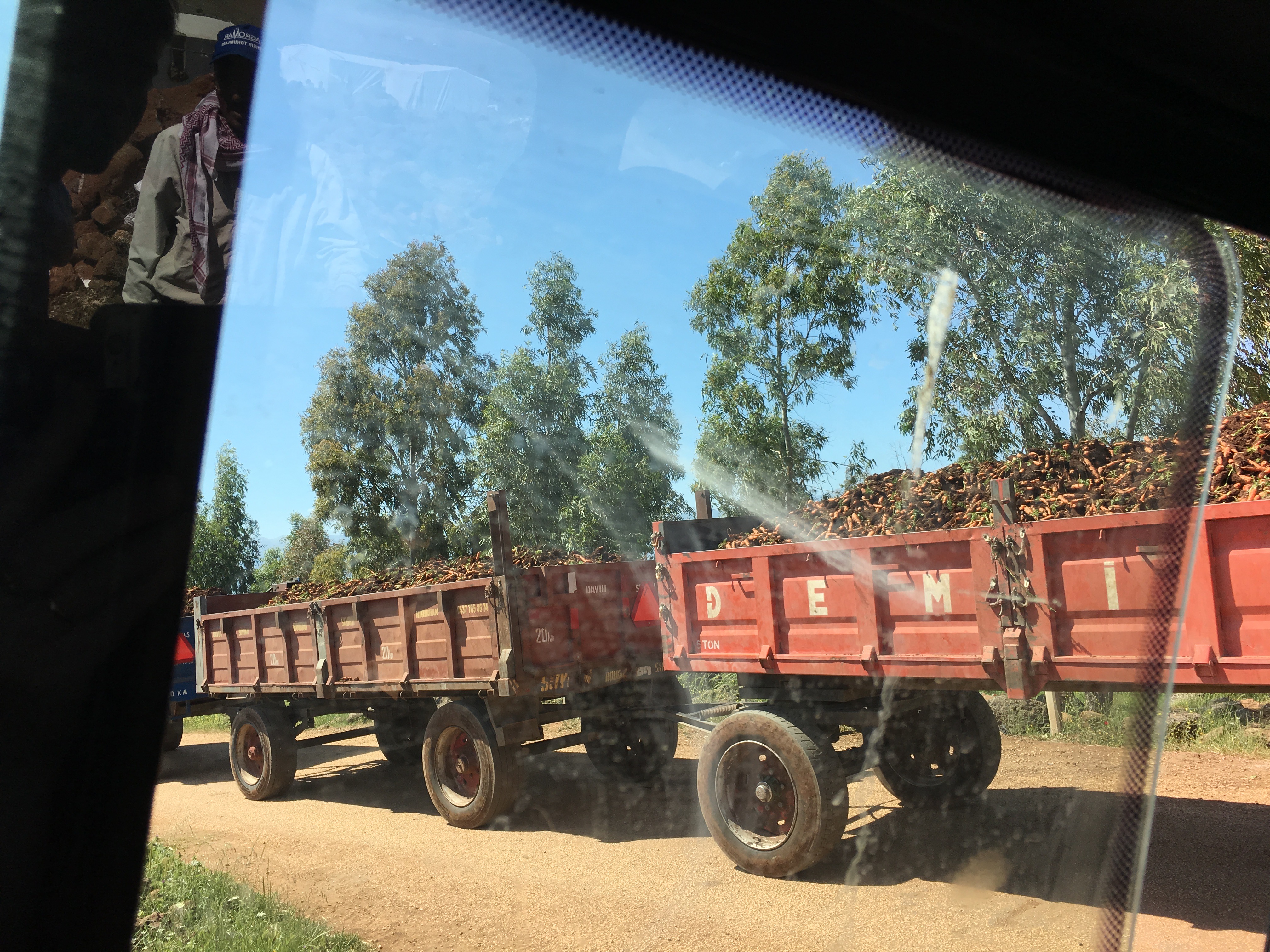
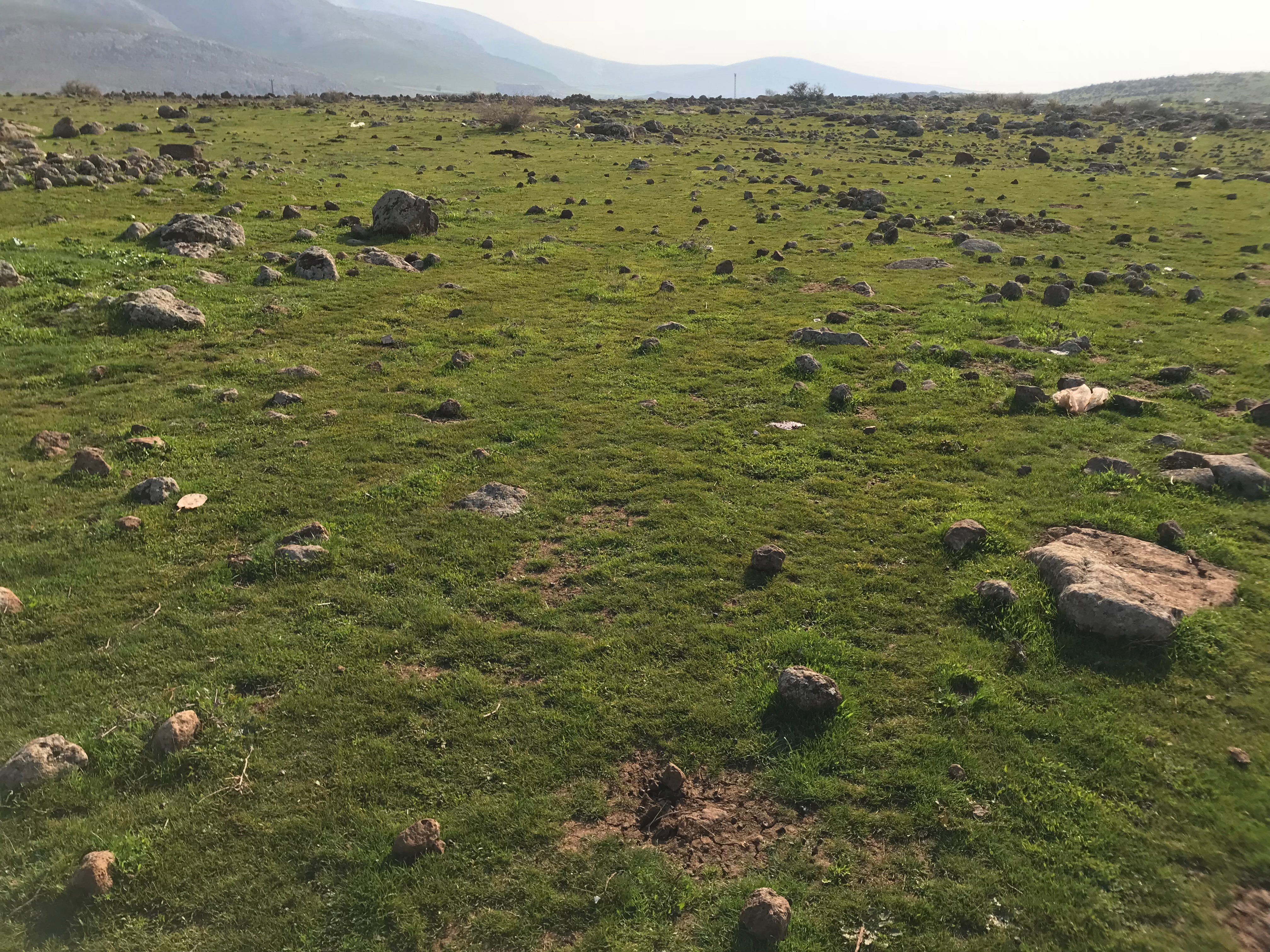
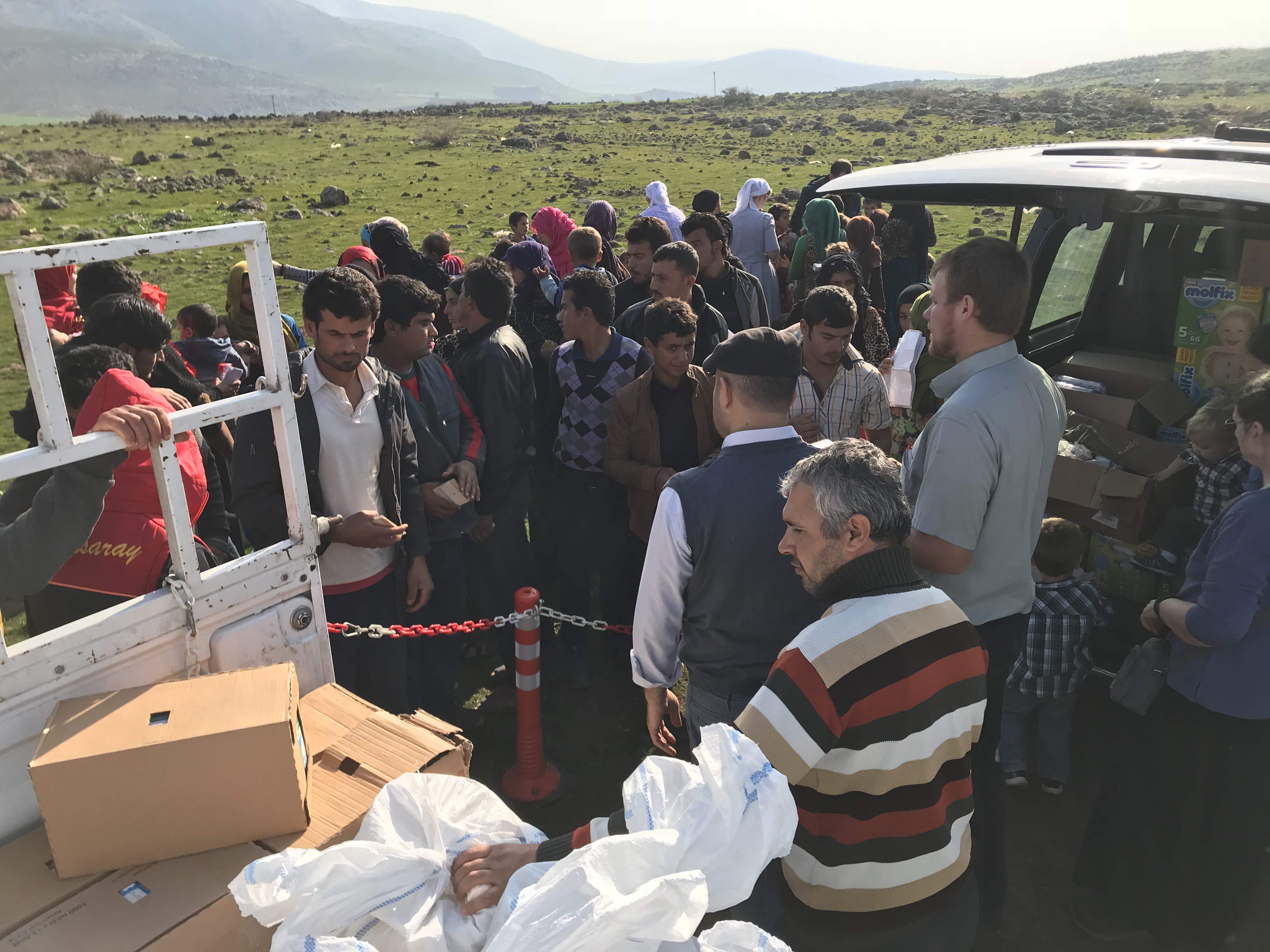
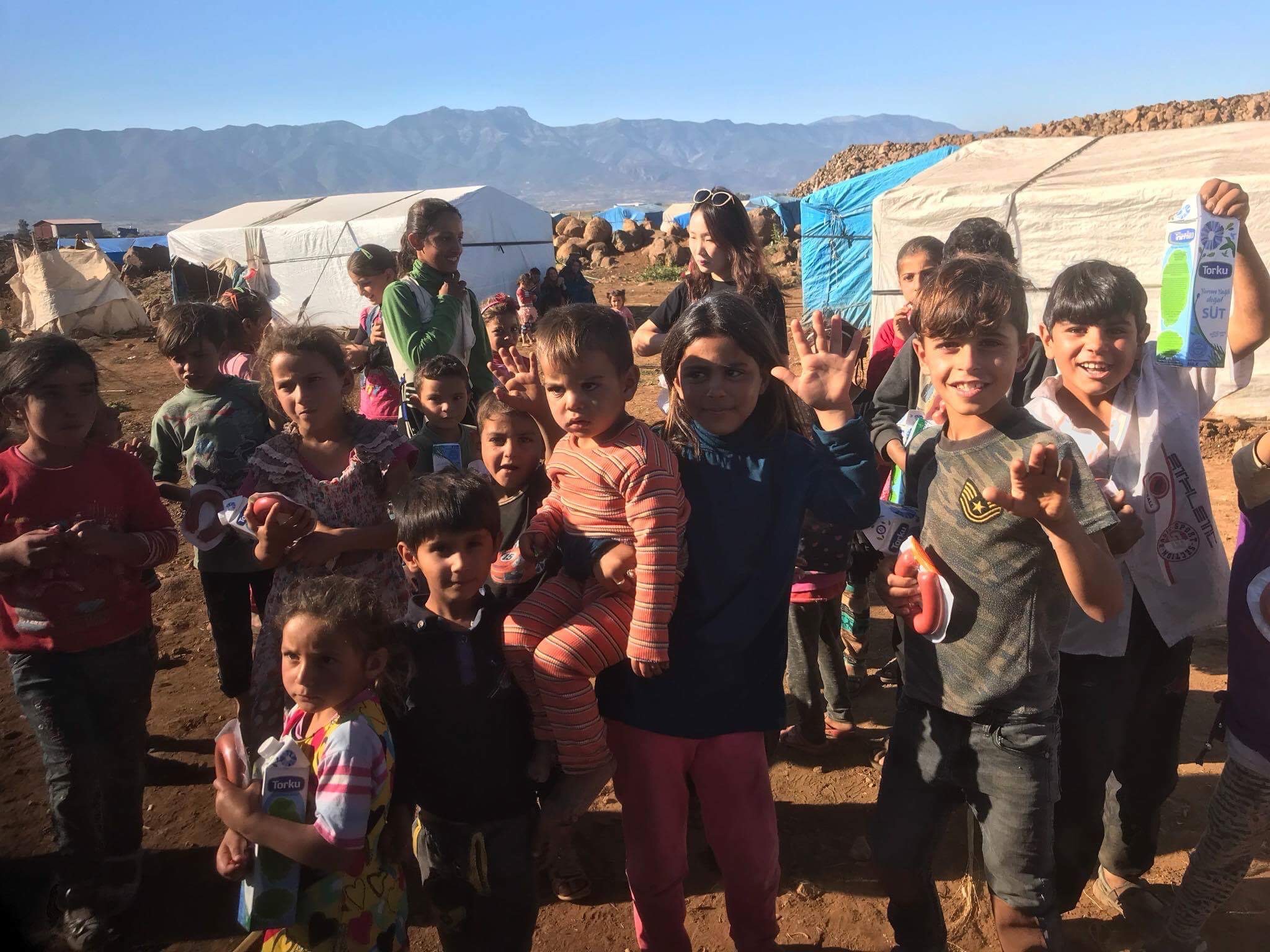


 Typically, entrance is afforded by one single, solitary steel door.


 It was some years ago that we had planted this olive tree in the courtyard of the church and it had flourished.

 At the end of the day there remained no impediment for a roof to be constructed to cover ⅔ of the courtyard and redeem the space which is lost in winter to rain and in summer to the intense Antiochian sun.
 We wanted a roof to keep the rain off, but the Lord of the rain took care of it in His own way.