Behind the Veil in Turkiye

The second book in my series is on our life in Turkiye. It follows from where the first book (Selling Snails in Istanbul) left off.

It is easy to say things when we do not have the benefit of direct knowledge. We hear things, see things, and are told things. Too often, blanks in understanding are filled in with logic, hearsay, or an expression of the author’s bias. Extreme caricatures frequently result in being foreign to reality and truth.

More than ever, we need to see and hear the evidence of actual, first-hand observation and experience. As the saying goes, ‘the truth will set you free,’ which is critical in this age of disinformation and silo-thinking. Too often, people have been lulled into dividing society and countries into an adversarial ‘us and them’ scenario.

The truth is something in between. People are fundamentally very, very similar. We laugh at the same things, we love, we cry, and we seek to improve our lives and provide for our families. There are differences in ideology and belief and differences in governmental systems, but people, at the end of the day, are people.

In the few pages of this book, I hope to pull back the veil so that you, the reader, may see what is really there and not the boogeyman many take pleasure in telling you is there.

Be brave. Look behind the veil and see what is really there.

Did Jehu Have a Cousin?

The morning finally arrived, and we were ready.  All the paperwork was prepared and checked.  We had taken a dry-run; travelled out to the office we would visit and the Tax office we would also need to go to.  We thought it out.

But Monday was both a workday and the first day after the school break.  The time we needed to go was smack dab in the middle of rush-hour.  So we decided although we use public transport to get around this vast city – for this appointment, we would go via taxi.  Not to be extravagant, we would come home normally.

So, rising early, I did a quick check of the traffic situation and it all looked good.

With plenty of time, we left the flat we were staying at and went to the roadside.  Here I opened an app on my phone and put in our destination. 

The app showed a taxi relatively close, travel time to our destination was much longer than when I checked earlier. Instead of twenty-eight minutes, now it was showing forty minutes.  I hadn’t pushed the button to call the taxi before, but now I was ready.

I Was Ready… But the App…

Unfortunately, it seems the app was not ready.  It would not process my request until I “joined”. Muttering at the app I say, “But I am a member, I’ve used you before.”  And it said “Enter your password.” Hmm, that would be the password I cannot remember.

I was at a loss and I did not know what I needed to do or could do?  So, I ‘joined’ again.  Then I went to log in and it failed and all the while, time was ticking…

Again I joined, but with the same result.

And again, and again I tried, and it was too late in the day for a ‘Plan B’.  In fact, public transport was my Plan A, and the taxi was Plan B. It was too late for Plan A – and Plan B was not working.  

What Could we Do?

I persevered, not that I had much choice and, at last, it worked.  It worked – but why it worked, I have not the foggiest notion.  But it worked.

I called a taxi.  The app told me how long the journey would be (forty minutes), the name of the driver, the licence number of the taxi and how much it would cost.  All good – well, except for the time needed for the trip, we barely had forty minutes before our appointment.  Nothing for it but to press on.

The taxi was five minutes away.  The map updated in real time.  I was glued to my phone, watching his progress…

And then the taxi was cancelled.  Did I inadvertently push a button?  Did the driver cancel it?  I do not understand what happened, but the taxi was no longer coming.

Time continued to tick by…  So, I re-entered our destination and called another taxi.  This one, a different one, was just two minutes away – and it came sooner.  We piled in and he headed off.  

Now our destination and the cost has already been passed on to the driver.  I shouldn’t have to explain anything – just sit back and be taken to our destination.

Regardless, he asks where we are going and I tell him.  He then queries if rather than Ümraniye I mean Çekmeköy?  What do I know?  The name and address I have are all for Ümraniye.

I look on the app-map and the ‘blue line’ is pointed at our destination, so I do not argue.  But I diligently watch our progress along the blue line.  It is a nice feature that the app shows you in real time where you are and where you are going.

The App Was Adamant…

The app declares we will be late.  The journey is forty minutes and we no longer have forty minutes before the appointment. 

Long ago I learned that if you need to be some place and you are late – well, settle down, relax and, well, arrive late.  Worry and stress will not enable us to arrive earlier.  And as the old saying goes “haste makes waste” or in this context, “haste makes for mistakes (= accidents).”

I did NOT mention to the driver we were short on time.  Nor did I request he drive quickly.  I am glad I made NO mention. We just settled back in our seats for the journey to the office.

However, the time is perversely called ‘rush-hour’. I don’t know why as no one can make headway. The roadways are clogged with traffic everywhere. There is not a single clear road to be seen.

But our driver was not to be deterred.  As there was a lock on the road ahead (nothing ahead was moving), he threw the taxi into a sharp right-hand turn and flew down a side road.  From there he found a road going left, and he pressed on.

Now I am in the back seat and I am not driving.  But I am a person accustomed to driving.  So I notice road signs and such even when I am not behind the wheel. I see a sign forbidding a left-hand turn… just before our driver executes a sharp left turn.

Let me just say, He Drives Energetically.

He manoeuvres on various side streets and pops out on a fairly main road.  By exploiting any gap, or even a semblance of a gap, he powers on.  When the lane he is in is stopped, he flings the car into the next lane and powers on.

Now when I, the old man that I am, go to change lanes, I live by the MSM – mirror, signal, manoeuvre that I was taught.  And I always throw in a shoulder check, just to be safe. I guess I do MSSM – mirror, shoulder check, signal and manoeuvre.

But Our Driver Had Gone to a Different Driving School

I could observe no check of any sort before the manoeuvre.  Nor did he engage the use of the signal.  In a split-second he would decide and manoeuvre.   Simple as that.

We are on a road running parallel to a main road.  We did not join the main road.  Traffic there was inhibited by ‘sheer weight of traffic’.  Whereas although the side road was busy, with a diligent application of all available lanes, he was making progress.

Then we hit a point where all the roads were filled with stationary traffic.  Again he turns right and looks for a clear road going left.  After six or seven roads he finds one and powers down the narrow single lane road.  As we come to the far end, a large SUV powers into our street.  Our driver says nothing; he utters no curse, and no gesture is offered.  We squeeze by and as we turn onto the main road, I see why.  We had just come up a long stretch of a one-way road.  Er, but we were powering along the wrong way up the one-way road.

Calling All Taxis…

Then we came to a point where he was on the radio warning all other taxi drivers that the road ahead was ‘locked up’.  We needed to go straight – and it seems to be a popular choice. Everyone was going that way.  No one, it seems, wanted to go along the left lane and merge onto the main road.  

So our driver, not to leave any opportunity neglected, jumped into the empty lane, flew up to the exit. There he bullied his way into the straight through lanes.  A judicial use of his hooter and he intimidated people to advance when maybe they did not feel they could or should.

At the busy junction he forced a crossing and powered down the opposite side. He was making jolly good time.

Did I say ‘Jolly’?

He turns on to a busy road and ahead everyone is turning left.  There are two or three long lanes of stationary traffic waiting to turn left at the light.  No one was going straight through.

Seeing the empty lane, he pops in and screams up to the light, where, you probably can guess, at the head of the queue he turned left.

In Turkey, as a traffic calming measure they use ‘sleeping policemen’.  These are raised humps on the road surface to slow traffic down.  All reasonable and normal drivers slow down to negotiate these traffic humps.

Not so our driver. By his driving, uh, technique, I think he could be the prophet Jehu’s crazy cousin.  The Old Testament declares the words of the watchman when he saw a chariot coming towards the city and said, “I think it is Jehu for he drives furiously.” Our driver treated those humps as flat road and powered over them.

I am watching the time, the distance, oh, and the cost of the journey.  We are flying along but only half-way there.

The blue line on the app-map continues to reassure me. And, contrary to what he said, we are heading towards the Ümraniye office.

We hit some uncongested road and our driver shows us what he can really do.  The world is flying by.

We are near our destination.  Because of our dry-run, I recognise where we are.  

He powers down the road and I recognise our destination on the left and so declare.  He screeches to a halt.  Then he confidently tells me this is Çekmeköy – as he told me.  Okay.  I paid the man and went into the Ümarinye office.

Oh, and we were there before our appointment time.

We Arrived…

The app came up and asked me to rate my driver – I passed on the opportunity.  I could not, with a clear conscience, say anything good.  

But we had arrived.  And we arrived not just on time, but early. 

But let just say, we always planned to return via public transport and our morning journey did not change my mind.

Really refreshing…

We began our distribution at a newly reconstituted old location with new occupants.  The site, thankfully,  had been abandoned all winter.  I say ‘thankfully’ because the ground is low lying with no drainage.   It would be a damp and soggy nightmare in winter.  And there is a seasonal stream running beside it.  But with the onset of summer, and the growing season in full swing, it has been re-established.

My plan was to drive down off the raised road into the encampment.  Our van and lorry could fit nicely among the shelters for the distribution.  We would be off the road and on flat ground. Importantly, we would be off the road and on flat ground.  In this encampment there is a child with learning difficulties – and no road-sense.  As people naturally cluster around the vehicles, it is best to be off the road where possible.

the reconstituted encampment distribution

Alas, this was not to be.  They had strung rudimentary wires parallel to the road to convey limited electricity to the shelters.  I perceived there was not sufficient clearance to pass beneath them.  So we stayed on the road.  It was not the best location, but it was workable.

Most of the residents we had formerly registered in other encampments.  Therefore, it was not a challenge to re-instate them.  There were a few new registrations.

From there we went to Ağaçlık (the Grove), once our most difficult encampment.  We cannot now call the Grove ‘easy’, but no longer does it bear the title of ‘most difficult’.  

foreground: the remnants of former shelters. Background: some of the current shelters

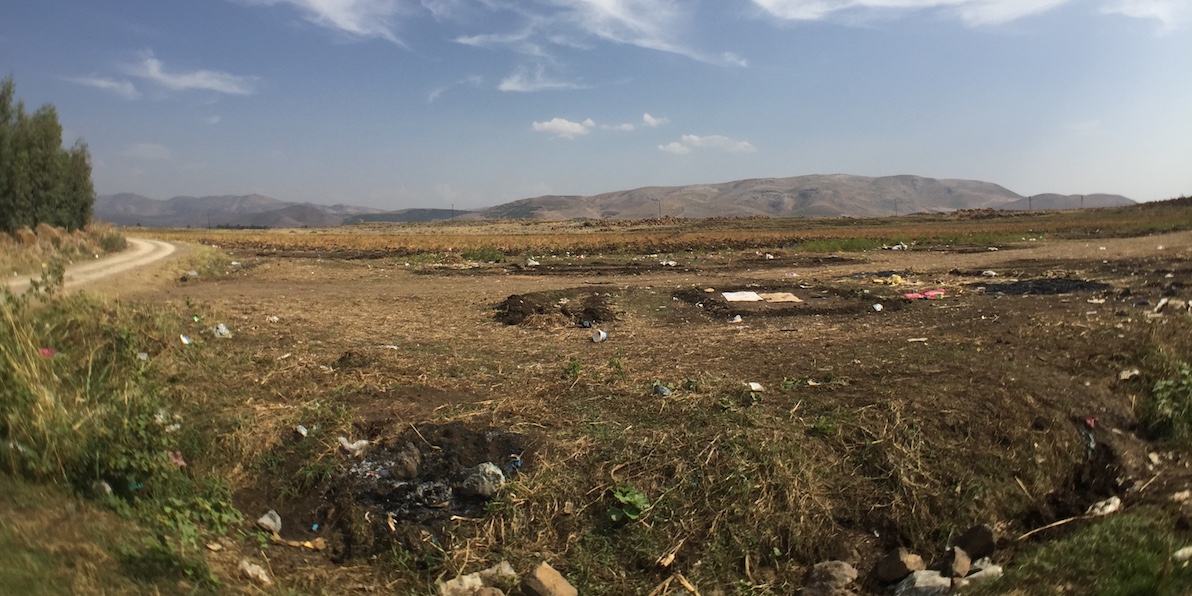
On arrival it was plain the reports we had of people leaving this encampment were true.  It looked like ⅓ of the former residents were gone.  Now just rows of rocks and lines of earth giving silent testament of where the shelters once stood.  I drove right into this encampment and set up our vehicles back to back.

We were aware the ‘good’ gang-master had not yet arrived. The active presence of the ‘good’ gang master changes this from a difficult to a not-so-difficult encampment.  We decided we would begin without him.  But we would wait until he came before we attempted the distribution to the children. They are a rambunctious gaggle. 

Once the good ‘gang-master’ arrived we got the children grouped together and gave them Turkish simit.  Simit is a delightful Turkish bread ring coated in toasted sesame seeds.  We purchased them nice and fresh that morning.

Mind you, the children’s distribution was again marred by the mums.  After a child received their simit their mum took the simit.  Then she immediately sent the child back to say they didn’t get one to get another.  And, if it worked, she repeated the scam!  Teaching their children to lie and cheat at a very young age.  Again, this was not children trying it on, but the mums cajoling and prodding the children.

When we finished the food-stuff distribution, we knew we had enough for the next planned encampment.  But first lunch was called for.

Now, just down from the Grove is a large shade tree near the road.  We have lunched there many times.  This location is located very near a small cluster of houses and farms. We do a monthly distribution there and we call it the ‘White House’. 

We like the White House because there is a clean and private Turkish style toilet there  And, something we hold dear, a sink with running water to wash our hands.  In the past they have given us tea and Turkish coffee.  And once or twice, after our distribution there, we have had our luncheon on their front veranda.  There is a table and sufficient chairs for everyone.  It is very pleasant.  And it is out of the sun.

It was lunch time.  We were close.  But, importantly, we had no distribution at White House that day. Nevertheless, I asked E if it would be appropriate to lunch there.  Her immediate reaction was ‘yes’.  I think the key factor was the sink and water.  We carry our own soap.  After handling all the paperwork, shaking hands and interacting with people, we appreciate being able to wash up before we eat.

I manoeuvred the van into the drive of the White House.  There we parked the lorry and van side by side.  We approached the house, and we saw no one.  My first thought was “We’ve come and they are not home.”  However, there was a large pan of water on the veranda – so someone was doing something at sometime.

The toilet and sink are accessible on the veranda.  E knocked on the door.  Eventually the lady of the house came.  She welcomed us and when we asked if we could luncheon there she was quick to say yes.  Turks are given to hospitality.  Once she understood we did not come to distribute food-stuffs, she told her people not to come.

We washed our hands and got our lunch materials ready.  Our ‘hostess’ offered to make us hot beverages.  I had already told E I was pining for a Turkish coffee.  We gratefully accepted her kind offer.

Then another vehicle arrived.  I recognised it immediately as the head of the house.  He is also the gang-master’s at the White House.  And he could not park in front of his own home.  I felt bad.  But I do not think it fazed him in the slightest.

He came, and we exchanged warm greetings.  He sat with us and asked his wife for Turkish tea.  So, now Turkish coffee and Turkish tea which is made by the pot, is available.  Turkish coffee for those who wish, and Turkish tea for the head of the house and anyone else.

We all sat on chairs, around a table and had our noon-time repast.  Everyone appreciated being protected from the intense sun on the veranda.  At this time of day, the UV index had soared past Very High and had entered Extreme.

We relaxed.  We imbibed on our hot beverage of choice.  And when it came time to go, we took our leave thanking our impromptu host and hostess.  They seemed genuinely thankful that we felt close enough to come and break bread at their home.

To be honest, I felt refreshed after our lunch.  Sadly, this is not normally the case.  But it was today.

From there we went to unquestionably the most difficult encampment.  We planned to visit this encampment last.  We ensured there were enough bags on the lorry according to our plan for this encampment but not too many. This was by design because this is an avaricious, grasping, lying, loud and demanding assemblage of people.

the last encampment of the day…

We are aware not everyone who presents really lives there.  Not everyone speaks the truth about the size and make up of their family.  

We worked our way, with difficulty, through the known, registered individuals.  Then there were others, many others.  It was confusing.   Some would be genuine, and others, shall I say, “less so”.

They crowd in on the simple plastic chains we erect to divide our working space from the recipients.  They thrust their papers forward.  And they are constantly crowding forward.  They are noisy.  Not shouting and bellowing – but not quiet either.  And they are demanding.

We worked our way, with difficulty, through the known, registered individuals.  There were others crowding and clustering there.  It was confusing.   Some would be genuine, and others, shall I say, “less so”.

The end descended into utter chaos.  We corporately decided how we would finish in this tumult.  We would distribute the remaining bags without registering people.  There were approximately ten bags left on the lorry.  We gave one bag of food stuffs and one litre of milk to each of the remaining families – deserving or not.  We would not register them as it was unclear who was telling truth and who was not.

It felt remarkably hot.  It was only 33º – 34º C, and yet the heat and humidity of the day was oppressive.  And the people were constantly crowding in and thrusting papers in our faces.  Our response, our goal was to smile, to act patiently, to be gracious.  We know some people were knowingly lying.  And we knew others are truly in desperate straits.  How should we react when others are ‘trying it on’?  Our calling is to model grace and not law.  We need to show love and not to react as their actions naturally demand.  We must rise above these things, showing a better way by the Power of God.  Our calling is to receive and share the Love of God.  And over-all we are ambassadors of the Unbelievable Grace of God.

As His representatives here on earth, to these Syrian refugee fields workers this is our primary task and calling.  This is also our calling to all the others we encounter in this work. 

In this service to the Syrian refugee field workers, we are the last in a long chain of saints and churches.  We are the hands that give them food and nappies.  Together, providing essentials to live is good.  But our primary task is to treat them graciously, giving them respect and love.  As Christians, we are more than ‘aid workers’ we are ambassadors of Christ in what we say, do, act and react.  

Recently a Turkish gang-master we do not know asked where we came from.  I said, “the Church.”  He immediately replied, “from Antakya.”  He knew of us.

Rain – Lot’s of Rain….

After a good, fruitful three day conference, we loaded the van with seven people and headed home.  We were taking two people to the bus station in Adana.  They would continue their journey from there.  And we were picking up one person in Adana to bring back to Antakya with us.

We headed out in bright sunshine.  However, as we made our way along the Mediterranean coast it began to cloud over.  It darkened to the degree that I swapped my sunglasses for my normal glasses.

The coast road transects many villages and towns. It may be four lane divided, but it is not a fast road.  After about 45 minutes, we reached the point where we joined the otoban.  ‘Otoban’ is what Turks call six lane divided, controlled access motorways.  Oh, and invariably, they are toll roads. But what you receive for what you pay is worth it.

We moved from a congested four-lane roadway to a six lane, high speed motorway.  And it started to rain.  Now, praise the Lord, our new van is equipped for such contingencies.  Our old van was temperamental about wiping the windscreen.  Sometimes it would.  Sometimes it wouldn’t.  And, frustratingly, sometimes it wouldn’t stop.

The windscreen wipers are ‘smart’ wipers.  And so, according to the intensity of the rain, it automatically wipes. We were entering a summer squall.  The rain starts light, just the occasional wipe of the windscreen required.  Then more intense.  The wipers automatically responded.  The squalls next stage begins.  The rain is pelting down and the wipers respond with intense, feverish thrashing.

As we are thundering down the motorway, it is harder to see the vehicles ahead of us.  One person in the van remarks they should have their running lights on.  But as we draw near we see they did, in fact, have their lights on. There was a lot of rain and a lot of road spray.

And being a squall, we passed from the intense portion into the raining portion.  From there we entered the light rain and finally, out to the opposite side of the squall.

As we arrived in Adana, turning off the motorway to find the bus garage, we entered the trailing edge of another squall.  The bulk of the squall had passed, and we were dealing with the aftermath.  It was still lightly raining, but there was standing water everywhere.  We dropped our brother and sister in the Lord at the bus station.  Then we began our unfamiliar twenty-minute journey through the streets and byways of Adana.  We had agreed to pick up another passenger.

It has been over thirty years since we lived in Adana.  This is a different city for me.  I could not find my way without the modern help of a navigation app.  The navigation app showed three paths – one of which was to carry on the road I was on.  I choose that one.

We made our way through the city, down lanes small and large.  Then we turned onto a road running parallel to a water canal filled to the brim. Now if it hadn’t been raining, nor the road awash with water it would not have been remarkable.  The canal was full to the extreme top of the canal and flowing with visible vigour. There was abundant standing water in the lane running beside the canal.  It was almost like the canal was sharing its abundance with the road.  It wasn’t.  But it felt like it.

We made good time crossing the city, working our way north.  Then we came to a key turning.  I misread the navigation and the road ahead of me.  With one turn, we were heading the wrong way.

Navigation apps are grand.  It immediately calculated how to return to the right path.  Following in obedience we were soon back on the correct road.  As we re-entered the same intersection, I made a better choice.

Soon we arrived at the designated location and were told to ‘wait’ and the person would come.  And so we waited.  It was still lightly raining.

Once we had our final passenger, we resumed our journey.  Our first task was to break free of the city and return to the motorway.  As we were departing a brother declared encouragingly, “It is very easy, just go down this road”.  Okay, it wasn’t difficult, but without the navigation app, I would have floundered.

Back on the motorway we were back to speed and heading home.  It was my plan to stop at a certain Services, about 20 kilometers out of Adana for a wee break.  It was dry until we approached the services.  Once again, we encountered the trailing skirt of a squall and drove into a light rain. 

After our pause at the services, somewhat refreshed, we began the final leg of our journey.  We were about two hours from home.

We crossed the plain to where the motorway branches.  The main arm carries on to the East and a secondary arm drops to Iskenderun and over the mountains to Antakya.  We took our turn and pressed on at speed.

However, as we drew near to the town of Dörtyol a new, dark, brooding squall lay before us.  This squall looked like it meant business.  We pressed on – it is not like we have a choice.

The light rain phase began – we sped onwards.  The moderate rain began, and we thundered on.  Then the heavy rain began obscuring the roadway, and we kept going apace.

We continued, and the rain increased in ferocity.  The automatic wipers entered their frenetic wiping phase.  No longer a sedate thumping back and forth but now a violent, feverish thrashing back and forth.  It was like a two-year-old on a sugar high after drinking coffee and an energy drink.  And traffic on the roadway was becoming difficult to discern.

I feel Turks are often energetic drivers.  But now they had slowed their driving.  Almost universally they turned on their warning lights, the four-way flashers.  It really increased their visibly.

The rain, the lack of visibility and common sense declared that one needs to slow down.  And so I, too, reduced speed.  Later, I reduced our speed again.  And, once more I slowed.

We entered the squall’s heart; the deluge part.  Time seemed to have slowed.  But, slowly, the intensity began diminishing.  Hope was born that we shall see the end of this tempest.

We gradually exited the heart of the squall and into the heavy rain portion.  Glad the obscuring rain and road spray were lifting and we could see more of the way ahead.  We pressed on.  Our emergency flashers were still on as we were not free of the squall yet. 

We crested a rise in the motorway.  As the blind side of the crest came into view, we saw a car askew, broadside in lane one.  There was light debris scattered on the road.  I briefly wondered if it was one who had powered past us in the deluge.  Even in the depths of the storm some intrepid drivers forged on.  

Unsure what was happening, and as we were still at speed, I tried not to make any sudden changes.  I passed by in lane three.  There was an intense miasma of diesel. 

The squall ended and shortly we were on bone-dry motorway.  We did not encounter any other squall on our return to Antakya.  There we dropped some passengers to transfer to another vehicle for the final leg of their journey to a nearby village.  We also dropped our passenger from Adana at their residence.

We stopped to fuel the van.  And as there was a car wash attached to the petrol station, I decided it would be worth the effort to wash the road spray off the van immediately.  I sprayed the soap on, covering everything.  Then I opened up the high-pressure hose to wash it all off…  And the grit, grime and muck remained.

I was surprised.   Normally, that combination washes the grunge off.  I rubbed the filth with my hand and that helped to removed it.  The chap at the petrol station offered to spray it down (at no charge).  He grabbed a broom and began scrubbing the van.  So I got a cloth from the vehicle and began wiping it down.  It seems there had been diesel on the road – and diesel laughs at water.  But soap, water, a broom and a cloth and we could persuade it to depart.

I wasn’t planning on hand scrubbing the van after an intense drive, but there you go.  I was much happier knowing the muck is gone.  Undoubtedly, it is easier to wash when fresh than after drying.

I have learned, that dirt, like sin, is easier to clean up immediately.  As time passes the stains and the stubbornness only increases.  I said ‘easier.’ I did not say easy.  It is easier than if I wait, whether paint, grit, grime or sin in my life.  Easier does not make it ‘easy’ but once dealt with, it is gone.  Easier is better than harder.  And ‘dealt with’ is far superior to festering.

Driving in a Foreign Land…

I am a product of my culture.  Maybe I am a unique expression of that culture; I don’t know.  But for me road rules are absolute; they must be obeyed.  I know brothers and sisters who love the Lord and strive to please Him in their life and actions.  And these same God pleasing brothers and sisters flaunt, flout, stretch and ignore the traffic laws.  These laws which I find hard to cross – are mere shadows on the road for them.

Then I came to Turkey. 

Here we see two principles at work.  The first are the actual laws as formed and legislated.  The second is the actual practice on the roads of Turkey.

I noted in the early 1980s, when we first came to Turkey, this extreme dichotomy.  Then the practical rule of the road was ‘bigger vehicles’ are right and ‘little vehicles’ aren’t.  Traffic lights were considered ‘advisory’.  There were traffic policemen out and they were enforcing the actual, legal, legislated road rules.  But they were few.

Now over thirty years later, the same basic equation exists.  There remains a tension between what is done and what the laws declares.

Now for a dyed in the wool legalist like me I have a conflict.  If I drive according to the legal rules, I will be a hindrance on the road.  No one will expect what I am doing.  This is because drivers just drive.  They do this without thinking of the ‘legal requirements’.  They only change their driving habits when they are forced to.  Driving is a corporate affair – moving like a herd; everyone in the same manner..

But the majority often choose poorly. For example, if you were to reverse engineer the laws by observation, you would come to some strange conclusions.  You could conclude it is a requirement that all drivers have a mobile phone in their hands whilst driving.

Recently I was driving through the town of Erdemli.  Erdemli, means with good virtue.  As I am driving along, I note many pedestrian crossings.  They are clearly painted, signed and marked.  They have even written on the asphalt to give preference to pedestrians.  The authorities are changing Turkish driving habits.

And so, I am going along, seeing all these pedestrian crossings.  And then, just ahead, I note one with people waiting to cross.  Well, I should be part of the positive change, shouldn’t I? 

So, I brake to stop and allow the pedestrians to cross.

Then came the panicked screeching of tyres as the small lorry behind me struggles to stop before we kiss.  He never, in a million years, expected me to stop ‘for pedestrians’!

And the poor pedestrians; they want to cross the street, and one lane has stopped – but the other? Who knows?

The driver of the lorry catches up with me and inquires why I had stopped.  I explained there was a pedestrian crossing. He expounded, with energetic and broad hand gestures, “this is the roadway, the roadway….” To him, vehicles have an absolute and unquestionable priority.

So, the dichotomy remains.  Do you drive according to the rules – and be an active hazard on the roads?  Do you, keep to the rules and cease to be predictable by other road users?  Or, do you drive ‘with the flow’?  Do you join the herd?

The final stretch to our destination was a built up area.  It may be towns and villages or just a build up of structures along the road.  Anyway, what is the speed limit?  And, does anyone care?  To be predictable, I moved with the flow of traffic.  I drove at a rate not faster than the rest, nor slower.  

Was my speed technically at the correct level?  The inner legalist within me declares “nay“.  But it was safe and predictable. 

What should my response to the new pedestrian road crossings be?  Well, it is a good change.  I want to support this positive development.  Besides, I spend a lot of my time as a pedestrian. 

Therefore, as I drive, wisdom would have me look further ahead.  And when I see waiting people, to slow gradually to a stop.

Ultimately, I want to be part of the solution and not part of the problem.

No Qualms….

Hmm.. that was ‘interesting’ and totally ‘unexpected’.

We were on the way out to recommence our food distribution to the Syrian refugee field workers.  On the way, we had a short discussion about English.  I was clarifying the meaning of the common English word ‘sure’.  One example I gave was “I’m sure this is right.”  And someone raised a counter point about the word ‘positive’.  Again, an illustration like: “I am positive I left it right here” was given.

Routine traffic stops are common in Turkey.  They do not stop every vehicle – there is often a winnowing, a selecting of whom to stop.  There are two kinds of traffic stops. The first is to issue fines for offences committed (speeding).  The other kind is a routine stop – checking for various things.

This was a routine stop and all the officer wanted was to see my driver’s licence.  This was not an unreasonable request.  And for me, there was no problem because I always have my driver’s licence with me.  Of this I was sure.  In fact, I was downright positive my license lives in my wallet.  This is a product of my upbringing.  I learned you MUST always have your driver’s license when you drive.

So, I had absolutely no qualms when I reached for my wallet….

Now, regardless of qualms or no qualms, I confidently reached for my wallet.  No matter how thoroughly and diligently I searched, I did not find my driver’s license!

In Turkey, this is an undisputed offence. There is no point in declaring: “It is my other trousers, I forgot it at home or whatever.”  All such statements are pointless and utterly meaningless.  

The officer could have hit me with a 4,000 fine AND having to appear in court (!).  The fine would have been bad.  Appearing in court would have been very disruptive and frankly unappealing.

And, he could have written me up for not having a notarised translation of my license.  Thankfully, he didn’t make either of those two choices.

He wrote me up for not having my license to present.  T, always going the extra mile, had taken a photograph of her and my license.  We showed this to the traffic officer on her phone.  Thankfully, he accepted it as proof I have a license to drive. This was a gift.  For how could he know if I possess a license?   

But then it was in English, hence the requirement to have a notarised, translated copy.  He asked for my father’s name, a key Turkish requirement.  And asked where it was written on my license.  Well…. It isn’t. 

The upshot is he wrote the ticket with this photograph of my license. My offense: not having my driver’s license to show when required.

So, having earned a new piece of paper requiring a payment, we carried on to our food distribution. And, I continued to drive. The officer stated there was a risk of another fine. He felt any reasonable traffic officer would not write a second ticket.

All this was unintended….  I was sure it was in my wallet.  Indeed, I was positive.  But now, I had no inkling to its location.  I never move it about nor take it out. Nothing, I do nothing clever with it. It belongs in my wallet, and my wallet belongs on me. So, whenever I am called upon to drive, I have my driver’s license.

Needless to say, we did not find it where I expected it to be.

Oh, on returning home, not encountering any more traffic stops, we found my driver’s license.  The only conceivable place to look was my English wallet.  And true enough, there we found it.  When we arrived back to Turkey, it never made the transfer over.  Yani, I’ve been driving without a license for nigh on three months (!).  God is Gracious!

Interestingly, previously and for a few days I have been ‘feeling’ that I should get my license translated and notarised…. But I did not follow through.  If I had, this whole episode would not have happened.  Except what would have been a simple meet and greet with the traffic officer.

Anyway, it was a worthwhile – and tiring – day with the refugees.  We went to an encampment we have named Isken 1 which is teeming with children.  There I spent the time holding hands with the children, walking about, sometimes in a great circle.  Over the years we have built up relationships with umpteen children.

We are scheduled to go to the Syrian refugee children on Thursday, the second day after this incident.  Happily we have found my license and AND we will get it translated and notarised before we go. One fine is one too many for me.

A half day task…

It is only recently that they require a health check as part of the residence permit process.

I understood it to be a half day task.  We scheduled our appointment at a State hospital.  And it was on the day before we were to submit our application for a residence permit.  I really believed it to be a half day task.  Our helpers in this task did not suggest otherwise.

Alas, if only it were so.

For our health checks we chose a large teaching hospital near Kozyatağı in Istanbul.  We had to commute to the hospital as it was not near to our lodgings.

To make things more trying, the various departments are spread out over the campus; each building standing independent and on its own.  While at the hospital we observed various patients, being wheeled down the roads.  They travelled not only in wheelchairs but also in their hospital beds.

The health report is not like visiting your local GP.   Over the course of our time, we visited; x-ray, EKG, Ear Nose Throat, Eyes, Internal Medicine, Heart, Psychiatry, Infectious Diseases, Neurology, and general surgeon.  Too many to remember; I’ve lost count.  The process means we need to visit all the appointed doctors.  And we must also complete all the referrals that crop up in our visits.  Once we complete all this, the Medical Panel coordinator will assemble the file.  After this he passes the file to the medical panel for assessment.

Hence we must visit every department.

At this sprawling complex, there is a system.   Notably, the doctors and support staff are all working according to the system.   My only problem is, I lack an overview of the system.  I am ignorant of where I need to go or even in which building the office is.  I am unfamiliar with the order I need to visit.  Nor am I cognisant of when various departments are open and when they are closed.  Importantly, I am not au fait what we must do first and what is dependent on another test.  And I am unaware when the results of the various tests are posted.  This is essential as without the results we can not go to the next stage.  And I do not know if I needed to collect the results and then carry them to the doctor; which we did sometimes.  Finally, I am oblivious when the results will appear on the computer for the doctor to peruse.

Hence I was relieved when our helper said they would go with us for the first day.  Of course, at this point, I thought it was just a ½ day job.

Our first appointment was at nine o’clock.  We met up with our Turkish helper at the hospital.  With its myriads of buildings, I didn’t have a clue as to where to begin.  But, not so our helper.  Following her instincts, she led us to a small, nondescript building.

Once we identified the starting point, we attended the office of the coordinator for the medical panel.  He said because we lack a residence permit, we would need to pay ₺1,800.  This was to be paid at the hospital cashiers office.  Only then could we begin the process.  I had heard there were two different potential costs for these health checks; one ₺200 and the other ₺900 per person.  I prepared for the worst-case scenario.  It was a good thing I did.

Once paid, the chap printed off a whole stream of tickets.  There was a set for me and another set for T.  These declared who we were, what department and which doctor we were to see.

In former days, people would go to the hospital and queue early in the morning.  Often they would arrive well before the hospital opened to get a number.  Later that day they would see the doctor in number order.  No longer; now people make their appointments by phone before they get to the hospital.  This is a grand system.

However, the new system is appointment based and if there were only appointments, the system would work well.   But, throughout the day, ad hoc referrals are set up within the hospital.  These exist outside of the appointment system.

I found it strange that although we ‘had appointments’, at the same time we didn’t.  It was because we were doing a Medical Panel health check that there were no assigned times.  So, we began with first finding the appropriate building.  Upon entering the building we saw a long ‘waiting corridor’, clogged with people.  Along the length of the corridor, doctors’ offices were on either side.  Next we strove to discover which doctors’ office we needed.  There were clusters of people gathered around every door.  In these groups there were those with appointments and those with referrals.  We were numbered in the latter group.  Whenever a patient left the office, it was a scrum to discern who was next to go in; one with an appointment or one with a referral.

Sometimes, we slipped in, our helper working the system.  At other times the doctor instructed us to wait in the corridor giving precedence to those with appointments.

This health check was not merely a bureaucratic function.  For example, after the EKGs were done, T commented that our printouts were different.  Well, the doctor also noted that.  He sent T to a cardiologist.  There, he did an echograph of her heart.   It seems she has an enlarged aorta.

After the blood tests, and the results were posted we saw another doctor.  She told T she had an infection and there was blood in her urine!

The ear doctor examined both our ears, and we left, believing all was done.  However, it seems he said we both needed hearing tests – but, alas; we did not hear him.

Later, in preparing T’s file, the coordinator discovered her failure to have a hearing test.  Consequently, he sent her for a hearing test.  But, in order for this referral hearing test to be done, she had to see the doctor again.  After that she went for the test.  Then she returned to the doctor with the results.

I had a good chuckle.  For, despite my difficulties in hearing, they sent T for a hearing test.

However, later, on examining my file, it was clear I had failed to have my hearing test.  So, he sent me as well back to the doctor – hearing test – doctor to complete my file.

The results are enlightening and unexpected.

The last doctor on the list, was “dahiliye”, which I am translating as ‘internal medicine’.  When asked what medicines I take, the doctor, hearing I have diabetes, ordered up another blood test.  But, I could not get it done then, as it must be a ‘fasting blood test’.  This added another day to the process.  But, due to the weekend, it was three more days.

This meant we began the process on Tuesday, carried on Wednesday, on Thursday, and Friday.  Because of my blood test we returned on Monday.

Our first task on Monday was collecting the blood test results.  And then I took them to the doctor.

Sometimes you knock on the door, and the doctor is with a patient.  I always feel bad when we do that.  This time, we thought we would wait before barging in.  Whilst patiently waiting a woman strode up, knocked and entered.  Ah, there was no patient in there.

When she came out, we went in.

It seems my diabetes is higher than normal, but acceptable.  That was not a serious concern.  However, it was my triglycerides count that caused concern.  It caused a great deal of concern.  They were really, shockingly high!  I did not expect that.  This is in stark contrast to my blood results from January this year done in the UK.  Then they were high, and a challenge to improve.  But it was not deemed time to change prescription or a serious intervention type of concern.

Therefore, I take this result with a pinch of salt.  This is serious and needs follow up.  But maybe we should also have confirmation.

We had seen the last doctor.  We returned to the co-ordinating office and all the paperwork was collated and stapled together.  Then the chap informed us we needed to be there at 14:00 to see the Medical Panel.   Evidently, we must present ourselves to the Medical Panel.

Now, we were unaware of this requirement.  It is no biggie, just we were not expecting that.

Therefore, before 14:00 we arrived in the crowded waiting corridor.  There we assembled with all the others gathered to see the Medical Panel.  After 14:00 they called people in, one by one.

I was called and directed into a room where eight doctors were seated around a conference table.  The head of the panel greeted me in English and I replied in like manner.  Only later did he twig I speak Turkish, and we switched to Turkish.

He cautioned me in no uncertain terms that my triglycerides needed to be dealt with!  And he added ‘especially with your heart condition’.  Now, I did not understand this reference in the slightest.  I confessed to the panel I was still in shock over the blood test results.  Nevertheless, as I take my responsibilities towards my health seriously, I said I would do whatever I could.  I did not address my confusion over his reference to ‘heart condition’.  I thought he said it because diabetics are susceptible to heart disease.

Next, T was called, and knowing I spoke Turkish, they spoke Turkish with her.  At the end of the interview the head of the panel asked if there were any objections.  There were none.  And then he told her to be back after 16:00.  He told me the same.

At 16:00 we were once again in the waiting corridor with the assembled ensemble.  There we waited for them to call our names one more time.

This time they called T first.  So she had to learn what we needed to write on the back of the form.  It need to be in Turkish and written by our hand.  This made it much easier for me.

Once we had the report, we had time to read it.  There I learned they have stated that I have ischaemic heart problems.  How do they know?  And, they specifically referenced that the existing treatment was a stent.

Well, this was news for me!  I mean, at the least I should know if I have a stent or not.  This then was what the head of the panel was referring to.  To say the least, I do not understand.  But, I know I have not had a stent applied, or is it installed?  I do not even know the terminology connected with a stent.

This is something I will address with my British doctor.

Nevertheless, we still have some outstanding tasks.  We had to send our criminal records checks to the UK to have an apostille affixed.  And we need to have our birth certificates translated and notarised.  Oh, and we need to produce the title deed of the home we are officially living at.  Oh, and a statement from the local Council that the property is still being lived in.

When all of this is ready, the next task is to pay the application fee.  And the final step is to submit all the documentation and health reports.  At the end, we will have done everything that was in our hands to do.

I believe the local office will send the completed application forms to Ankara.

In spite of all the effort and expense, there remains no guarantee of a residence permit.  They may or may not issue the permit.  And, if they issue a residence permit, there is no idea of how long it could be.  Recently some people have been given just five months.  In our case it is looking very much like just one year.

Ah, the Health Reports, which I thought was a half day task, has taken five days.  But it is done.

In all these things, we face them with patience and grace.  It is our first calling is to be Light and Salt in all our comings and goings.  This is especially so in times like these.  And, once again, our trust, our rest, our peace and our patience is all in the Lord.

Not as easy as you may think….

I think the year was 2006, and we were in the ‘pearl of the Aegean’, the city of Izmir. T and I travelled and stayed in the city for two-weeks every month for over a year.

When there, we stayed with our friends and coworkers.  They lived in an area of Izmir called Balçova, a place noted for its hot springs.  In this area the thermal water is so abundant that they use thermal hot water to heat the homes and apartment buildings.

This, I found to be magnificent, free heating and free hot water.  At the same time I found this to be quite terrifying that the conditions to heat the water were so close, so very, unnaturally near; in fact, just under our feet.  Still, one advantage of staying there was the ability to visit the thermal springs.  It was a real treat to indulge and relax in the natural hot water.

Izmir, was in ancient times known as Smyrna.  It was then a thoroughly cosmopolitan city.  It still is today whilst at the same time is also a typical Turkish city.  And so it was not surprising that many signs in the hot springs were bi-lingual, Turkish and English.

Once, as I was passing through the lobby, my eyes fell on a rather large notice.  Typically, the English drew me.  I read that “parents are liable from their children”.  I must admit this tickled my funny bone.  I snickered to myself over the obvious error.  My assumption being it was supposed to be ‘for’ in ‘for their children’ but had been misspelt as ‘from’.   No doubt the sign writer did not know English and so this error silently passed by.

Feeling smug, I then turned my attention to the original Turkish.  I confess, reading the Turkish surprised me.  The Turkish states that “Veliler çocuklardan sorumlu”.  Let me explain.  Turkish is a suffix based language.  This means suffixes are added on to words, and so, if we translate this literally it is: “parents children-from responsible [are]”.

This straight away brought two things to my attention.  The first is the method which shows the relationship in the Turkish language and according to Turkish syntax is using the suffix ‘den/dan’.  This we typically translate into English as ‘from’.  The dilemma isn’t Turkish but our translation of the suffix which is most often, but crucially, not always accurately rendered as ‘from’.  Another thing that stuck me was I would constantly translate wrongly as I would eschew ‘from’ and consistently use ‘for’.  The Turkish for ‘for’ is ‘için’ which is not a suffix but a separate word.

Oph!  I completed the rapid descent from smugness to chagrin.  One moment I felt superior, and the next embarrassment.  I again realised that my Turkish is full of English-inspired errors.  I was reminded my Turkish reflects English forms and English syntax.  These I subconsciously wield to create my own, personal form of Turkish.

I giggled when I read the English.  That was wrong.  If, in like fashion, Turks chuckled at my linguistic faux pas, they would be justified.  But there is a problem.

We have lived amongst Turks for thirty-five plus years.  In that time I’ve never witnessed or overheard them mocking, laughing, ridiculing or making fun of foreigners’ verbal blunders.  I have heard of many foreigners’ gaffes.   Some of which are funny – er, am I doing the same thing again?  But, I’ve never heard them from the Turks.

It seems making a mockery of someones struggles in a second language is more the forte of foreigners.  I have found the Turks to be genuinely gracious.  Turks strive to understand what the foreigner is trying to communicate.  Full stop.  They do not take the mickey, nor take pleasure at the expense of the foreigner.  Here the foreigner can take a lesson from the Turks.

Oh, as for the grammar lesson… it is only this year I’m applying it to my Turkish.  In guess I’m a slow learner.

Number One…

Some encampments of Syrian refugee field workers, cease-to-be, they close up shop and disappear in the wet, windy and bleak months of winter.

Good for them.

Living in the fields in winter is not a desirable nor attractive proposition. Life is hard and miserable in summer, and just plain deplorable in winter.

We have been encouraged when we go to provide some assistance to an encampment to find a barren field with just the debris, cast-offs and the detritus left by human habitation that proclaims that there was once an encampment there – but the encampment is no more. They have moved on and maybe, just maybe, to some better place, or, we must confess, sadly, it may be to an equally bleak site somewhere.

This day was our last visit to just such a place. There remains but a few families living in some farm buildings which means that those few remaining will enjoy relatively good accommodation. The main encampment is barren and deserted – workers will return in the spring when field work will again be plentiful.

Those who are remaining in this location, by and large, are dry, secure and have proper sanitation. When there is work, they will work.

However, these remaining Syrian refugee field workers, in spite of the benefits they have, will still be in need. On this, our last trip up the long and prone to being reduced to a hopeless quagmire of a track, our goal was to provide some assistance and to collect their phone numbers. For the remainder of the winter months, we will ring them and then draw nigh to their location – to the closest point where the roadway is sound. They will come to us – farm equipment will happily power through where road vehicles will become well and truly mired.

From there we made our way to the encampment we have named ‘the Grove’ due to the small stand of trees across the road from the encampment; there are no trees or bushes of any description within the actual encampment; it is rather barren.

This slideshow requires JavaScript.

This encampment is situated on some high ground. I would not call it a hill, it is just a simple piece of higher ground. It is rocky and would be impossible to farm in its current state. The rocks in this region are large; I mean they are literally gargantuan – they can only be removed with large excavators. The majority of the rocks are buried in the ground, sometimes their heads, sometimes just their shoulders protruding from the soil. Shelters, as best as one can, must be placed around these boulders as they can not be shifted.

On the plus side, this higher, slightly lifted up location, at the very least, will not become a bog in the incessant rains of winter.

And, sadly, it appears that this encampment will be remaining in this remote location over the dark, damp days of winter. The prospects of living in rude shelters, exposed to the wind and rain through the long, dismal days of winter is truly appalling.

The headman in this encampment is from the area in eastern Turkey near the city of Urfa. He is a bilingual Turkish / Arabic speaker and his life occupation has always been a ‘field worker’. He is the headman in this encampment because he is the ‘gang-master’ and the residents of this encampment are his work force.

As the gang-master, he organises the field labour and provides a modicum of the essentials for the workers – it was up to him to find and arrange a place for the workers to pitch their shelters. He also will provide some source of water (often it can simply be a water bowser as in this encampment). I would say in most, not all, but most encampments, the gang-master will arrange a degree of electricity (most often illegally sourced by attaching wires to the passing electrical cables).

The electricity that may be supplied is not properly established. Most frequently you observe wires running over the floor, lying on and through the dirt and puddles. There is no fuse box or circuit breaker. Wires can be spliced together and protected from the elements and curious children with whatever tape-like material is to hand, even sellotape. I suppose if the wires get too hot and burn up, then that will function as a rudimentary fuse… of sorts…

It is up to the residents in the encampment to construct simple out-houses and some kind of structure to bathe in. The bathing structure will have a dirt floor as everything else has, but the tarpaulin will be stretched around and over to afford a degree of privacy to have a rudimentary sponge bath. For the winter months, they also manufacture some primitive shelters to act as kitchens.

IMG_3114We arrived at the Grove, and, as I have been doing recently, I did not drive into the encampment proper, but rather chose to stay on the roadway. The road at the entrance is wide enough for us to set up on the far side, and traffic – traffic is rather infrequent on this passageway – can easily pass by on the remaining side. The residents of the encampment come and stand in the road, hence not in the mud, for the distribution.

The lorry reversed up to the van and hence the vehicles were back to back. This created a separated area for the team to work in. This space together in concert with the simple barriers we bring with us, forms a division between those who are waiting to receive some assistance and the team who are organising and distributing the provision.

Separate from the regular food-stuffs distribution and as the result of some special gifts being provided, we have been enabled to give the children some milk or fruit drinks and a sweet snack.

We have been doing this at each encampment.

But this encampment is different.

This encampment is fundamentally and dramatically different.

The gang-master in this encampment tends to be an ill-tempered, peevish, quarrelsome individual. We witnessed at an earlier time, in a different location, this gang-master physically assaulting a man who he thought needed being put in his place. In all the time we have been engaged in this work, this was the one time where we have observed a fight, a brawl between two men.

This gang-master can be pleasant, but he can be bellicose, petty and, well, short-tempered and grouchy.

It must be said, he is not short-tempered or grouchy toward us; with us he tends to try to manipulate and use us, he tries to get more for himself and his greater family – oh, and also for his Syrian refugee field workers. He is not above lying to our faces, or saying that someone is no longer in the encampment, when they are still in residence. It appears he has done this in the past in order to deprive them of the assistance.

However, it must be remembered that the gang-master is the gate-keeper of the encampment. If we do not make an effort to work with him, he may deny us access to his encampment and the Syria refugee field workers in that encampment; he can be petty, and then it will be the adults, the children and the babies who will suffer…

Today this most bellicose and quarrelsome of gang-masters, was present along with his brother, also a gang-master, and it would appear that they have brought their two different groups of workers together, to this one location, to winter there together.

Sometimes brothers can be very different, but in this case, it is glaringly obvious that they are two peas in a pod. They resemble each other in their looks and mannerisms. And it seems, they resemble each other in temperament. It is apparent they have had hard lives, and the scars on their bodies and more importantly on their personalities is patently evident. Of all the people in the encampment, that is, 197 individuals of which there are 65 children under ten and 18 babies, they were the only two who walked about with sticks, functioning as truncheons, in their hands.

In the past they have brought their separate groups of Syrian refugee field workers together to winter together in one place. In fact, when they this did this a few years ago, at one location, it was felt by the local Turkish village that they were too close to the village and they were rejected and ejected – the villagers required them to relocate.

Yes, the Muslim villagers told the Muslim gang-masters, and the Muslim refugees to depart.

Their current location, situated on some higher ground, is at a distance from any other habitation… so the chances of this happening again are diminished.

I took a quick tour of the encampment, and there are many more people and shelters there than before – indeed it is self-apparent that the other brother has brought his Syrian refugee work force to winter here. This location is now roughly twice the size it was previously.

In the course of my walking tour, I also noted the gang-masters’ shelters. Yes, the gang-masters frequently live in the encampment with their charges.

IMG_3341I immediately recognised the gang-master’s shelters as they had liberally spread fresh, clean, large stone gravel under and around their shelters. No mud for them. The rain can drain nicely away and their shelter will be dry within. I even noted that they had placed wooden pallets inside their shelters, raising them off the floor and providing a healthier environment to pass the winter months.

IMG_3346Not so the other shelters surrounding theirs. They are pitched on the raw earth, hence dampness within the shelters is guaranteed.

As I mentioned, previously, this encampment, that is both the gang-master and the residents, had proven to be a bit of a challenge. We especially encountered difficulties when we attempted to have some activities with the children.

The Team have been going out once a week and playing with the children, organised games, painting, fun things for children that have experienced precious few ‘fun things’. We have provide milk and something to eat as well.

For most encampments this has been a very positive, pleasant experience.

Sadly, even I have noticed that the children in this encampment are all exceptionally filthy. In all of the encampments, all the children are dirty. This is not surprising after all, as there is no proper washing facilities in any of the encampments. But here, in this one, they were dirty to the extreme; clothes, hair, arms, hands, faces were all grimy beyond measure.

Today, as we set about our planned provision of assistance, we also made ready to give the children the special juice boxes together with a sweet treat.

IMG_3336Now, as we do at other encampments, we attempted to line the children up to receive the juice boxes and sweet treat.

In all the other encampments, once the line is established, we begin at the head of the line, and the line slowly advances towards us and all receive their portion in good time and all are happy; no one is left out, no one has extra.

Here, the children, and not a few aggressive mums with babes in their arms, seemed content to line up in a semblance of a line…

…that is until…

….until the juice boxes and sweets came forth.

Then the nicely formed line instantly dissolved, it disintegrated and all broke free and set siege to the two hapless young foreigners whose only crime was to be the ones holding the prize, the juice boxes and treats.

They were surrounded and besieged – children and some quite demanding, aggressive mums – with a thicket of out stretched arms coming at them from all angles accompanied by a cacophony of cries to give to me, to me, to me and the insistent, pleading, whining of the mums. All the while other hands were striving to snatch and steal their prizes from the boxes in the embrace of the foreigners…

The two young people were immediately overwhelmed and forced back four or five metres to the side of the lorry where they abandoned the task as impossible to do in an orderly, organised and fair way. The box of chocolate bars was desperately cast up onto the lorry, the box of juice boxes was pirated safely away.

In advance, I knew it would be difficult to give the juice boxes and sweets to the children in this encampment.

The previous time we attempted to do this, it was bad, not as bad as this, but it was bad. It, too, had ended in a premature cessation of distribution of juice boxes and sweets to the children as the swarm of children was rapidly descending into an unruly, riotous mob.

True confession time: on the last visit, I was attempting to distribute the juice boxes after the main attempt had failed, and my phone rang, it was the wife of our interpreter. Whilst I was suitably distracted, one determined little chap reached up and tore a juice box from within the box that I was holding protectively in my grasp… needless to say, being engaged on the phone, I was caught unawares and I automatically responded in an instinctive, natural, way and I immediately relieved the young thief of the pilfered juice box.

I was angry.

What can I say?

There was and is no excuse for my response!

I really felt bad for the wife of the interpreter who I was speaking with, when suddenly there was a loud exclamation and my attention became solely focused on dealing with my small thief. I felt bad for the lady on the phone, but, I confess, I did not feel bad for the young lad who had his prize in his hand only to have it forcibly snatched from his grasp.

Now to compound my un-Godly response, I made matters worse as later on, when I was able to achieve a more orderly distribution, that is, ‘orderly for this encampment’, of the juice boxes and sweets, and he presented himself to receive something, I specifically, knowingly, and on purpose, looked him in the eye and did NOT give him any.

This was my so-called ‘just’ response to his unsuccessful grasping theft. I am ashamed as I recount this event.

Where is Grace?

Where is forgiveness?

Where is compassion?

Where is love?

Where is a modicum of understanding of the situation he finds himself cast in?

Where indeed…

After the fact, I felt stricken in spirit for my callous and so-called ‘righteous’ response – the response of justice and law…fully ignoring grace, love and compassion.

And for me, as one who was fully undeserving of the Grace of God, the Love of God, the Mercy of God, I, who have ‘tasted and seen that the Lord is good’ to react in this way is a travesty of all that God has done for me – far more selfish and undeserving than that young lad had exhibited.

Again, my response and actions were far more selfish and undeserving than that young lad had exhibited.

He was desperate. He is actively living in truly appalling conditions of deprivation, hunger and suffering… and what is my excuse?

That was on our previous visit, this time I was determined not to make the same error. Mistakes are made, but, we can learn from them.

And this time it was far, far worse than the previous, difficult and contrary time.

Seeing the failure of the two young people to execute the distribution of the ‘special juice boxes and sweet treats’ for the children, I, once again, waded in to the fray, grabbing the juice boxes from the shaken young man. I was determined to effect some kind of distribution – gracious distribution – in spite of their rambunctious and riotous behaviour.

I forged into the teeming mass of the dirty, the neglected, the desperate children. Arms were vigorously, aggressively thrust up at me from all angles, voices cried out to gain my attention, the box in my arms was under constant, determined assault and I attempted to execute a gracious form of distribution.

As I was giving the juice boxes, I was aiming to prioritise the wee ones, the small, the weak, the ones unable to overcome their neighbour – and then I witnessed a larger child wrench the juice box from the grasp of the smaller child, I promptly wrenched it back and gave it to the smaller child – and then I gave the offender, the selfish bully, a juice box.

Why? Because of Grace, that is the unmerited, unearned, undeserved favour or blessing. Did he deserve it? No – but to get what you deserve is ‘justice’, not ‘grace’.

Scripture does not say in vain, love your enemies, bless them, do good to them… it does not make this conditional on their repentance or a change in their behaviour.

If your ‘enemy’ is thirsty, give him drink, if hungry, feed him.

It is rather straight forward and it is not difficult to understand. Sometimes we declare it difficult to do, but it is not difficult to understand – and these are the words of our Lord Jesus Christ.

The children (and a few aggressive mums) behaved as a rapacious horde of barbarians intent on taking and plundering and we strove to give them something to drink and something, special even, to eat.

In the course of this mini-distribution, I recognised my little thief from the previous time, still behaving as is his wont, as he has been taught and trained by all those around him, and I deliberately looked him in the eye, a look of recognition, and gave him a juice box.

There was one point where I bellowed. Oh, and I can be quite loud.

Regrettably, I have observed that more often than not, I can come across as angry, cross, upset. Truly, I am not, nor is it my intention. Actually, it is the furthest thing from my actually feelings. But, alas, it is how I am commonly perceived.

Nevertheless, in this situation I bellowed, knowingly. I was not upset. I was not angry. I was not frustrated.

What did I bellow?

Well, it was a bellow, a “AAAahhaHHHaa” like sound… they do not know English or Turkish, and I do not know Arabic, and my intention was to make a distraction in the raging mayhem.

There was an immediate, short-lived, positive effect in that they slowed down their physical assault on me. I was able to continue in my distribution.

But, soon, it was more than I could sustain and I had to bring it to a premature close. The aggressive ones were coming again and again, demanding, pleading, stretching forth their arms or attempting to snatch from the box in my embrace.

Some of the children received juice boxes and sweets, and many did not and some possessed more than their share.

Maybe next time we need to have several people doing the distribution, and dividing the horde – that way more, and more of the most vulnerable, will receive a wee blessing. Or, maybe, we should endeavour to include it with the food-stuffs, as part of the regular distribution.

Back at the van there were children who came and persistently begged, wheedled, connived and otherwise tried to gain possession of the treats.

Some of the children tried to force open the locked window in the van to gain possession of the treats. They were discouraged from this activity on several occasions. Finally I posted one of our foreign helpers to simply stand before the door to bring an end to these assaults on the vehicle.

This was proving to be a very difficult distribution, especially as we were dealing with a less than trustworthy gang-master, and the corporate conniving, lying, cheating, and grasping adults of the encampment only compounded matters.

Consequently, the distribution was taking a disproportionate amount of time and, with the passage of time, the door minder left his post by the vehicle.

The ever diligent and watchful children immediately launched another attempt on the window. They were able to force it fully open… and caused some damage in the process… for it was locked shut.

However, even opening the window did not put the prize within their grasp.

Once again I returned, and on my coming, the guilty parties became conspicuous by their absence and I was able to get the window shut.

In addition to those intent on assaulting the window, there was one little one who was conniving to get a juice box and sweet. Rather than getting angry, I would pick them up and cart them away from the distribution area, as you would your own child or more like your own grandchild where you indulge them and smile and have them smile as you truck them away.

More than juice boxes and sweets these children are yearning for some attention. They will take attention in any form, a shout, a slap, a smack with a stick, but of course, positive, non-violent attention is the pearl of great price.

I’m not about to beat anyone, nor shout at them in anger (been there, done that, repented) nor threaten physical violence upon them. I will scoop them up and in a positive manner, remove them from the immediate area.

So, now this wee one, trying to finagle a juice box or sweet, had a new game. They would come, I would pick them up, swing them happily about, and cart them away. Sometimes they would beat me back to the distribution area to start the process all over again.

Being in close proximity means there is a danger of head lice being transmitted – but they are more valuable and special than the danger and inconvenience of head lice.

The distribution at this encampment was not a pleasant experience for any in the team.

And on our departure, after fully completing our distribution (everyone receiving their allotted portion), one lady ran up to the reversing lorry, grabbed a bag of food-stuffs, and hoisted the bag, about ten kilos of basic food stuffs, out of the back, and made off with it. Our minder, from the local Social Assistance Department, was there, helping the lorry driver reverse and he tried to prevent her – to no avail.

In my experience, this has NEVER happened at any of the other encampments we have gone to over the course of the three years we have been going out among the fields to assist these refugees.

As we put this encampment firmly in the rear-view mirror, there was a general feeling of relief and also a palpable degree of exasperation…

It was striking that even our lorry driver, who acts and strives to a ‘part of the team’ – on that day he even joined our prayer time before headed out for the day – was of the opinion that we should ‘zero’ the whole encampment. ‘Zero’ is what we do when we make someone ‘inactive’ – historically this has always been due to their moving away.

And so an emotional, natural response would be to ‘zero’ the whole encampment due to their manner of behaviour, their lying, their cheating, their aggressive attitude, their demanding actions and the general, casual violence from the gang-master downwards to the smallest child.

It is a natural, human response to feel that “they are not worthy”.

We can easily compare them to other encampments where, for example, on the very same day, something fell from the vehicle and a child standing nearby swooped in to scoop it up and return it to its rightful place in the vehicle – he was striving to assist and help us. And again, on the same day, a young child was offered a juice box and they responded by saying they had already received theirs and went on their way.

It is very easy, very natural, to conclude that this encampment has declare themselves a pariah encampment – justifiably worthy to be avoided.

It would be so easy to declare that this particular encampment is too difficult, too hard to try and provide anything to them because of their contrary, aggressive, grasping behaviour. Indeed, as we go from encampment to encampment, if anyone will lie, and it can happen in other places, but it will definitely happen here; if anyone will attempt to present twice for provision, which can happen in other encampments, it will happen here, and, as we witnessed, if someone will steal out of the lorry, this simply has not happened in any other encampment, but it has happened here. Indeed, I think is is fair to say that if we looked, we could find another encampment which would be far easier to work with.

The natural, earned and deserved response, is to write off this difficult and contrary encampment – to ‘zero’ them, to leave them to their own devices, to avoid them like the plague, to treat them as the pariah they declare themselves to be…

That is the natural, human response, and what is the appropriate response from God’s perspective?

Let us recall that the world was at total, absolute enmity with God.

We, everyone, each of us, were going our own individual ways.

We declared, that is each and everyone of us, declared ourselves to be as ‘god’ in our lives – that is, the final authority in our lives. We lived according to our thoughts, our plans, our desires and our passions. We purported to be masters of our own fate, living, planning, executing, solving problems according to our own understanding and desires. The last word in our lives was from ourselves, our desires, our will – that which we determined.

And today our world is filled with sexual harassment (and worse), warring, killing, maiming, hurting, enslaving, cheating, abusing, using, harming, boasting, strutting and all the while mankind is making like all is well in our world.

We, each and every one of us, deserved and earned the right to reap that which we had so plentifully sowed.

God was under absolutely no compulsion to intervene.

God was not forced to make a way of ‘salvation’ and to offer it to any who would desire it.

God was not required to make a provision to enable undeserving man a way, a means to renew and re-establish a relationship with Almighty God – but He did.

But He did…

He, by an act of His free will, expressed His Love, His Mercy and His Grace and provided for us that, which we did not, by any definition, remotely deserve.

God Almighty did this whist we were active enemies of God, being proud, arrogant, going our own ways with no thought nor regard for the Creator God, while we were in this state, God sent His one and only Son into the world that through Him we might have Life and Life to the full.

And, as those who have received this free gift of life, even eternal life in Christ, those who have been reconciled to God through the finished work alone of the Lord Jesus Christ, we have now been given the ministry of reconciliation, whereby we call our fellow man to be reconciled to God, and as scripture says, we are called to make our calling sure, and to be productive in our knowledge of the Lord Jesus Christ; we are exhorted to put behind us the ‘old man’ and ‘its natural responses’ and to be re-made into the image of Christ, reflecting God’s values and God’s Love, God’s Grace, God’s Mercy and the Character of God in our lives.

Therefore, what then, can be our response to this rather contrary and difficult encampment, this encampment which will, naturally, experience rejection and be reviled by all in the world?

What, then, can be our response to these lying, cheating, demanding, ungrateful, conniving, violent people?

I can hear some voices articulating that, “Surely they must learn the consequences of their actions – how else will they learn and change…”

In other words, just like God left us to our fate, to the natural consequences of our actions that we might learn and change….

Except He didn’t!

He intervened, and He Himself established an example, sending His only Son, Jesus, who came teaching and then by sacrificing Himself, He completed and made a way that we may be fully reconciled with God. Through the Lord Jesus Christ, we, fallen, sinful, rebelling, proud and arrogant mankind may know God, learn directly from God and receive the Power of God to enable us to overcome temptation and sin in our lives, empowering us to live good, productive, clean, wholesome, pure, honest, lives with integrity.

Jesus, the Son of God, sacrificed Himself that we might live – and He calls us to follow Him, to be like Him, and, yes, to sacrifice ourselves that others might live…

I am convinced that this encampment should take the Number One place in our hearts – not because the people are so pleasant and such a delight to assist, not because they are a pleasure to be about, but, truly, because they, more than all the others, need to see the Love of God, the Grace of God, the Mercy of God lived out among them.

And how will they see and experience this?

God has called each one of us, He has given to each and every one of His children the ministry of Reconciliation. In fact the Lord Jesus Christ has declared that each and every one of His children are Light and Salt in this world.

People – and the people in this encampment – will only see the revelation of God, if we go, if we love, if we serve, if we forgive, if we are gracious, if we are compassionate, if we are patient, if we persevere, if we are kind and if we come back again and again and again… and give them that which they do not deserve.

Just as God has done in each and everyone of our lives to call us and bring us from our darkness to His light, from death to life, from slavery to my passions and desires to full freedom, so we need to be available to do the same for those we encounter.

I feel that this encampment needs to be our Number One encampment because of all the encampments we serve, they need the message, the testimony, that Almighty God loves the world, the whole world, including them and He has done all that is required that mankind, each and every one of us, regardless of who we are or what we have done, can know Him.

It is my conviction that this encampment needs to be our Number One because of all the encampments we serve, their need is the greatest.

All the encampments have a shared need of physical assistance.

All the encampments have a shared need to see and to know the Love of God.

All the encampments have the same needs; they are shared among them all.

But of all the encampments we serve,

this encampment is the darkest,

it is the dirtiest,

it has the most violence against the weakest members of their own encampment.

The only hope for them is the Good News.

The only hope for them is to know God.

The only hope for them is for them to taste and see that God is good.

The only hope for them is to receive the Grace of God, the unmerited, unearned, undeserved favour of God.

How will they know any of this if we, His children, write them off and avoid them as the plague, rejecting them, as they clearly deserve to be rejected, and if we abandon them to their chosen path and their chosen fate…

God didn’t do this with us…

….what, then, shall we do….

Mystified…

I try and walk every day with my aim of accomplishing at least 10,000 paces.

Ten thousands paces is a number bandied about as a good, healthy goal, but this first came about as a marketing name for a Japanese pedometer (!). Since then most studies since have endorsed this as a reasonable goal for most – too much for some, too little for others, but conventionally it is good as a broad ‘rule of thumb’ guide.

In any event, my goal is 10,000+ per day, but not in a legalistic, ‘absolutely must accomplish’ manner.

I have a variety of routes around the city and I endeavour to accomplish various tasks in the course of my travels.

In my ramblings I have observed a variety of things including Urban Renewal projects whereby older, weary, unsafe apartment buildings are being systematically rendered into dust and debris to be replaced by new, modern, earthquake-resistant constructions. I have seen the river reduced to a stinking, green morass due to the lack of water at the height of summer and I’ve seen it swelling with the prodigious abundance caused by torrential rains in the winter months. I’ve observed the Water Authority digging and laying a large pipe in the base of the river. I do not know why it has been laid, or to what purpose it will be put – but after two years, it now lies, buried and hidden in the bottom of the riverbed. And, there are banners displayed about town ‘promising’ that the river will be returned to its blue, non-reeking past by next summer (2018).

And, in my meanderings, I came across some renovations of the ground floor corner, front and side garden of an apartment building – something was being prepared. Over the course of weeks, slowly stone cladding was laid on the floor in the front and side of the building, the corresponding walls of the building were decorated with a brick façade and the corner section, the bit that is actually in the fabric of the apartment building, a service counter and various pieces of equipment were installed.

All of that is normal enough, but what caught my eye was the lack of, er, well, a ceiling, a protective roof and exterior walls with doors, in the place where the front and side gardens had been – that is, 75% of the footprint of the shop was exposed to the elements.

I had discerned that it was destined to be a coffee shop, providing light snacks and a selection of hot and cold beverages. But, at the end of the day, there was no way to ‘close up shop’, it was fully exposed.

I thought, surely, they will put shutters up, or a screen, or bars or something around the essential food preparation area which is situated in the building… but, alas, there were no shutters, no fittings for bars nor any way to enclose this area at the end of the business day.

“Strange” I thought.

The day of their Grand Opening came and went, and the cafe / coffee shop was, wide open and unrestrained.

I must say that I found this rather intriguing.

Finally, I could contain myself no more and I broke my walk and stepped up – there really was no ‘in’ to step into, and I enquired as to what they do when the business of the day is over.

The answer was simplicity itself: “One of the employees stays on the premises overnight – he becomes a night watchman.”

I realised, then, that like many things in Turkey, they were ‘open’ but the project was not yet completed.

A good example of this is our local airport. For years there were visible works. The runway, the access road, some diverse buildings. But once they had all the absolutely essential elements in place – the electronics, radar, airport fire brigade, runway, lights, support systems, all the indispensable and vital elements, they constructed a small, basic building to act as a temporary terminal and ‘opened’ the airport.

It would be two years before the proper, large, modern terminal would be constructed and ready.

As time passed, they added to the simple two lane road connecting the airport to the main road with an additional second, parallel road and so, when fully finished, it formed a four lane divided carriageway.

In the initial phase, there were few flights, and so they could work all the kinks and teething problems out before it was fully completed and more passengers would be flowing through on a daily basis.

Very clever methinks.

Turks have truly mastered the phased construction methodology and so things are up and functioning before they are fully finished. And so, in a similar manner, those creating this coffee shop brought it up to an acceptable level, and together with a night watchman, they opened for business.

But the finishing of the shop would slowly continue over the course on the following year.

They opened in summer, when it literally, never rains in Antakya – yes, you may get a very rare, once in a blue moon, rain, but it really is a unique exception. However, before the onset of September, when at sometime in that month the first rain of autumn / winter will descend, they arranged for some retractable, high quality – luxury – roof awnings to be installed. They have built in lights and are extremely well made.

They are electrically powered retractable roof awnings – they open and close at the push of a button. It was clear this ‘retractable’ roof would provide the essential protection in the winter months from both the drizzly rains and the torrential flooding downpours. Of course, in the summer months, they will provide blessèd relief from the intense, scorching, Antiochean sun.

Additionally, these ‘retractable roof awnings’ also enabled the coffee shop / cafe to be considered ‘outdoors’ and hence exempt from the ‘indoor smoking ban’; the customers are free to imbibe in their smoking addiction. This is a massive business plus because smoking has been banned inside restaurants since July 2009. And, remarkably, this ban has been universally respected.

Since that time all enclosed restaurants, cafes, coffee shops and such are smoke-free in Turkey. Whilst this has been greatly appreciated by the growing numbers of non-smokers in society, it has left the smokers frustrated and fuming.

But, here, in this cafe, those ensnared by the entanglements of tobacco, are free to sit, relishing in the beverage (non-alcoholic) of their choice and engage in a relaxed, comfortable chat, and, in this outside-in cafe, if they so desire, they can light up at any point it takes their fancy or are forced to by the power of their tobacco craving.

This is a unique selling feature.

In time walls consisting of powered glass panels, which could automatically be raised or lowered, were fitted. These formed the exterior walls. These can be raised, to protect from the rains or the driving, bitter, cold winds of winter and lowered, to allow the delightfully cooling breezes of summer to pass through the shop.

They even fitted proper, lockable doors to the front of the shop.

At the end of the major works, the coffee shop / cafe is now weather tight, and the need for a night watchman is greatly diminished. The need is diminished, but they still have a night watchman, I asked, for although the shop is enclosed and the roof is made of a strong, sturdy , flexible awning material, it could still be pierced.

At the very least now, with the walls, firmly in the ‘up’ position at night and the roof tightly closed and weathertight, it is a more secure proposition – and a more amenable locale for the watchman to, er, well, watch in…

As the months passed, they have continued to polish and refine the interior décor. They have installed misting fans for the summer, fancy, mosaic like lights for decorative lighting and special, under-table heaters to provide directed heat for the patrons in winter.

The shop, now, after the passage of time, actually a fair amount of time, has been completed and the space is fully fitting out. Now, when I see tradesmen, it is not something new being fitted, but essential maintenance to ensure that all continues to function as desired.

I find it interesting to note that even when the walls are fully up and the roof is tightly closed, people freely smoke… To my eye, and nose, the space is now fully ‘enclosed’ and feels like ‘inside’. I ponder if it is still ‘legal’ to light up. I wonder if the space would now be more accurately described as ‘indoors’. I suppose it can be argued that the space is still to be identified as ‘outdoors’ for at the push of a button or two, it can easily be wholly outdoors.

Regardless as to the legal technicalities, at the end of the day, functionally, it is treated as a smoking friendly zone.

I tend to frequent this particular establishment, not because of the smoking or the freedom to light up – I find the revolting stench of cigarette smoke decidedly off-putting – but because I have developed a rapport with the owners and the staff. I come by – generally at off times – when there are few other patrons and precious little smoke fouling that air. Oh, and they make a rather nice de-caffeinated cappuccino.

It seems that I am the only customer who enjoys a nice de-caffeinated beverage. I asked.

There are times when it is cold, cloudy, a light rain mizzling and the retractable roof and glass walls are all tightly closed up, and the cigarette smoke, lazily drifts in the space and it is inescapable.

Well, I grew up in a time and in a home where my mum and dad smoked. My early working life was before the current enlightened era; in those days everyone, all smokers smoked everywhere, unrestricted, inside, outside, work places, offices, buses, cafes, restaurants, absolutely everywhere.

Seriously, it was not that it seemed or felt like it was ‘everywhere’, it really was everywhere.

I do not enjoy the obnoxious, gagging, stench, but I am not driven away by it either – in the old days, you had to accommodate it as it was inescapable and I guess I just fall into old habits.

In any event, as I said, I tend to go at times when there are few patrons – so, even if the roof and walls are fully buttoned up, often, although not always, I can be blissfully unaware of anyone smoking.

Over the time that I’ve been going there, I’ve noticed that there are some people who seem to be always ‘there’. I assumed they are either partners in the business or backers of the enterprise or relatives of the owners.

As we have recognised one another, we have chatted, and they have come to know this crazy foreigner who comes and sits and writes away over a hot cuppa and I have come to recognise the various players.

In the course of our time together, I have discerned that they are of the Sunni division of Islam – the more orthodox branch.

They, in turn, have learned that I am both a Christian and that I am associated with a local Christian fellowship here in Antakya.

Recently, I was sitting, enjoying my beverage, doing some writing, when an individual who once, for a period of time, had come to our fellowship, approached and sat down beside me.

She is a single mum and is struggling with her teenage son. What single mum, or, for that matter, what married mum doesn’t have struggles with their teenage son?

She shared some of her struggles and a recent event when she, in frustration and anger, stumbled and struck her son in exasperation and helplessness and his general, surly attitude. She was asking what she should do.

Well, in my world view, the problem is neither unusual nor is there an easy, ‘off the shelf solution’ that can be drawn upon to sort things out.

I was open and honest with her and told her where, I believe, real help, real hope, real solutions can be found. Be warned, if you ask me, you get my answers.

So, I found myself, in this coffee shop, telling her Where and in Whom the answers can be found. I spoke candidly, frankly, honestly and sometimes rather bluntly…

I was sincerely speaking with her irregardless of the staff and one of the owners/backers being nearby… in any event, in Turkey, very little is done secretly.

I was sitting in the coffee shop, writing, when she came to me. I was visible. I was available. She approached me, shared a wee bit of her burden and asked her questions. I responded and answered her.

This, I believe, is all part of being ‘Light’ and ‘Salt’ in our world. Not doing something ‘special’ but going about our normal lives, and being who we are in Christ. Remembering: “But in your hearts revere Christ as Lord. Always be prepared to give an answer to everyone who asks you to give the reason for the hope that you have. But do this with gentleness and respect,” 1 Peter 3:15 NIVUK

What will she do? I do not know, that is for her to decide.

Often our lives, like this coffee shop, which, although not complete and all tricked out, was open for business, and so, we, are alive and functioning and interacting with one another, although we are not complete nor finished, there is still an on-going work in our lives – always learning, ever changing.

I know this is true in my life.